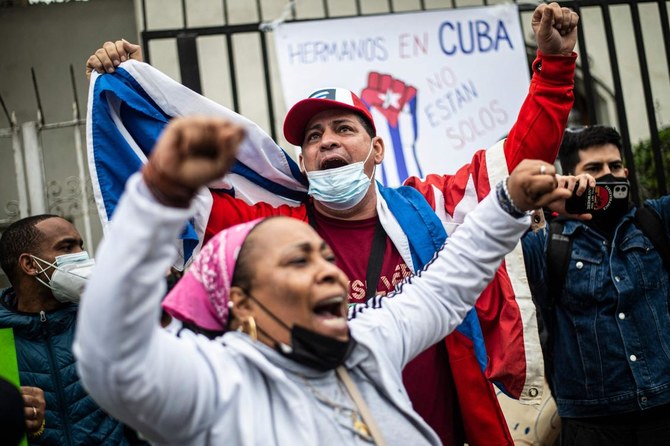
GENEVA: The UN human rights chief voiced alarm Friday at the alleged use of excessive force during unpre`cedented street demonstrations in Cuba, demanding that all those detained simply for protesting be freed.
Michelle Bachelet urged the government to address the protesters’ grievances and also called for the lifting of sanctions against the island.
One person has died and at least 100 people have reportedly been arrested since massive protests erupted across Cuba on Sunday.
“I am very concerned at the alleged use of excessive force against demonstrators in Cuba and the arrest of a large number of people, including several journalists,” UN High Commissioner Michelle Bachelet said in a statement.
“It is particularly worrying that these include individuals allegedly held incommunicado and people whose whereabouts are unknown,” she said, stressing that “all those detained for exercising their rights must be promptly released.”
The rallies are the largest since the Cuban revolution of the 1950s and come as the country endures its worst economic crisis in 30 years, with chronic shortages of electricity, food and medicine, just as it records a spike in coronavirus infections.
Cuba’s San Isidro free speech protest movement published late Monday a list of 144 people held or reported as disappeared following the demonstrations in dozens of cities and towns.
A 36-year-old man died during a protest on the outskirts of Havana on Monday, the interior ministry said Tuesday.
“I deeply regret the death of one protester in the context of protests in Havana,” Bachelet said.
“It is important that there be an independent, transparent, effective investigation, and that those responsible are held accountable.”
She also urged Cuban authorities to ensure Internet access is fully restored, after it was cut for several days earlier this week.
The UN rights chief pointed to the difficult economic context of the demonstrations, with protesters demanding the lifting of economic measures that have restricted access to food, medicines and Covid vaccines.
“I urge the Government to address the protesters’ grievances through dialogue, and to respect and fully protect the rights of all individuals to peaceful assembly and to freedom of opinion and expression,” she said.
Havana, under US sanctions since 1962, has blamed the show of discontent on Washington pursuing a “policy of economic suffocation to provoke social unrest.”
In her statement, Bachelet reiterated her call for the lifting of unilateral sanctions on the country, “given their negative impact on human rights, including the right to health.”


UN condemns alleged excessive force in Cuba protests
https://arab.news/2rp6u
UN condemns alleged excessive force in Cuba protests

- A 36-year-old man died during a protest on the outskirts of Havana on Monday, the interior ministry said Tuesday


Tarique Rahman-led BNP set to form Bangladesh’s next government after major election win
- Jamaat-e-Islami, banned during Hasina’s government, won 68 seats
- Majority of Bangladeshis endorsed sweeping reforms in national referendum
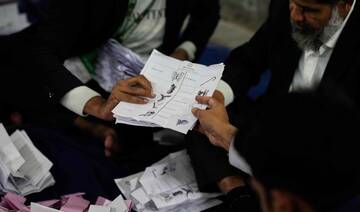
DHAKA: The Bangladesh Nationalist Party, led by Tarique Rahman, is set to form the country’s next government after securing a more than two-thirds majority in the first elections since a student-led uprising in 2024 ousted ex-prime minister, Sheikh Hasina.
The BNP has won at least 209 seats out of the 299 contested, according to the latest election results released by the Election Commission on Friday, paving the way for Rahman to become the country’s next prime minister.
Jamaat-e-Islami, banned during Hasina’s 15 years in power, has registered its best performance yet, winning at least 68 seats and emerging as the main opposition party.
The National Citizen Party, which was born out of the 2024 protests, was in third place with six seats, including for its leader Nahid Islam, while Hasina’s Awami League was barred from participating in the elections.
The majority of Bangladeshis also reportedly voted “yes” in a national referendum on the “July National Charter” that was held alongside the general vote on Thursday.
Named after the month when the uprising that toppled Hasina began, the charter is aimed at achieving sweeping democratic reforms to prevent authoritarian administrations, including term limits for premiers, stronger presidential powers and greater judicial independence, while also proposing increased representation of women in parliament.
The BNP-led government is likely to follow the commitments made under the charter, said Prof. A.S.M. Amanullah, vice chancellor of the National University in Dhaka, adding that the implementation of the July charter was also included in the party’s election manifesto that covers reform of the state and rebuilding of the economy.
“Mr. Tarique Rahman is a highly trained politician, highly sensitive politician, and he takes decisions based on facts. I believe he prepared himself to run this country locally and play a role internationally,” Amanullah told Arab News.
Rahman is the son of former Prime Minister Khaleda Zia and former President Ziaur Rahman. He returned to Bangladesh late last year after nearly two decades of self-imposed exile in the UK, and assumed BNP’s leadership days later, following his mother’s death from a prolonged illness.
In an interview with Arab News earlier this week, the 60-year-old pledged to pursue accountability for the former leadership and meet the political and economic expectations of the youth movement that brought about the change.
The new government is likely to be a mix of young and old politicians, Amanullah said, with Jemaat-e-Islami set to balance out the BNP’s rule.
“This is a very good size of opposition to press the issues or to challenge the government on different issues, different policies and decisions of the government. I’m hopeful about Jemaat,” he said.
“The way the people voted for these major two parties, the BNP and Jemaat, I think if they could work jointly, Bangladesh should see a stable political situation in the near future.”
Mohiuddin Ahmad, a political analyst and researcher, described Jemaat-e-Islami as “the most organized party” in Bangladesh and that it would therefore play an “instrumental” role as the opposition party.
Voter turnout averaged 59.44 percent, the EC said, with many Bangladeshis considering this week’s vote as their first “free and fair” election after more than 17 years.
“Such a result of an election we haven’t actually experienced before,” Muhiuddin Iqbal, a history student at Dhaka University, told Arab News.
“The festive feeling has not gone yet, so we’re very much excited about it and hopeful for the future.”