

Yemeni government scores fresh military gains in Marib province

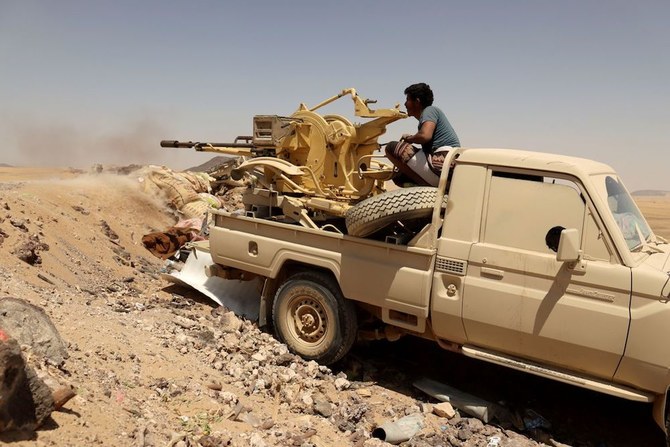
A fighter loyal to the Yemeni government fires a vehicle-mounted weapon at Houthi positions in Marib, Yemen, March 28, 2021. (Reuters)
Short Url
Updated 15 July 2021
Follow

Yemeni government scores fresh military gains in Marib province

  • Maj. Gen. Abdu Abdullah Majili said that government troops controlled the center of Rahabah district after heavy clashes with Houthis
  • Backed by massive air support from the Arab coalition, the Yemeni army and tribesmen have applied defensive and attrition tactics in Marib to push back a major Houthi offensive

ALEXANDRIA: Yemeni troops and local tribesmen seized control of the headquarters of a key district in the central province of Marib, scoring major gains in the area for the first time in years, an army spokesperson said Thursday.

Maj. Gen. Abdu Abdullah Majili said that government troops controlled the center of Rahabah district after heavy clashes with Houthis, who retreated to neighboring areas. The army had killed, wounded and captured dozens of rebel fighters during the latest clashes in Marib, he added.

“The battles will continue until we take full control of Rahabah district.”

Local tribesmen first announced the liberation of Rahabah on Wednesday afternoon, shortly after dozens of fighters stormed a building that hosted government offices.

Combatants posed for pictures outside the building as other armed men retrieved weapons and vehicles abandoned by the Houthis, witnesses said.

Backed by massive air support from the Arab coalition, the Yemeni army and tribesmen have applied defensive and attrition tactics in Marib since earlier this year to push back a major Houthi offensive on the oil-rich city.

Thousands have been killed in battle, with the rebels failing to make major advances toward Marib.

Local army officials and experts said the liberation of Rahabah would put troops closer to Sanaa province and enable them to send military reinforcements to neighboring Al-Bayda.

Pushing the Houthis from Rahabah, which sits along a key road that links Sanaa with Marib, would help the army cut the militia’s supply lines to fighters in Marib’s Serwah district.

Local media on Thursday reported that the Houthis had amassed troops nearby, preparing for a counterattack to recapture Rahabah and other liberated areas in Jabal Murad district.

Majili said that government troops pushed back many assaults by the Houthis in Al-Mashjah and Al-Kasara, west of Marib, as the rebels pressed to break the army’s defenses. He hailed the coalition’s warplanes for destroying dozens of Houthi fighters, military vehicles, and weapons.

Experts said the army should now focus on securing liberated areas in Marib from predicted counterattacks by the Houthis and defuse landmines instead of pushing into new areas.

Troops suffered major defeats in Al-Bayda after the Houthis recaptured Al-Zaher district through a brief counterattack.


UN rights chief shocked by ‘unbearable’ Darfur atrocities

Updated 35 min 38 sec ago
Follow

UN rights chief shocked by ‘unbearable’ Darfur atrocities

  • Mediation efforts have failed to produce a ceasefire, even after international outrage intensified last year with reports of mass killings, rape, and abductions during the RSF’s takeover of El-Fasher in Darfur

PORT SUDAN: Nearly three years of war have put the Sudanese people through “hell,” the UN’s rights chief said on Sunday, blasting the vast sums spent on advanced weaponry at the expense of humanitarian aid and the recruitment of child soldiers.
Since April 2023, Sudan has been gripped by a conflict between the army and the paramilitary Rapid Support Forces that has left tens of thousands of people dead and around 11 million displaced.
Speaking in Port Sudan during his first wartime visit, UN Human Rights commissioner Volker Turk said the population had endured “horror and hell,” calling it “despicable” that funds that “should be used to alleviate the suffering of the population” are instead spent on advanced weapons, particularly drones.
More than 21 million people are facing acute food insecurity, and two-thirds of Sudan’s population is in urgent need of humanitarian aid, according to the UN.
In addition to the world’s largest hunger and displacement crisis, Sudan is also facing “the increasing militarization of society by all parties to the conflict, including through the arming of civilians and recruitment and use of children,” Turk added.
He said he had heard testimony of “unbearable” atrocities from survivors of attacks in Darfur, and warned of similar crimes unfolding in the Kordofan region — the current epicenter of the fighting.
Testimony of these atrocities must be heard by “the commanders of this conflict and those who are arming, funding and profiting from this war,” he said.
Mediation efforts have failed to produce a ceasefire, even after international outrage intensified last year with reports of mass killings, rape, and abductions during the RSF’s takeover of El-Fasher in Darfur.
“We must ensure that the perpetrators of these horrific violations face justice regardless of the affiliation,” Turk said on Sunday, adding that repeated attacks on civilian infrastructure could constitute “war crimes.”
He called on both sides to “cease intolerable attacks against civilian objects that are indispensable to the civilian population, including markets, health facilities, schools and shelters.”
Turk again warned on Sunday that crimes similar to those seen in El-Fasher could recur in volatile Kordofan, where the RSF has advanced, besieging and attacking several key cities.
Hundreds of thousands face starvation across the region, where more than 65,000 people have been displaced since October, according to the latest UN figures.