

More qualified than Afghan government to run Kabul — Taliban spokesman

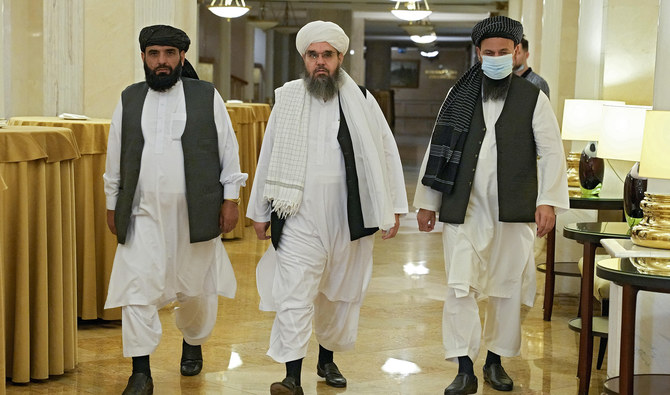
Taliban spokesman Suhail Shaheen, left, with other members of Afghan Taliban delegation including Mawlawi Shahabuddin Dilawar, center, and Dr. Mohammad Naim, arrive to attend a news conference in Moscow, Russia on July 9, 2021. (AP)
Short Url
Updated 16 July 2021
Follow

More qualified than Afghan government to run Kabul — Taliban spokesman

  • In interview to Arab News, spokesman Suhail Shaheen appeals to UN, other countries to assist Taliban financially
  • Says Taliban do not want Afghanistan to be a “field of rivalry” between countries like Pakistan and India

DUBAI: Taliban spokesman Suhail Shaheen said this week the insurgent group was more qualified than the Kabul government to run a future political setup in Afghanistan, as violence surges in the war-torn country and doubts mount about the future of United States-backed peace negotiations.
Taliban officials said last week the group had taken control of 85 percent of territory in Afghanistan, a claim Kabul has dismissed as a propaganda campaign launched as foreign forces, including the United States, withdraw after almost 20 years of fighting.
In an exclusive interview with Arab News on Wednesday, Shaheen said “tens of districts” were surrendering to the Taliban daily, saying this was happening despite the “weapons and armaments” available with the Afghan security forces. In the last two weeks, the Taliban have overrun areas bordering five countries — Iran, Tajikistan, Turkmenistan, China and Pakistan.
When asked if the Taliban had the expertise and the budget in order to run the day-to-day affairs of the areas they were capturing, Shaheen said:
“We are the people of Afghanistan. We are living among the people. We have experience not only for one year [but] for the past 25 years. Our governors, security chiefs, provincial security chiefs, the judges, ... and all commissions, which are equal to a ministry, have been working for the last 25 years. So all our people have experience. They are more experienced than those in the Kabul administration.”
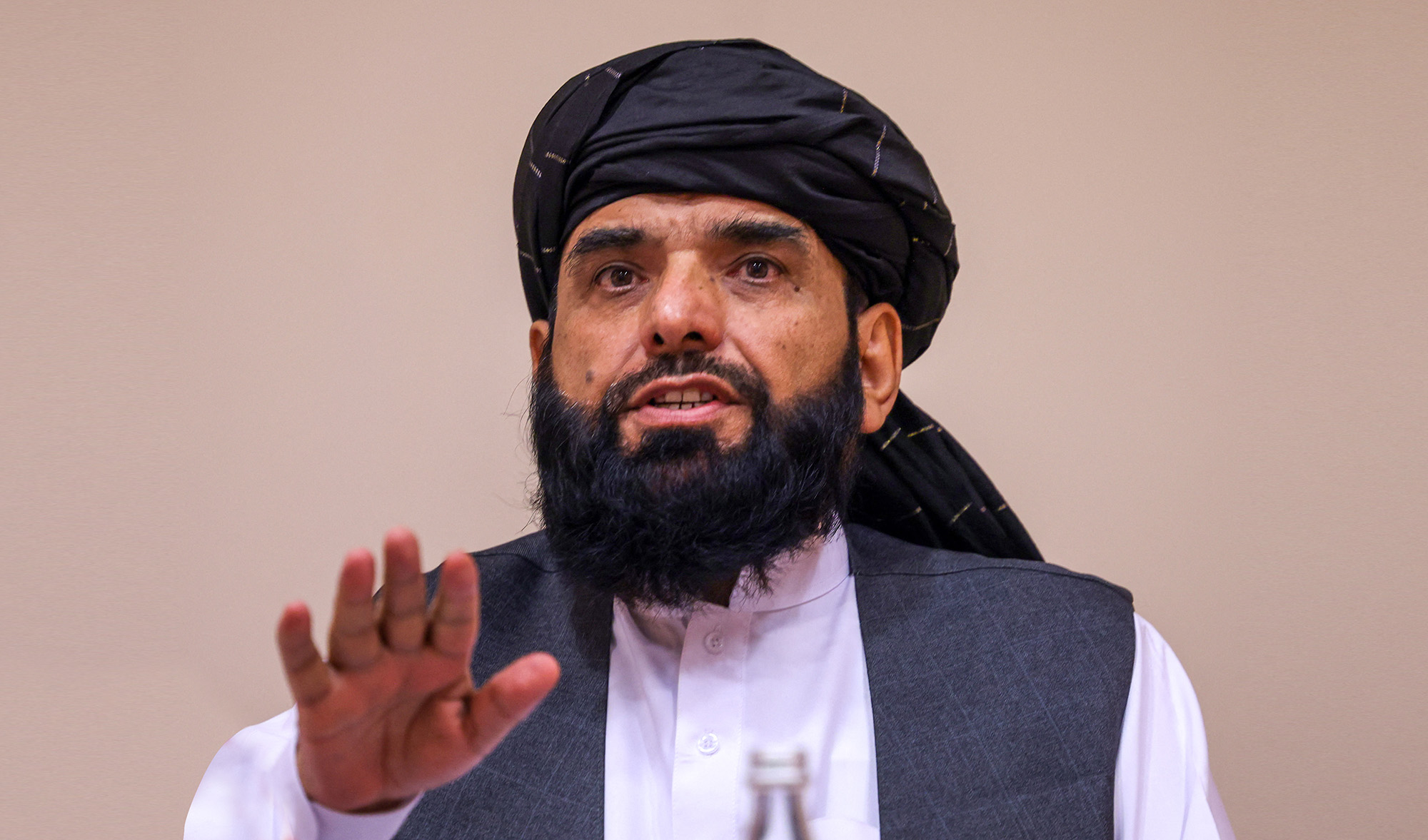


Taliban negotiator Suhail Shaheen attends a press conference in Moscow on July 9, 2021. (AFP/File)

The Taliban spokesperson said there was no change in the traffic of people and goods on the border crossings the Taliban had captured, and traders were carrying on with businesses “normally“: “Now, under the control of the Islamic Emirate of Afghanistan, they are doing it without any corruption, easily and normally. They are very happy with that.”
Shaheen said schools, offices, and all other establishments in Taliban-captured territories had been asked to remain open and functioning. However, he appealed to the United Nations and other international organizations and countries to assist the Taliban financially.
“That is important for the facilities to be provided to the common people,” he said. “We have almost 85 percent of the Afghan territory in our control. So in order to keep all these offices intact, operative, and active, we do need financial assistance.”
Part of the US pullout deal signed by the Taliban and Washington in February last year was the group’s commitment to negotiate a cease-fire and a power-sharing deal with the Kabul government.
But little progress has been made toward this even after several rounds of negotiations since September.
“First, we should reach a solution about the political roadmap and then we [will] go for a cease-fire,” Shaheen said when asked what the Taliban’s conditions were to agree to a cease-fire. “There is a sequence.”
The Taliban spokesperson said no individual or group would be allowed to use Afghan soil to attack another country, including Al Qaeda, which mounted the September 11 attacks that prompted the US invasion of Afghanistan, and the Tehreek-Taliban Pakistan (TTP), which is responsible for dozens of high-profile attacks in Pakistan and whose leaders and foot soldiers are believed to be hiding in sanctuaries inside Afghanistan.
“We had made a commitment that we will not allow anyone to use the soil of Afghanistan against the United States, its allies, and other countries,” Shaheen said, saying the group had “sent our message” to the Al Qaeda.
“About TTP or any other group, we have a commitment that we will not allow anyone to use the soil of Afghanistan against another country,” he added. “Right now ... we do not have all the territory of Afghanistan in our control. When a new Islamic government will be in place, that policy [of not letting anyone use Afghanistan soil against another] will be implemented. That is clear and is our commitment.”
When questioned about how a new Taliban government would balance its ties between archrivals Pakistan and India, both of whom have interests in Afghanistan, Shaheen said:
“We do not want Afghanistan to be a field of rivalry or rivalries of any countries ... When there is an Islamic government in place in Afghanistan, I think we need reconstruction of the country. Therefore, we would like to have cooperation with other countries, which benefit our people, but, at the same time, we do not want Afghanistan to be a center of rivalries.”


A month on, flood-struck Aceh still reels from worst disaster since 2004 tsunami

Men wait to receive privately donated aid in in eastern Aceh regency of Aceh Tamiang, on Dec. 14, 2025. (AFP)
Updated 58 min 35 sec ago
Follow

A month on, flood-struck Aceh still reels from worst disaster since 2004 tsunami

  • Aceh accounts for almost half of death toll in Sumatra floods that struck in November
  • Over 450,000 remain displaced as of Friday, as governor extended state of emergency

JAKARTA: Four weeks since floodwaters and torrents of mud swept across Aceh province, villages are still overwhelmed with debris while communities remain inundated, forced to rely on each other to speed up recovery efforts.

The deadly floods and landslides, triggered by extreme weather linked to Cyclone Senyar, hit the provinces of North Sumatra, West Sumatra and Aceh in late November.

Aceh, the westernmost province of Indonesia, was the worst-hit. Accounting for almost half of the 1,137 death toll, a month later more than 450,000 people are still unable to return to their homes, as many struggle to access clean water, food, electricity and medical supplies.

“We saw how people resorted to using polluted river water for their needs,” Ira Hadiati, Aceh coordinator for the Medical Emergency Rescue Committee, or MER-C, told Arab News on Friday.

Many evacuation shelters were also lacking toilets and washing facilities, while household waste was “piling up on people’s lawns,” she added.

In many regions, people’s basic needs “were still unmet,” said Annisa Zulkarnain, a volunteer with Aceh-based youth empowerment organization Svara.

“Residents end up helping each other and that’s still nowhere near enough, and even with volunteers there are still some limitations,” she told Arab News. 

Volunteers and aid workers in Aceh have grown frustrated with the central government’s response, which many have criticized as slow and ineffective.

And Jakarta continues to ignore persistent calls to declare the Sumatra floods a national disaster, which would unlock emergency funds and help streamline relief efforts.

“It seems like there’s a gap between the people and the government, where the government is saying that funds and resources have been mobilized … but the fact on the ground shows that even to fix the bridges, it’s been ordinary people working together,” Zulkarnain said.

After spending the past two weeks visiting some of the worst-affected areas, she said that the government “really need to speed up” their recovery efforts.

Aceh Gov. Muzakir Manaf extended the province’s state of emergency for another two weeks starting Friday, while several district governments have declared themselves incapable of managing the disasters.

Entire villages were wiped out by the disastrous floods, which have also damaged more than 115,000 houses across Aceh, along with 141 health facilities, 49 bridges, and over 1,300 schools.

The widespread damage to roads and infrastructure continue to isolate many communities, with residents traveling for hours on foot or with motorbikes in search of basic supplies.

“Even today, some areas are still inundated by thick mud and there are remote locations still cut off because the bridges collapsed. For access, off-road vehicles are still required or we would use small wooden boats to cross rivers,” Al Fadhil, director of Geutanyoe Foundation, told Arab News.

“From our perspective, disaster management this time around is much worse compared to how it was when the 2004 tsunami happened.”

When the Indian Ocean earthquake and tsunami struck in 2004, Aceh was the hardest-hit of all, with the disasters killing almost 170,000 people in the province.

But MER-C’s Hadiati said that the impact of the November floods and landslides is “more extensive and far worse than the tsunami,” as 18 Acehnese cities and regencies have been affected — about twice more than in the 2004 disaster.

As Friday marks 21 years since the cataclysmic tsunami, Fadhil said the current disaster management was “disorganized,” and lacked leadership and coordination from the central government, factors that played a crucial role after 2004. 

“The provincial and district governments in Aceh, they’ve now done all they could with what they have,” he said.

“But their efforts stand against the fact that there’s no entry of foreign aid, no outside support, and a central government insisting they are capable.”