

Iran warns it can enrich uranium to nuclear weapons grade

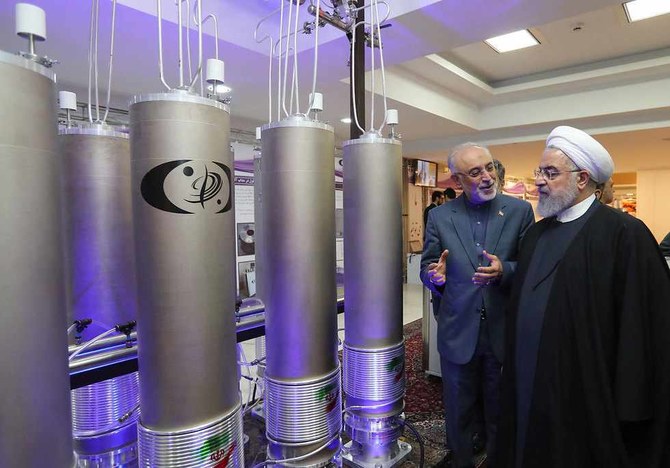
Outgoing President Hassan Rouhani inspecting one of Iran’s nuclear plants. (AFP)
Short Url
Updated 15 July 2021
Follow

Iran warns it can enrich uranium to nuclear weapons grade

JEDDAH: Iran claimed on Wednesday that it had the ability to enrich fissile uranium to 90 percent purity  — the level required to build the core of a nuclear weapon.

“Iran’s Atomic Energy Organization can enrich uranium by 20 percent and 60 percent and if … our reactors need it, it can enrich uranium to 90 percent purity,” President Hassan Rouhani told a Cabinet meeting in Tehran.

The outgoing president, who leaves office next month, also blamed hard-liners in the ruling theocracy for the failure so far to negotiate a revived Joint Comprehensive Plan of Action (JCPOA), the 2015 deal to curb Iran’s nuclear program in return for the lifting of sanctions.

“They took away the opportunity to reach an agreement from this government. We deeply regret missing this opportunity,” Rouhani said. “We are very sorry that nearly six months of opportunity has been lost.”

The JCPOA collapsed in 2018 when the US pulled out and President Donald Trump reimposed sanctions that have crippled Iran’s economy.

Tehran responded by incrementally breaching its obligations under the terms of the deal, increasing its stocks of enriched uranium and levels of enrichment, which the agreement caps at 3.67 percent.

Indirect negotiations between Tehran and Washington aimed at reviving the deal have been taking place in Vienna, where the sixth round of talks adjourned on June 20.

No resumption has yet been scheduled, and Iranian and Western officials have said significant gaps remain to be resolved.

Iranian officials said Ebrahim Raisi, the incoming president, planned to adopt “a harder line” in the talks, and the next round of talks might not take place until late September or early October.

Members of Iran’s nuclear team could be replaced with hard-line officials, but top nuclear negotiator Abbas Araqchi would stay “at least for a while,” they said.

One official said Raisi planned to show “less flexibility and demand more concessions” from Washington, such as keeping a chain of advanced uranium enrichment centrifuges in place and insisting on the removal of US sanctions related to human rights and terrorism.


Hamas official says group in final stage of choosing new chief

Updated 1 sec ago
Follow

Hamas official says group in final stage of choosing new chief

CAIRO: A senior Hamas official told AFP on Sunday that the Palestinian movement was in the final phase of selecting a new leader, with two prominent figures competing for the position.
Hamas recently completed the formation of a new Shoura Council, a consultative body largely composed of religious scholars, as well as a new political bureau.
Members of the council are elected every four years by representatives from Hamas’s three branches: the Gaza Strip, the occupied West Bank and the movement’s external leadership.
Hamas prisoners in Israeli jails are also eligible to vote.
The council subsequently elects the political bureau, which in turn selects the head of the movement.
“The movement has completed its internal elections in the three regions and has reached the final stage of selecting the head of the political bureau,” the official said, speaking on condition of anonymity as he was not authorized to speak publicly.
He added that the race for the group’s leadership is now between Khaled Meshaal and Khalil Al-Hayya.
A second Hamas source confirmed the development within the organization, which fought a devastating war with Israel following its October 7, 2023 attack.
Hayya, 65, a Gaza native and Hamas’s chief negotiator in ceasefire talks, has held senior roles since at least 2006, according to the US-based NGO the Counter Extremism Project (CEP).
Meshaal, who led the political bureau from 2004 to 2017, has never lived in Gaza. He was born in the West Bank in 1956.
He joined Hamas in Kuwait and later lived in Jordan, Syria and Qatar. The CEP says he oversaw Hamas’s evolution into a political-military hybrid.
He currently heads the movement’s diaspora office.
Last month, a Hamas source told AFP that Hayya enjoys backing from the group’s armed wing, the Ezzedine Al-Qassem Brigades.
After Israel killed former Hamas leader Ismail Haniyeh in Tehran in July 2024, the group chose its then-Gaza chief Yahya Sinwar as his successor.
Israel accused Sinwar of masterminding the October 7 attack.
He too was killed by Israeli forces in the southern Gaza city of Rafah, three months after Haniyeh’s assassination.
Hamas then opted for an interim five-member leadership committee based in Qatar, postponing the appointment of a single leader until elections, given the risk of the new chief being targeted by Israel.