

Pakistan blames 'mechanical failure' for bus blast that killed 13, including nine Chinese

Rescue workers and onlookers gather around a wreck after a bus plunged into a ravine following a bomb explosion in Kohistan district of Khyber Pakhtunkhwa province on July 14, 2021. (AFP)
Short Url
Updated 15 July 2021
Follow

Pakistan blames 'mechanical failure' for bus blast that killed 13, including nine Chinese

  • The bus was carrying Chinese workers to a dam project in the northwestern Kohistan district, rescue work underway 
  • China asks Pakistan to ‘thoroughly’ investigate the incident, issues security and travel advisory for its citizens, companies and projects

KARACHI: Pakistan’s foreign office has said a blast on a bus that killed 13 passengers, among them nine Chinese nationals and two Pakistani soldiers, on Wednesday was the result of a mechanical failure, after China said it wanted Islamabad to “thoroughly” investigate the incident. 
The bus was carrying Chinese workers to a dam project in the northwestern Kohistan district, one of many such projects Chinese engineers and Pakistani construction workers have been working on for years as part of Beijing’s Belt and Road Initiative in the remote province of Khyber Pakhtunkhwa and elsewhere in Pakistan. 
“This morning a bus carrying Chinese workers in Khyber Pakhunkhwa Province, plunged into a ravine after a mechanical failure resulting in leakage of gas that caused a blast. Further investigations are underway,” the Pakistani foreign office said, extending condolences to the families of the Chinese and Pakistani workers who had died. 
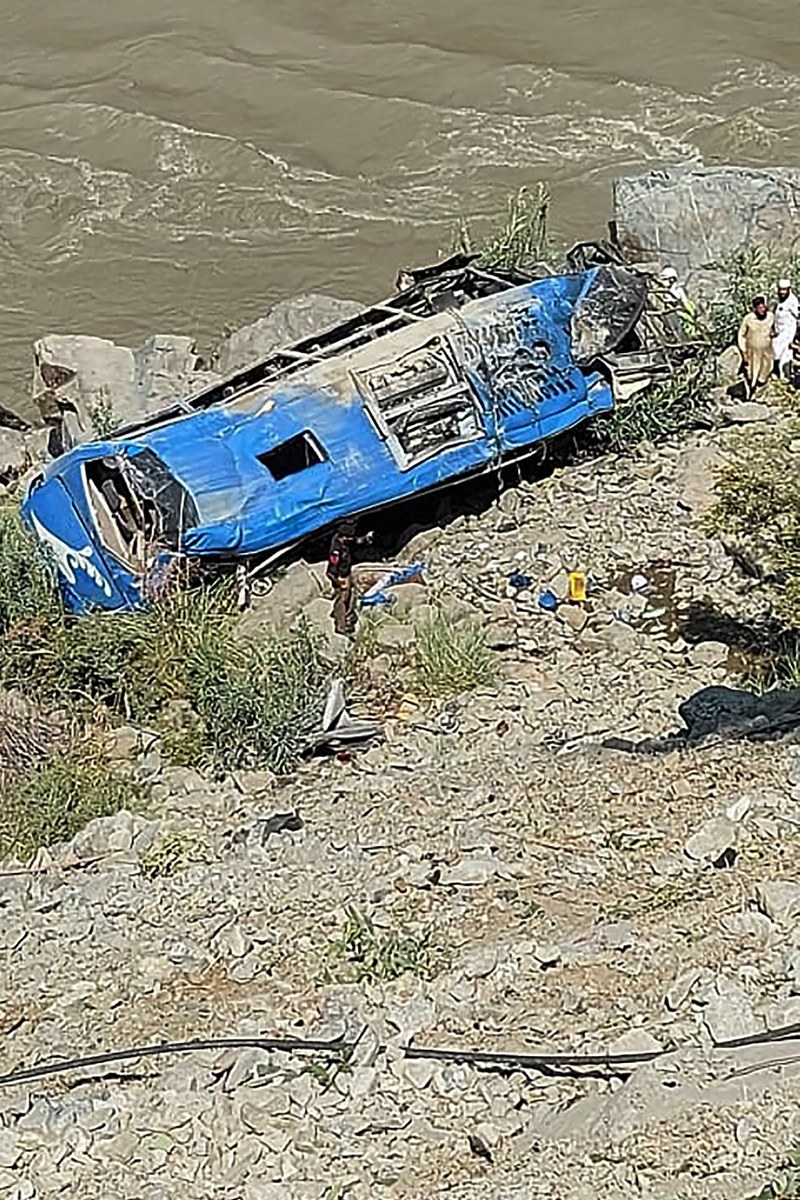


 People stand next to a wreck after a bus plunged into a ravine following a bomb attack, which killed 12 people including 9 Chinese workers, in Kohistan district of Khyber Pakhtunkhwa province on July 14, 2021. (AFP) 

The Chinese embassy in Islamabad said in a statement it had “requested Pakistan to carry out rescue and treatment in the first place, and strengthen security protection for the Chinese citizens, institutions and projects in Pakistan, and investigate the incident thoroughly.”
Speaking to Arab News, a senior health official confirmed the number of dead and injured. 
“Fifty-one people have been brought to a local hospital and 13 of them are dead,” Dr. Taj Muhammad, the district health officer in Upper Kohistan, said. “Among the deceased, nine are Chinese nationals, two are FC [paramilitary frontier corp] personnel and two local residents.”
He said 27 out of the 38 injured people had been referred to Islamabad for medical treatment, with seven of them in critical condition.
A local policeman told Arab News helicopters had been dispatched to the site of the accident to carry out rescue works. 
“As of now, the nature of the incident remains unknown,” Muhammad Zahir, who works with the police, said.
Speaking to the media, Deputy Commissioner Kohistan, Arif Khan Yousafzai, also said it was too early to declare that the incident was caused by a blast:
“Police have reached the spot, the bomb disposal squad is also there and investigations are underway. We will be able to share factual position after investigations are completed.”
However, the Chinese Embassy in Pakistan reminded Chinese citizens, enterprises, and projects in Pakistan “to stay on alert, pay close attention to the local security situation, strengthen security protection, take strict precautions, and stop going out unless necessary.”
In April, a car bomb blast ripped through a luxury hotel’s parking area in the southwestern Pakistani city of Quetta, killing four people and wounding 11. It is believed that senior Chinese officials were staying at the hotel at the time of the attack.
In 2018, three suicide attackers stormed the Chinese consulate in the Pakistani city of Karachi amid a series of gunshots and an explosion but were killed before they could force their way in with a car packed with explosives.


Pakistan’s Punjab deploys satellites, drones, AI to combat smog

Updated 5 sec ago
Follow

Pakistan’s Punjab deploys satellites, drones, AI to combat smog

  • Senior minister warns industrial masks may become necessary without a change in public attitudes toward pollution
  • Cities in Punjab face worsening smog each winter, driven by crop burning, vehicle emissions and industrial pollution

ISLAMABAD: Punjab Senior Minister Marriyum Aurangzeb on Wednesday said Pakistan’s most populous province deployed satellites, drones and artificial intelligence to tackle smog, warning that industrial masks may become necessary if public attitudes toward air pollution did not change.

Punjab cities face worsening smog each winter, driven by crop burning, vehicle emissions and industrial pollution that threatens public health and daily life. The smog season typically begins in late October, peaks between November and January and can persist through February.

Smog causes symptoms such as sore throats, eye irritation and respiratory illnesses, while prolonged exposure raises the risk of stroke, heart disease and lung cancer. Children are more vulnerable due to higher breathing rates and weaker immune systems.

“We have the AI machine-learning forecasting system in place, surveillance drones and technology cameras,” Aurangzeb said while addressing an event.

“At present, what is considered one of the world’s best environmental protection forces — with training, equipment, technology and digitally integrated data — is operating in Punjab,” she added.

Aurangzeb said surveillance is now being carried out through drones.

“There is monitoring, technology, cameras,” she continued. “Everything is digital.”

The minister maintained the eastern corridor from India was a major source of smoke which becomes active during the winter season.

She said this was the first time a complete testing system was introduced by the Environmental Protection Agency to measure pollution released by vehicles.

She added the government has loaned 5,000 super seeders to farmers, which are agricultural machines that plant crops directly into fields without removing leftover stubble, reducing crop burning, and helping curb winter smog.

Aurangzeb warned the situation could reach a point where people may have to use industrial masks and carry therm around like a “purse or wallet.”

“This will become a mandatory item if we do not change our attitudes and habits toward air quality, climate and conservation.”

Pakistan’s main urban centers routinely rank among the most polluted cities in the world, with vehicular emissions remaining one of the top contributors to air pollution.

The severe air pollution also undermines economic productivity and diminishes the quality of life for millions of residents.