

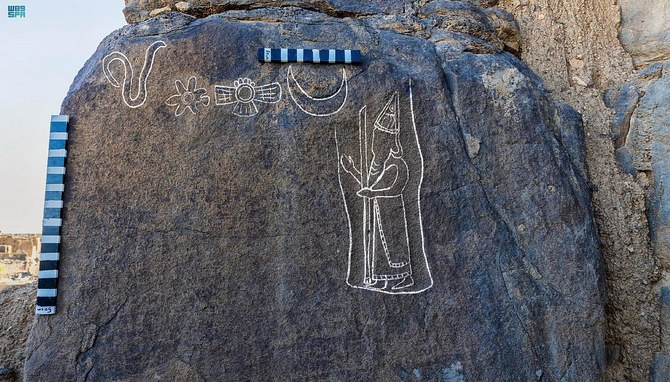

RIYADH: Saudi Arabia’s Heritage Commission announced an archaeological discovery in the country’s northern region that consists of rock inscriptions to the Babylonian King Nabonidus that date as far back as 540 B.C.
The discovery in Al-Hadeed Governorate in the Hail region provides further evidence of the historical role of the Arabian Peninsula and its cultural link with most of the civilizations of the ancient Near East.
The finding includes an inscription on one of the basalt rocks depicting the Babylonian king holding a scepter in his hand, and in front of him are a number of religious symbols. The inscription also contained a cuneiform text with around 26 lines, making it the longest written text found so far in the Kingdom.
Archaeologists from the Saudi #HeritageCommission have discovered fascinating rock inscriptions in the Hail region (northern Saudi Arabia) that depict the Babylonian King Nabonidus. pic.twitter.com/HqQ0BZ3mUw
— هيئة التراث (@MOCHeritage) July 13, 2021
Details of the discovery will be released after specialists have more time to analyze. It will be linked to previous results that have been documented in the northwest of the Kingdom.
This archaeological finding will accompany previous discoveries of stone inscriptions and obelisks in a number of sites between Tayma and Hail that mention King Nabonidus, who ruled from 556 to 539 B.C. The finding proves the expansion of cultural and commercial contact between the Arabian Peninsula and the Mesopotamian civilizations.
The site of the wall, known in the past as Fadak, represents an important site in northwestern Arabia from the first millennium B.C. until the early Islamic era. A group of drawings, rock inscriptions, and early Islamic writings were found on the sides of its mountains. The site also contains a set of castles, forts, and walls, along with water facilities that give another dimension to its cultural importance.


