

Saudi military industry booms fueled by local companies: GAMI

1 / 2
Global defense sector companies are set to attend a major industry exhibition in Riyadh next March. (AFP)
2 / 2
Short Url
Updated 13 July 2021
Follow

Saudi military industry booms fueled by local companies: GAMI

  • Saudi Arabia is investing heavily in its defense industries to add higher value jobs and reduce reliance on imported military hardware

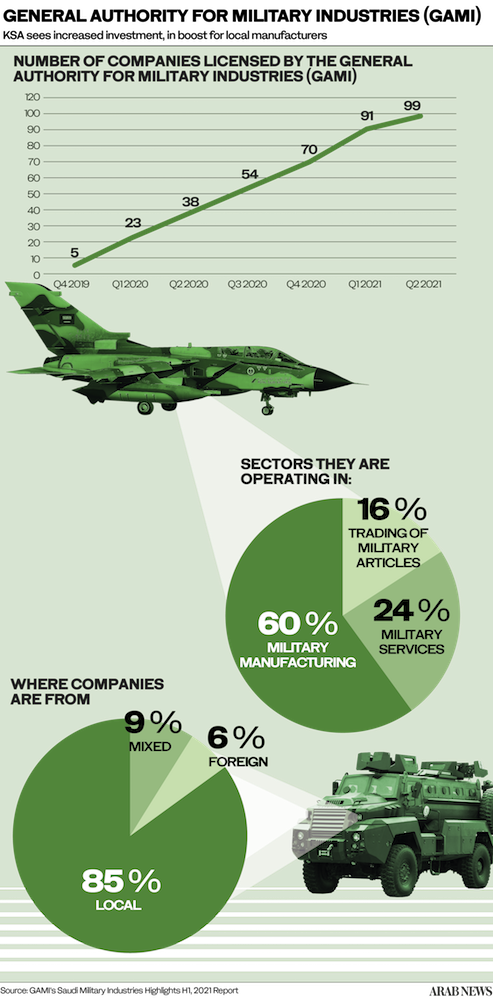
RIYADH: The number of licensed companies in Saudi Arabia’s military sector rose sharply in the first half of the year according to new data from the General Authority for Military Industries (GAMI).
It reported a 41 percent increase in licensed companies to reach a total of 99 — 85 percent of them local companies. More than half (55 percent) were granted to operating companies while military services providers accounted for 24 percent and product suppliers accounting for the rest.
“Through the National Military Industries Sector Strategy we have identified 11 target areas as strategic priorities, developed a research roadmap, adopted an acquisition strategy, and identified how to incentivize the enablers that will help the military industries flourish in the Kingdom,” said GAMI Governor Ahmad Al-Ohali in the organization's half-year report.
Saudi Arabia is investing heavily in its defense industries to reduce reliance on imported military hardware as well as add higher value jobs in the Kingdom.
GAMI was established in 2017 and has helped drive the localization rate within the sector to 8 percent last year from just 2 percent before its formation.
The aim is to increase this to up to 50 percent by 2030.
Among the latest investments to boost local manufacturing is a project to develop armored protected vehicles spearheaded by the Military Industries Corporation.
Zamil Offshore Services and CMN Group have also collaborated on the development of high speed interceptor vessels. Riyadh will next March host the World Defense Exhibition which GAMI hopes will showcase the Kingdom’s burgeoning defense sector.
Some 86 percent of the space has already been allocated to exhibitors that include Lockheed Martin, Embraer and General Dynamics.
The event is expected to attract more than 80,000 visitors and include at least 85 military delegations.
Total global military expenditure rose to $1981 billion last year, up 2.6 per cent in real terms from 2019, according to data from the Stockholm International Peace Research Institute.
The combined military spending of the 11 Middle Eastern states for which SIPRI has data decreased by 6.5 per cent in 2020, to $143 billion.


Saudi minister at Davos urges collaboration on minerals

Global collaboration on minerals essential to ease geopolitical tensions and secure supply, WEF hears. (Supplied)
Updated 51 min 44 sec ago
Follow

Saudi minister at Davos urges collaboration on minerals

  • The reason of the tension of geopolitics is actually the criticality of the minerals

LONDON: Countries need to collaborate on mining and resources to help avoid geopolitical tensions, Saudi Arabia’s minister of industry and mineral resources told the World Economic Forum on Tuesday.

“The reason of the tension of geopolitics is actually the criticality of the minerals, the concentration in different areas of the world,” Bandar Alkhorayef told a panel discussion on the geopolitics of materials.

“The rational thing to do is to collaborate, and that’s what we are doing,” he added. “We are creating a platform of collaboration in Saudi Arabia.”

Bandar Alkhorayef, Saudi Minister of Industry and Mineral Resources 

The Kingdom last week hosted the Future Minerals Forum in Riyadh. Alkhorayef said the platform was launched by the government in 2022 as a contribution to the global community. “It’s very important to have a global movement, and that’s why we launched the Future Minerals Forum,” he said. “It is the most important platform of global mining leaders.”

The Kingdom has made mining one of the key pillars of its economy, rapidly expanding the sector under the Vision 2030 reform program with an eye on diversification. Saudi Arabia has an estimated $2.5 trillion in mineral wealth and the ramping up of extraction comes at a time of intense global competition for resources to drive technological development in areas like AI and renewables.

“We realized that unlocking the value that we have in our natural resources, of the different minerals that we have, will definitely help our economy to grow to diversify,” Alkhorayef said. The Kingdom has worked to reduce the timelines required to set up mines while also protecting local communities, he added. Obtaining mining permits in Saudi Arabia has been reduced to just 30 to 90 days compared to the many years required in other countries, Alkhorayef said.

“We learned very, very early that permitting is a bottleneck in the system,” he added. “We all know, and we have to be very, very frank about this, that mining doesn’t have a good reputation globally.

“We are trying to change this and cutting down the licensing process doesn’t only solve it. You need also to show the communities the impact of the mining on their lives.”

Saudi Arabia’s new mining investment laws have placed great emphasis on the development of society and local communities, along with protecting the environment and incorporating new technologies, Alkhorayef said. “We want to build the future mines; we don’t want to build old mines.”