

Pakistan says Iran border 46% fenced, to be completed in a year

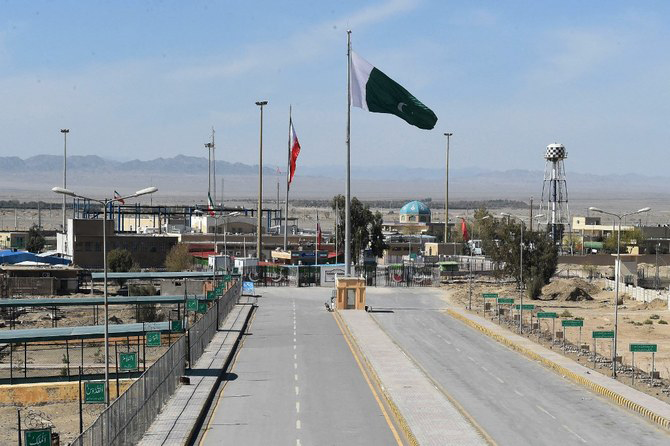
General view of Pakistan-Iran border in Taftan, one of Pakistan’s border crossing with Iran. (AFP/File)
Short Url
Updated 13 July 2021
Follow

Pakistan says Iran border 46% fenced, to be completed in a year

  • Final decision on banning Tehreek-e-Labbaik religious political party to be taken next month, says Pakistani interior minister

KARACHI: Work on fencing along Pakistan’s border with Iran is underway and will be completed within a year, Pakistan’s Interior Minister Sheikh Rasheed Ahmed said on Monday.

The 959-km Pakistan-Iran border begins at the Koh-i-Malik Salih mountain and ends at Gwadar Bay in the Gulf of Oman. It includes a diverse landscape of mountain ridges, seasonal streams and rivers, and is notorious for human trafficking and smuggling, as well as cross-border militancy. 

In February last year, then-Pakistani Army spokesperson Gen. Asif Ghafoor said Pakistan and Iran were considering fencing the common border so that “no third party could sabotage relations” between the two countries. 

Both nations have repeatedly accused each other of allowing militants to cross their shared frontier and carry out attacks. Both deny state complicity. 

In May this year, Moazzam Jah Ansari, commandant of the paramilitary Frontier Constabulary in Balochistan, a province that borders Iran, told the Pakistani Senate that Iran was resisting the fencing. 

“Pakistan’s border with Afghanistan is 90 percent fenced and the rest will be completed within one month,” Ahmed told reporters. “The border with Iran is 46 percent fenced and it will be completed within a year’s time,” he said, adding that his ministry was “fully focused” on border management. 

Ahmed said that a final decision on the fate of the Tehreek-e-Labbaik Pakistan (TLP), a religious political party that was banned by the government in April this year for holding violent protests, would be taken next month.  

“The last and important (issue) is that a summary of the decision regarding the TLP has been sent, and tomorrow, a meeting of the Cabinet will decide what should be the fate of TLP,” Ahmed added. 

The law requires that the Cabinet gives its approval to enforce a government ban on any political party before the election commission dissolves it and it is proscribed from contesting elections.



Poland slow to counter Russia’s ‘existential threat’: general

Updated 4 sec ago
Follow

Poland slow to counter Russia’s ‘existential threat’: general

  • The general highlighted a low “pace of technical modernization,” compared to increases in the army’s size
  • Kukula said the Polish army should reach 500,000 soldiers by 2039

WARSAW: Russia poses an “existential threat” to Poland and its military is lagging, the country’s armed forces chief warned senior officials on Wednesday.
Poland, the largest country on NATO’s eastern flank and a neighbor of Russia, Belarus, and Ukraine, is the western alliance’s largest spender in relative terms.
This year, the country is allocating 4.8 percent of its GDP to defense, just shy of the alliance’s five percent target to be met by 2035.
However, that record defense spending was not enough to “make up for nearly three decades of chronic underfunding of the armed forces,” General Wieslaw Kukula, chief of the general staff, argued at the meeting, which included top officers, the defense minister and Poland’s president.
The general highlighted a low “pace of technical modernization,” compared to increases in the army’s size.
Kukula said the Polish army should reach 500,000 soldiers by 2039, compared with around 210,000 at present.
As a result of a lack of updates, some new Polish units “are not achieving combat readiness,” due to insufficient equipment, rather than a personnel shortage, the general argued.
Meanwhile, he added, “the Russian Federation remains an existential threat to Poland.”
Russia “is constantly reorganizing its forces, drawing on the lessons from its aggression in Ukraine, and building up the capacity for a conventional conflict with NATO countries,” he stressed.
Poland is to receive 43.7 billion euros ($51,5 billion) in loans under the European Union’s Security Action For Europe (SAFE) scheme, designed to strengthen Europe’s defensive capabilities.
Warsaw plans to use these funds to boost domestic arms production.
The Polish government claims that Poland will be able to access SAFE finance even if President Karol Nawrocki — backed by Poland’s conservative-nationalist opposition — vetos a law setting out domestic arrangements for its implementation.
Law and Justice (PiS) — the main opposition party — argues that SAFE could become a new tool for Brussels to place undue pressure on Poland, thanks to a planned mechanism for monitoring the funds, which they claim risks undermining Polish sovereignty.