Jordan sees hopes of tourism industry revival

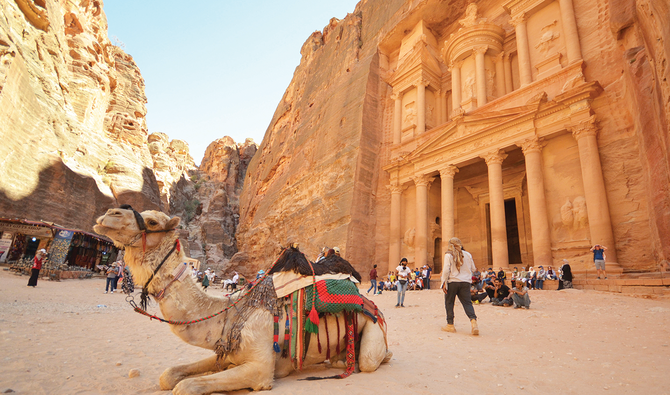
Tourists gather in front of the treasury site in the ancient city of Petra in Jordan on July 2. Foreign tourists are starting to trickle back. (Reuters)
Short Url
Updated 11 July 2021
Follow

Jordan sees hopes of tourism industry revival

  • At the start of July the government also lifted most lockdown measures after a sharp drop in infections

AMMAN: Hoping for customers, Ahmad Nassar is dusting and polishing the trinkets and souvenirs in his tourist shop in Madaba, an ancient town in central Jordan known for its early Christian mosaics.

The coronavirus disease (COVID-19) pandemic has been a disaster for Jordan’s tourism industry and for its economy as a whole, which suffered its worst contraction in decades last year.

“I felt despair, there was no income, no work, there was no support for shop owners,” Nassar said.

Now foreign tourists are starting to trickle back, and the situation is looking more hopeful, he said.

The EU last week included Jordan among a dozen new epidemiologically safe countries as of July 1, and government efforts to revive the tourism sector appear to be paying off.

Officials this month announced special measures for Jordan’s “golden triangle,” which includes famous sites such as the ancient city of Petra, Wadi Rum and crusader castles, closing the area off to all but the fully vaccinated.

At the start of July the government also lifted most lockdown measures after a sharp drop in infections, reopening gyms, pools and clubs in hotel facilities.

“At the height of the crisis, hotel occupancy did not exceed 2 percent or 3 percent,” Abdul Hakeem al-Hindi, the head of Jordan Hotels Association, told Reuters.

Now occupancy rates in some of Jordan’s main tourist centers are back up to 40-50 percent in the Dead Sea and the Red Sea port city of Aqaba and around 30 percent in Amman, the latter driven by returning tourists from the Gulf, latest hotel industry figures show.

The government is also taking other steps to get the number of foreign tourists back to the record 3 million visitors Jordan received in 2019, many of whom arrived on low cost European carriers led by Ryanair which resumed flights last month.

It includes subsidizing charter flights with around $60 for every passenger if they stay in Jordan for a week, said Abdelrazzak Arabiyat, director of the Jordan Tourism Board.

He expected the Russian market to grow the fastest in the coming months.

But Hindi said a revival would take time. “We need at least two years to return to what we were,” he said.


Saudi POS spending jumps 28% in final week of Jan: SAMA

Updated 06 February 2026
Follow

Saudi POS spending jumps 28% in final week of Jan: SAMA

RIYADH: Saudi Arabia’s point-of-sale spending climbed sharply in the final week of January, rising nearly 28 percent from the previous week as consumer outlays increased across almost all sectors. 

POS transactions reached SR16 billion ($4.27 billion) in the week ending Jan. 31, up 27.8 percent week on week, according to the Saudi Central Bank. Transaction volumes rose 16.5 percent to 248.8 million, reflecting stronger retail and service activity. 

Spending on jewelry saw the biggest uptick at 55.5 percent to SR613.69 million, followed by laundry services which saw a 44.4 percent increase to SR62.83 million. 

Expenditure on personal care rose 29.1 percent, while outlays on books and stationery increased 5.1 percent. Hotel spending climbed 7.4 percent to SR377.1 million. 

Further gains were recorded across other categories. Spending in pharmacies and medical supplies rose 33.4 percent to SR259.19 million, while medical services increased 13.7 percent to SR515.44 million. 

Food and beverage spending surged 38.6 percent to SR2.6 billion, accounting for the largest share of total POS value. Restaurants and cafes followed with a 20.4 percent increase to SR1.81 billion. Apparel and clothing spending rose 35.4 percent to SR1.33 billion, representing the third-largest share during the week. 

The Kingdom’s key urban centers mirrored the national surge. Riyadh, which accounted for the largest share of total POS spending, saw a 22 percent rise to SR5.44 billion from SR4.46 billion the previous week. The number of transactions in the capital reached 78.6 million, up 13.8 percent week on week. 

In Jeddah, transaction values increased 23.7 percent to SR2.16 billion, while Dammam reported a 22.2 percent rise to SR783.06 million. 

POS data, tracked weekly by SAMA, provides an indicator of consumer spending trends and the ongoing growth of digital payments in Saudi Arabia.  

The data also highlights the expanding reach of POS infrastructure, extending beyond major retail hubs to smaller cities and service sectors, supporting broader digital inclusion initiatives.  

The growth of digital payment technologies aligns with Saudi Arabia’s Vision 2030 objectives, promoting electronic transactions and contributing to the Kingdom’s broader digital economy.