

Pakistan tightens coronavirus rules ahead of Eid Al-Adha as infections rise

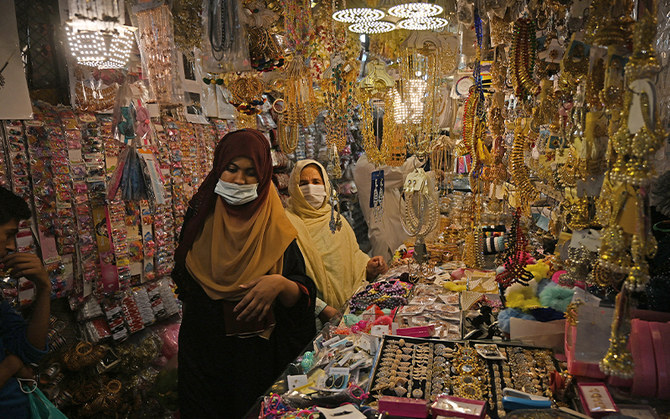
Women buy jewelry at market area during shopping ahead of the upcoming festival of Eid in Rawalpindi, Pakistan, on May 6, 2021. (AFP/File)
Short Url
Updated 12 July 2021
Follow

Pakistan tightens coronavirus rules ahead of Eid Al-Adha as infections rise

  • Pakistan's daily COVID-19 positivity rate crosses 4 percent, for the first time since late May
  • Eid Al-Adha, the second major religious festival of Islam, will be observed in Pakistan on July 21

ISLAMABAD: Pakistan's main pandemic response body on Sunday ordered all provinces to implement strict coronavirus guidelines ahead of the upcoming Eid Al-Adha holiday, as infections are rising again across the country.

After a decline in coronavirus cases in recent weeks, a fourth wave of the coronavirus is building up in Pakistan, as health officials say the highly contagious Delta COVID-19 variant is fast spreading across the country.

The National Command and Operation Center (NCOC), which formulates and coordinates Pakistan's pandemic response, said on Sunday the daily positivity rate crossed 4 percent — for the first time since May 30 — as the country recorded 1,980 new cases.

"(NCOC) issued detailed instructions to all provinces for strict implementation of SOPs," the state-run Associated Press of Pakistan (APP) reported.

"(NCOC) has also formed teams to ensure compliance of wearing facemasks and implementation of social distancing and safety protocols."

Eid Al-Adha, the second major religious festival of Islam, known as the "festival of sacrifice," will be observed in Pakistan on July 21.

Muslims in Pakistan usually crowd mosques and prayer grounds across the country to offer prayers and sacrifice goats and cows for the holiday. They also travel to tourist spots with families and friends during the vacation.

While earlier this month the NCOC banned open-air livestock markets in cities and required all vendors selling sacrificial animals at designated markets to be vaccinated, on Sunday it expanded the vaccination rule for visitors to Azad Jammu and Kashmir (AJK), Gilgit Baltistan, and Khyber Pakhtunkhwa — the country's favorite Eid tourism destinations.

"(NCOC) made vaccination certificate mandatory for tourists’ hotel bookings in AJK and Northern Areas," APP said. "Strict disciplinary action would be taken against the violators and the institution not complying with the SOPs."

As Pakistan has stepped up the pace of vaccination, it administers over 400,000 vaccines doses daily. So far, however, only slightly over 19.8 million people, or about 9 percent of the country's population, have been vaccinated against COVID-19.



Pakistan PM gives 48 hours to draft fuel-saving plan as global oil prices surge

Updated 4 sec ago
Follow

Pakistan PM gives 48 hours to draft fuel-saving plan as global oil prices surge

  • Government warns against hoarding after sharp fuel price hike amid Middle East tensions
  • PM wants provinces to enforce anti-profiteering measures and prevent public exploitation

ISLAMABAD: Prime Minister Shehbaz Sharif has asked his administration to formulate a strategy for fuel conservation and austerity in government affairs within 48 hours after a sharp rise in global oil prices pushed the country to increase domestic fuel rates, a senior minister said on Saturday.

The directive comes a day after the government raised petrol and diesel prices by Rs55 ($0.20) per liter, citing a surge in international energy prices triggered by escalating conflict in the Middle East after Israel and the United States launched attacks on Iran. The situation has rattled global oil markets and threatened key shipping routes.

Pakistan’s Information Minister Ataullah Tarar said Sharif had instructed officials to urgently prepare a practical plan aimed at reducing fuel consumption and promoting austerity across government institutions.

“The prime minister has given 48 hours to formulate an actionable strategy on savings, austerity and simplicity in government affairs,” he said in a social media post on X.

Tarar said Finance Minister Muhammad Aurangzeb and Petroleum Minister Ali Pervaiz Malik had also been tasked with consulting the country’s four provincial chief ministers to coordinate measures against fuel hoarding and ensure strict enforcement of government directives.

He informed the ministers had been asked to ensure that speculation and profiteering in fuel markets were prevented, adding that authorities would take strict action against violators.

“The prime minister has directed that no leniency be shown to elements involved in exploiting the public,” he said, warning that licenses of those petrol pumps violating government orders could be revoked.

Tarar also urged the public not to pay attention to rumors regarding petroleum supplies or pricing, saying the government and relevant ministries would continue to release verified information as the situation evolves.

He said Pakistan was not alone in facing rising energy costs, noting that many countries were grappling with similar pressures due to volatility in global oil markets.

Pakistan relies heavily on imported fuel to meet its energy needs and is particularly vulnerable to global price shocks, which can quickly push up inflation and strain the country’s fragile external accounts.