Pakistan tightens coronavirus rules ahead of Eid Al-Adha as infections rise

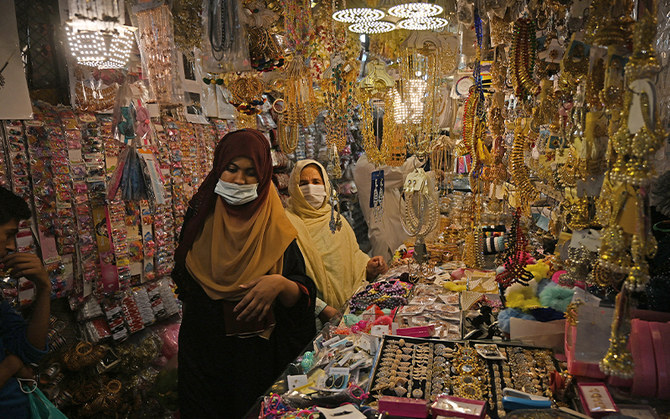
Women buy jewelry at market area during shopping ahead of the upcoming festival of Eid in Rawalpindi, Pakistan, on May 6, 2021. (AFP/File)
Short Url
Updated 12 July 2021
Follow

Pakistan tightens coronavirus rules ahead of Eid Al-Adha as infections rise

  • Pakistan's daily COVID-19 positivity rate crosses 4 percent, for the first time since late May
  • Eid Al-Adha, the second major religious festival of Islam, will be observed in Pakistan on July 21

ISLAMABAD: Pakistan's main pandemic response body on Sunday ordered all provinces to implement strict coronavirus guidelines ahead of the upcoming Eid Al-Adha holiday, as infections are rising again across the country.

After a decline in coronavirus cases in recent weeks, a fourth wave of the coronavirus is building up in Pakistan, as health officials say the highly contagious Delta COVID-19 variant is fast spreading across the country.

The National Command and Operation Center (NCOC), which formulates and coordinates Pakistan's pandemic response, said on Sunday the daily positivity rate crossed 4 percent — for the first time since May 30 — as the country recorded 1,980 new cases.

"(NCOC) issued detailed instructions to all provinces for strict implementation of SOPs," the state-run Associated Press of Pakistan (APP) reported.

"(NCOC) has also formed teams to ensure compliance of wearing facemasks and implementation of social distancing and safety protocols."

Eid Al-Adha, the second major religious festival of Islam, known as the "festival of sacrifice," will be observed in Pakistan on July 21.

Muslims in Pakistan usually crowd mosques and prayer grounds across the country to offer prayers and sacrifice goats and cows for the holiday. They also travel to tourist spots with families and friends during the vacation.

While earlier this month the NCOC banned open-air livestock markets in cities and required all vendors selling sacrificial animals at designated markets to be vaccinated, on Sunday it expanded the vaccination rule for visitors to Azad Jammu and Kashmir (AJK), Gilgit Baltistan, and Khyber Pakhtunkhwa — the country's favorite Eid tourism destinations.

"(NCOC) made vaccination certificate mandatory for tourists’ hotel bookings in AJK and Northern Areas," APP said. "Strict disciplinary action would be taken against the violators and the institution not complying with the SOPs."

As Pakistan has stepped up the pace of vaccination, it administers over 400,000 vaccines doses daily. So far, however, only slightly over 19.8 million people, or about 9 percent of the country's population, have been vaccinated against COVID-19.


Pakistan’s president defends ongoing strikes in Afghanistan, urges Kabul to dismantle militants

Updated 02 March 2026
Follow

Pakistan’s president defends ongoing strikes in Afghanistan, urges Kabul to dismantle militants

  • Afghanistan on Thursday launched attacks in retaliation for Pakistani airstrikes the previous Sunday
  • Pakistan’s military says it is only targeting Afghan military installations to avoid civilian casualties

ISLAMABAD: Pakistan’s president on Monday defended his country’s ongoing military strikes in neighboring Afghanistan, saying Islamabad tried all forms of diplomacy before targeting militants operating from Afghan territory, and called on the Taliban government in Kabul to disarm groups responsible for attacks in Pakistan.

Pakistan earlier said it is in “open war” with Afghanistan, alarming the international community. The border area remains a stronghold for militant organizations including Al-Qaeda and the Daesh (Islamic State) group.

“(The Afghan Taliban) must choose to dismantle the terror groups that survive on conflict and its war economy,” Asif Ali Zardari said during a speech to lawmakers, adding that “no state accepts serial attacks on its soil.”

Afghanistan on Thursday launched attacks in retaliation for Pakistani airstrikes the previous Sunday. Since then, Pakistan has carried out operations along the border, with Information Minister Attaullah Tarar claiming the killing of 435 Afghan forces and the capture of 31 Afghan positions.

Kabul has denied such claims.

In Afghanistan, the deputy government spokesman Hamdullah Fitrat said Pakistan’s military fired mortar shells at a refugee camp in eastern Kunar province, killing three children and injuring three others.

Afghanistan’s defense ministry said Afghan forces carried out strikes targeting a Pakistani military facility near Paktia province, causing “substantial losses and heavy casualties.”

Pakistan’s military did not respond to questions. It has said Pakistan is only targeting Afghan military installations to avoid civilian casualties.

Pakistan has witnessed a surge of violence in recent months and blames it on the outlawed Pakistani Taliban, known as Tehreek-e-Taliban Pakistan or TTP. It operates both inside Pakistan and from Afghan territory.
Islamabad accuses Afghanistan’s Taliban government of providing safe havens for the TTP, which Kabul denies.

The latest cross-border fighting ended a ceasefire brokered by Qatar and Turkiye in October. The two sides failed to reach a permanent agreement during talks in Istanbul.

Zardari reiterated Pakistan’s call for talks, saying, “We have never walked away from dialogue.”

The Pakistani leader again accused Afghanistan of acting as a proxy for India by sheltering militant groups.

“Stop being used by another country as a battlefield for their ambitions,” he said.

Zardari cited a recent report from the United Nations Security Council’s monitoring team that described the presence of militant groups in Afghanistan as an extra-regional threat.