

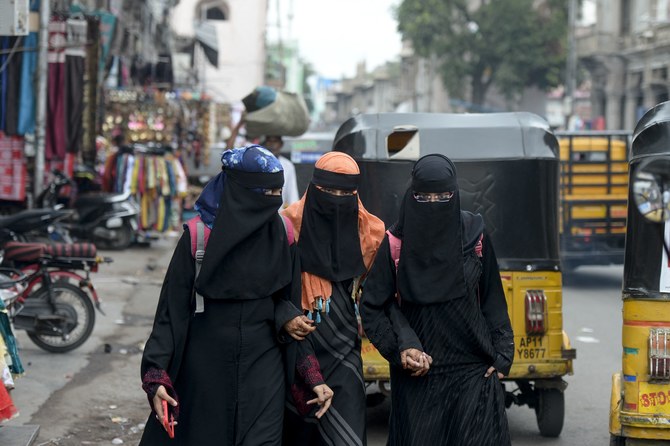

NEW DELHI: Police in India said this week they were investigating an online harassment case in which dozens of Muslim women had been put up for ‘sale’ in fake auctions online, with some saying they continued to receive threats and face online harassment even after the web platform was suspended.
Photos of at least a hundred women were stolen from their social media profiles and uploaded in recent weeks to GitHub, an open software development platform, under the title “Sulli deal of the day”. “Sulli” is a derogatory term used in India for Muslim women.
A police case was registered against “unknown persons” on Thursday after the matter was raised by the Delhi Commission for Women, a statutory body of the Delhi government.
“We have lodged a case on this issue, and we are now investigating the issue,” Delhi police spokesperson Chinmoy Biswal told Arab News on Saturday.
Though GitHub has now shut down the web portal for “violating its policies,” some of the women said they were still being harassed after their names appeared on the platform.
“Day in and day out [I am being harassed] with people sending all kinds of pictures and porn to me,” Delhi-based poet and writer Nabiya Khan said. “I am exploring legal action against these men and perpetrators. I hope to get justice.”
When asked who she thought was responsible for the platform, Khan said: “It’s a woman issue but it’s about Muslim women. It’s not about patriarchy, misogyny ... it is all of these along with Islamophobia.”
She added: “Muslim women’s identity is the most vulnerable identity in today’s India … It’s very obvious that it is the product of the hate that has been manufactured since the BJP [Bharatiya Janata Party] came into power.”
“FEAR AND DESPAIR”
Indeed, many among India’s 170 million Muslims say they feel like second-class citizens since Prime Minister Narendra Modi’s Hindu nationalist BPJ came to power in 2014. Since then, a wave of hate crimes against Muslims have sown fear and despair in the community.
In December 2019, the Modi government passed a law that makes non-Muslims from some neighboring nations eligible for fast-tracked citizenship. Persecuted religious minorities including from Hindu, Sikh, or Christian communities are eligible for citizenship, but those from Islam do not enjoy the same advantages.
Modi’s government says the new citizenship law is necessary to protect persecuted minorities from Pakistan, Bangladesh and Afghanistan, and denies any bias against India’s Muslims.
The citizenship law is only one of several steps taken by Modi’s government that have stoked mistrust among Muslims.
In August 2019, it stripped Kashmir, India’s only Muslim-majority state, of its special status, a move which Modi defended as a way of integrating the region with the rest of the country.
In November 2020, the Supreme Court handed Hindu groups control of a contested site in the city of Ayodhya that paves the way for a temple to be built on a site where a mosque once stood. That was a central election promise made by the BJP.
The Indian home ministry, ministry of minority affairs and the government-controlled National Commission for Women did not respond to phone calls from Arab News seeking comment for this piece.
Meanwhile, women like Sania Ahmed, a media professional, said harassment following the “Sulli Deals” ordeal had spilled on to other platforms.
“One account ran a poll for 24 hours with the question: ‘which one of these women would you choose for your harem?’ And my name was on the poll,” she said.
“The impunity with which they are doing this is because they are not afraid,” Ahmed said.
In an interview to AFP, Ahmad pointed the finger at what she calls an “online troll army of Hindu zealots” in India that had proliferated in recent years.
“HARD TO BE A MUSLIM WOMAN IN INDIA”
Hana Mohsin Khan, a commercial pilot whose name and photo were also released on the platform, said she would be pursuing the case until those behind it were put behind bars.
She said “Sulli Deals” was an attempt to intimidate Muslim women, already a vulnerable group in India: “They are trying to humiliate minorities ... It is no secret that it is very hard to be a Muslim in India, especially a Muslim woman.”
Journalist Ghazala Wahab, the author of “Born a Muslim: Some Truths about Islam in India,” said India’s government and “political climate” allowed for impunity in cases where Muslims are targeted.
“The present government and the present political climate,” she said, “have incubated and nurtured this.”


