PARIS: A leading Iranian exiled opposition group on Saturday held a hybrid physical and virtual meeting it said was unprecedented in scope, lambasting incoming president Ebrahim Raisi as a “henchman” of the regime whose election showed its weakness.
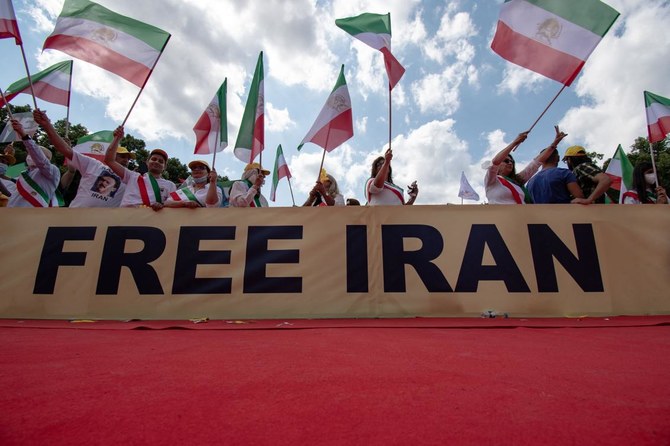
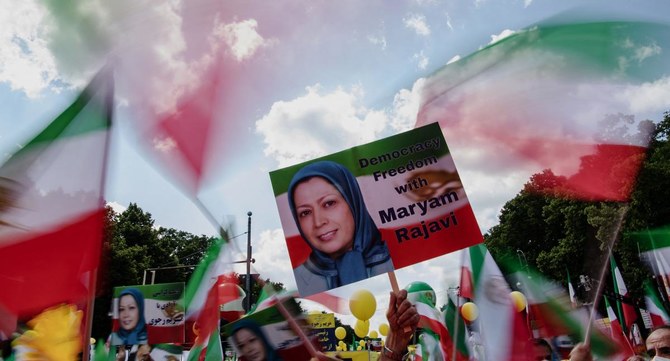
The event linked thousands of members of the People’s Mujahedin Organization of Iran (MEK/PMOI) at their camp in Albania with supporters across the world online including US senators, British MPs and French lawmakers as well as protests in cities including Berlin.
The MEK, whose political wing is the National Council of Resistance of Iran (NCRI), is proscribed in Iran and seeks the “overthrow” of Iran’s clerical leadership. It accuses Raisi of being responsible for the mass executions of thousands of its members in 1988.
“The mullahs’ regime is at an impasse... the Iranian people are nearing victory and will liberate Iran,” the NCRI’s president Maryam Rajavi told the event from its Ashraf 3 camp in Albania.
“We are standing at a watershed moment when everything is possible,” she added, referring to the coronavirus pandemic and Iran’s economic crisis.
She denounced the June election won in a landslide by the hard-line Raisi — formerly judiciary chief — as a “sham” and predicted his victory would haunt supreme leader Ayatollah Ali Khamenei.
The elevation of Raisi showed the leadership wanted “to close ranks and preserve power” as threats mount, said Rajavi.
“But they have dug their own grave. They are like a scorpion that stings itself when surrounded by flames.... The expiry date for this religious dictatorship has arrived.”
She compared the election of Raisi to the declaration of martial law in 1978 by deposed shah Mohammad Reza Pahlavi “which had an outcome contrary to his expectations” leading to the Islamic revolution.
Raisi, who takes office in early August, is accused by the NCRI and international rights groups of playing a key part in the executions of thousands of opposition prisoners — mostly suspected members of the MEK.
He is accused of being part of a four-man “Death Committee” that sent convicts to their death without a shred of due process.
Most rights groups and historians say between 4,000 and 5,000 were killed, but the NCRI puts the figure at closer to 30,000.
Last year, seven special UN rapporteurs told the Iranian government that “the situation may amount to crimes against humanity” and urged an international probe if Tehran did not show full accountability.
Rajavi described Raisi, Khamenei and new judiciary chief Gholamhossein Mohseni-Ejei as as a “squad of cannibals” who should face charges of crimes against humanity.
She added Raisi should never be allowed to address the UN in New York due to the events in 1988.
“Let us plant flowers in this wounded motherland again,” Rajavi added.
The MEK backed Ayatollah Ruhollah Khomeini in the 1979 revolution that ousted the shah but rapidly fell out with the new Islamic authorities and embarked on a campaign to overthrow the regime.
The MEK then sided with Iraq under Saddam Hussein in the 1980-1988 Iran-Iraq war.
Its fighters based in Iraq had by 2016 relocated elsewhere in an accord with the US and UN, notably to Albania where they are based at Camp Ashraf.
As Rajavi spoke, those present chanted the name of her husband Massoud who was long the leader of the group and has not been seen for decades. The group has never confirmed his death.


Iran opposition says Raisi victory shows regime weakness

https://arab.news/5846d
Iran opposition says Raisi victory shows regime weakness

- The elevation of Raisi showed the leadership wanted “to close ranks and preserve power” as threats mount: Rajavi
- Raisi is accused by the NCRI of playing a key part in the executions of thousands of opposition prisoners


Israeli measures in West Bank seek to ‘assassinate Palestinian state’: Saudi UN envoy
- Kingdom ‘strongly condemns decision to convert lands to state property,’ Abdulaziz Alwasil tells Security Council
- ‘There’s no doubt that these violations undermine efforts to achieve peace and stability in the region’
NEW YORK: Saudi Arabia on Wednesday strongly condemned Israel’s “unlawful coercive measures” in the occupied West Bank, telling the UN Security Council that the actions amount to an attempt to “assassinate the Palestinian state” and undermine prospects for peace.
Speaking at a ministerial-level council meeting chaired by British Foreign Secretary Yvette Cooper, Saudi Arabia’s UN Ambassador Abdulaziz Alwasil said Riyadh rejects Israeli moves to expand settlements, seize land and alter the status of the Occupied Territories.
Israeli authorities “continue to gravely violate the rights of the Palestinian people” in the West Bank, he said.
“We meet today, more than two years after the Israeli aggression against the Gaza Strip, and at a moment where we also witness a new chapter of suffering and violations committed by the Israeli occupation,” Alwasil added.
Recent coercive measures aimed at imposing “Israeli dominance over the West Bank, expanding settlement activity, escalating settlers terrorism, practicing forced displacement against the Palestinian people and seizing their land … reflects Israel’s persistence in its attempt to assassinate the Palestinian state,” he said.
Israel’s adherence to a ceasefire agreement and halting its “illegal policies and seizure of land” have become “urgent matters that can’t be further delayed,” Alwasil added, calling for an end to “ongoing violations associated with annexation of lands belonging to unarmed Palestinians in the West Bank.”
Alwasil said 85 states have denounced the measures, and Saudi Arabia “strongly condemns the decision of the Israeli occupying authorities to convert lands in the West Bank to what it calls state property as part of schemes that aim to impose a new legal and administrative reality in the occupied West Bank.”
He added: “There’s no doubt that these violations undermine efforts to achieve peace and stability in the region.”
Alwasil reiterated that “Israel has no sovereignty” over the Occupied Territories, and expressed Riyadh’s “absolute rejection of these illegal measures which constitute a grave violation of international law, particularly Security Council resolution 2334.”
He added that “these actions are an aggression on the inherent right of the brotherly Palestinian people to establish their independent state on the June 4, 1967 borders with East Jerusalem as its capital,” and that the measures aim to “alter the demographic composition and the character and the status” of the Occupied Territories.
He cited the 2024 advisory opinion by the International Court of Justice, saying it is “clear and explicit” in affirming that “Israel’s policies and practices in the occupied Palestinian territory and its continued presence there is considered unlawful.”
He added: “It stressed that Israeli occupation must end and that it is invalid to annex occupied Palestinian territories.”
Alwasil also condemned the seizure and demolition of a compound belonging to the UN Relief and Works Agency for Palestine Refugees in the Near East in East Jerusalem and the cutting of electricity to its facilities, including schools and health centers.
“This is an unprecedented violation of international humanitarian law aimed at undermining the status of Palestinian refugees” in the Occupied Territories, he said.
With the advent of the Muslim holy month of Ramadan, he called for protecting humanitarian organizations and ensuring that they can carry out their duties “without hindrance.”
He said: “We strongly condemn practices that target humanitarian workers throughout the Palestinian territories. UNRWA isn’t a terrorist organization, and such claims are unacceptable.”
Alwasil added: “The international community must come together to provide protection for UNRWA under international humanitarian law.”
He said that in response to an invitation from US President Donald Trump, Saudi Arabia will “participate constructively and actively” in an inaugural meeting of the Board of Peace scheduled for Thursday in Washington, DC.
“We value the efforts of President Trump and his administration and the attention that they have devoted to ending the war and achieving peace in the Gaza Strip,” Alwasil added.
The Kingdom has signed the instrument of accession to the Board of Peace “in support of its efforts as a transitional body in accordance with a comprehensive plan to end the conflict in Gaza that was adopted by the Security Council by virtue of resolution 2803,” he said.
“This track aims to establish a permanent ceasefire, support the reconstruction of Gaza, and push forth a just and lasting peace based on the Palestinian people’s right to self-determination and the establishment of their independent state.”
Alwasil called for opening crossings to allow humanitarian aid into Gaza and enabling “Palestinian and international committees to administer” the enclave “with no conditions to ensure the management of the daily affairs” of its population while preserving “the institutional and geographic linkages between the West Bank and the Gaza Strip in a manner that would guarantee the unity of Palestinian land.”
Riyadh rejects “any attempt to divide or undermine the integrity of Palestinian lands,” he said. “The only path to achieving a just and comprehensive peace requires establishing a permanent ceasefire, preventing displacement and annexation, ensuring Israel’s full withdrawal from the Gaza Strip, and supporting the reconstruction.”


