

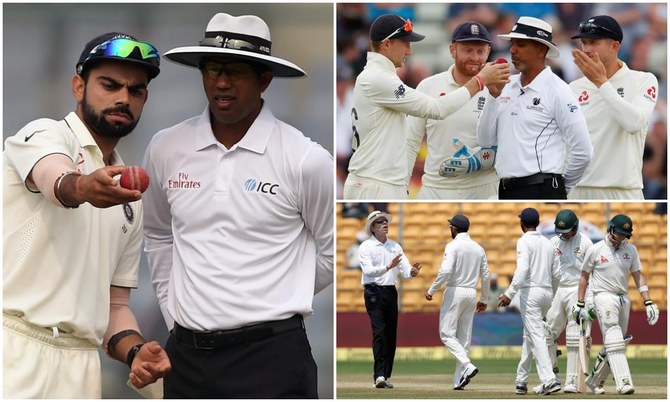

LONDON: There is no surer way to aggravate a cricket purist than to refer to the governance of the game as rules, instead of laws. My way of dealing with this is to say that rules are there to be broken, laws to be obeyed.
In my first column on the origins of cricket in England, the review ended at a point when the game began to transition from rustic origins into a more structured regime. This was in the early part of the 18th century, when cricket became a vehicle for gambling.
Significant sums were wagered on matches between teams assembled by members of the upper classes. Large crowds were attracted, much to the disapproval of the middle classes, who argued that workers should not be distracted, or encouraged to either gamble or spend money on drink.
Such was the intensity with which games were contested, that, inevitably, disputes broke out. On one occasion, in 1717, three members of a team, with defeat looming, fled the game in order to avoid paying their dues to the opposition. This led to a court case, and the judge ordered a rematch.
A decade later, a match in Essex fell foul of a local magistrate who thought it was an excuse to gather people together to cause trouble, ordering the crowd’s dispersal. This is likely to have served to focus attention on venues in South East England and London for the playing of these monied matches.
Those participating understood the unwritten mechanics of the game. Nevertheless, articles of agreement were drawn up to establish the hours of play (particularly the finishing time), residential qualifications of players, stake money, choice of umpires and code of conduct.
Emphasis was placed on the need for respect. Umpires’ decisions were not to be questioned and the authority of the nobles who championed teams would be invoked in any case of doubt. This early code of honor has remained for almost 300 years, though not without challenges.
Crowd control became an issue. The Artillery Ground at Finsbury in London, still in use today, offered the opportunity both to control entry and encroachment of spectators onto the field. The London Cricket Club was based there and its members, along with invited representatives from other clubs, were responsible for producing the first unifying code in 1744, published in 1755.
The code confirmed norms on things such as wicket size, ball weight and pitch dimensions. At this time, the bat was like a hockey stick, no body protection was used, and the ball was delivered underarm. Changes came after 1760 with the introduction of patented cricket balls and pitched delivery, which led to the use of a straight bat, for which, remarkably, no dimensions were specified.
In 1771, a visiting player used a bat as wide as the wicket against the Hambledon Club. At that time, this remote club in Hampshire had become the foremost club in England for noblemen and country gentry, who organized cricket for the purpose of betting and drinking. It is not known if betting was the reason behind the act, but the Hambledon Club moved to propose that the width of the bat should be a maximum 4.25 inches, a dimension that has remained to this day. Along with six other alterations, this was incorporated into a revision of the laws in 1774.
The influence of the Hambledon Club waned and the elite White Conduit Club in London, with many of the same members, became a new focus. Matches were played on open fields, where players were subject to verbal abuse from spectators. As a result, the club sought more privacy, and one member, Thomas Lord, was asked to find a suitable site. This was in Dorset Fields, Marylebone, where the Marylebone Cricket Club (MCC) was founded in 1787.
In 1788, the MCC undertook a revision of the early codes and published the “Laws of the Noble Game of Cricket,” which were adopted throughout the game. Subsequent developments in that era saw the specification of ball circumference, the introduction of boundaries to the field, protective equipment and a third stump. However, it was not until 1864 that a major change, overarm bowling, was legitimized, shaping the way cricket is played today.
Some common themes emerge from the evolution of cricket in the 18th century. Alongside the rustic, romantic vision of village greens, gambling pervaded, and substantial crowds of up to 10,000 in urban areas often became disorderly, particularly as commercial interests in the form of sellers of food and drink were encouraged. Maintaining law and order was paramount.
It is reasonable to assume that attempts to cheat, influence umpires and test agreed conditions did occur. Given the amounts of money at stake and the involvement of members of society who operated by supposed code of honor, it is only fitting that those who drew up the terms of engagement should regard them as laws, thereby creating the context for the epithet “it is just not cricket.”


