

Barty has Kerber on her mind, Pliskova prepares for big-hitter Sabalenka in semis

1 / 2
Australia's Ashleigh Barty in action during her quarter-finals match against Australia's Ajla Tomljanovic on Day 8 of the Wimbledon Tennis Championships on July 6, 2021.(REUTERS)
2 / 2
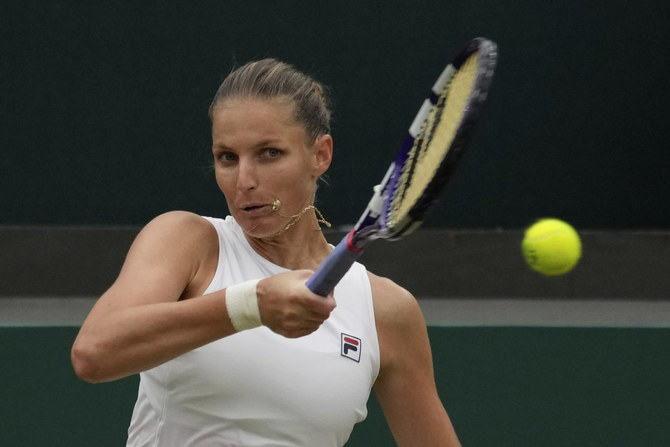
Czech Republic's Karolina Pliskova plays a return to Switzerland's Viktorija Golubic on Day 8 of the Wimbledon Tennis Championships on July 6, 2021. (AP)
Short Url
Updated 08 July 2021
Follow

Barty has Kerber on her mind, Pliskova prepares for big-hitter Sabalenka in semis

LONDON: One is motivated by a significant anniversary, another rediscovered the grass is definitely greener for her form, a third is driven on by “brutal” critics and the fourth, the girl with a tiger tattoo, finds herself in unknown Grand Slam territory.
The stage is set for the women’s Wimbledon semifinals on Thursday with three of the contenders new to the experience.
Headline names such as 2019 champion Simona Halep, four-time Grand Slam winner Naomi Osaka and seven-time Wimbledon champion Serena Williams are missing but there is the present world number one and two former number ones in the last four.
Ashleigh Barty’s clash with Angelique Kerber would be fit for a final, pitching the world number one against the 2018 Wimbledon champion.
The other semi is an intriguing duel between former world number one Karolina Pliskova and the powerful second seed from Belarus, Aryna Sabalenka.
Barty is motivated by a higher purpose.
For it is 50 years ago her fellow indigenous Australian Evonne Goolagong Cawley won the first of her two Wimbledon titles.
Barty has worn a specially-designed dress as a tribute to the ‘iconic’ scallop one her “friend and mentor” wore in that 1971 final.
“It’s a really special anniversary for a lot of Australians, but for indigenous Australians in particular,” said Barty at the outset of her not always convincing campaign.
“I think this is a really special one.”
Barty’s serve has been found wanting at pivotal moments — even her quarter-final opponent Ajla Tomljanovic broke her twice in their second set — but she believes her form is coming together.
“I think obviously play on grass is very different,” she said after her quarter-final.
“The grass season for me, it’s one tournament, pretty cut-throat.
“I certainly wasn’t as loose as I have been with errors and kind of ill-timed lapses. But I felt really sharp today.”

Barty, though, knows she will have to move up a gear if she is to see off Kerber.
The 33-year-old German has bounced back to top form after first round exits at both the Australian and French Open.
“I know one of Angie’s greatest assets is the fact that she can run and hunt and put the ball in an awkward situation to nullify my aggression and my weapons at times,” said Barty.
“It’s a really fine balance.”
Kerber, 33, has improved as the Championships have progressed from earning along with her second round opponent Sara Sorribes Tormo a five-minute standing ovation for their three hour marathon.
The 25th seed has gone on to impressive wins over higher-seeded duo Coco Gauff and then Karolina Muchova.
“I have always in my career had some ups and downs but I was always believing I could come back because I know what I can do,” said Kerber.
Pliskova too has never doubted herself despite dropping out of the top 10 — she is ranked 13 — after being a regular since 2016.
A first appearance in a Wimbledon semifinal has justified that self-belief — she is yet to drop a set and has only had her serve broken three times.
The 29-year-old Czech has hit 40 aces and she served one with full force directed at her doubters after she beat Swiss Viktorija Golubic on Tuesday.
“The Internet is the biggest problem,” said Pliskova who had failed to get to the second week of a Slam in her last five outings.
“Not that I would really read all the messages and all the comments, but sometimes you just see something or like some articles.
“I think they can be quite brutal. I was five years in the top 10. Then one week I’m not in the top 10, and it’s like huge drama, especially in my country.”
Sabalenka has defied the skeptics questioning her second seed status as she has broken new ground in reaching the last four having never before got past the fourth round of a major.
The 23-year-old’s tiger tattoo on her left thigh — due to her being born in 1998 the Year of the Tiger — led to her parents not speaking to her for a week.
However, she has lived up to the image of the tiger both in power and fighting spirit in eye-catching wins in the past two rounds over Elena Rybakina and Ons Jabeur to earn her place in the last four.
Pliskova will need no reminding of the 23-year-old Sabalenka’s battling qualities.
When they last met in Cincinnati in 2018 Sabalenka beat Pliskova having saved two match points.


Pakistan-born Australian Khawaja, set to retire from cricket, criticizes racial stereotypes

Updated 9 sec ago
Follow

Pakistan-born Australian Khawaja, set to retire from cricket, criticizes racial stereotypes

  • Usman Khawaja said he felt he was treated ‘a little bit different, even to now,’ because of his Pakistan and Muslim background
  • Khawaja was criticized in the days leading up to the Perth match for golfing twice, not taking part in an optional training session

Veteran Australia batter Usman Khawaja has announced he will retire from international cricket after the fifth Ashes test beginning Sunday at the Sydney Cricket Ground.

He didn’t go quietly.

The Pakistan-born Khawaja, who was the first Muslim to play for Australia, used his retirement announcement Friday to criticize the “racial” stereotyping he experienced during his career.

It will be the 39-year-old Khawaja’s 88th and final test — played at the ground where he began his first-class career. Khawaja scored his first Ashes century at the SCG with 171 against England in 2018.

It was also at that the SCG where he revived his career at age 35, scoring two centuries against England. That prompted one of the great late-career revivals, as Khawaja hit seven centuries in his next two years back in the side.

But Khawaja’s position had come under scrutiny and criticism this season after being unable to open in the first Ashes test in Perth due to back spasms and then missing the Brisbane test with the injury.

He was then initially left out in Adelaide until Steve Smith’s vertigo allowed Khawaja to return, before an 82 in the first innings there ensured he would stay in the side for the fourth test in Melbourne. Australia, with a 3-1 lead going into the fifth test, has retained the Ashes.

Khawaja said he felt he was treated “a little bit different, even to now,” because of his Pakistan and Muslim background.

“Different in the way I’ve been treated, different in how things have happened,” he said at a media conference in Sydney. “I had back spasms, it was something I couldn’t control. The way the media and the past players came out and attacked me . . . I copped it for about five days straight. Everyone was piling in.

“Once the racial stereotypes came in, of me being lazy, it was things I’ve dealt with my whole life. Pakistani, West Indian, colored players...we’re selfish, we only care about ourselves, we don’t care about the team, we don’t train hard enough.”

Khawaja was criticized in the days leading up to the Perth match for golfing twice and not taking part in an optional training session. Some commentators suggested the golf might have been responsible for his back issues.

“I can give you countless number of guys who have played golf the day before a match and have been injured, but you guys haven’t said a thing,” Khawaja told the assembled media.

“I can give you even more examples of guys who have had 15 schooners (large glasses of beer) the night before a game and have then been injured, but no one said a word because they were just being ‘Aussie larrikins,’ they were just being lads. But when I get injured, everyone went at my credibility and who I am as a person.”

Khawaja said he knew the end of his career was imminent.

“I guess moving into this series, I had an inkling this would be the last series,” he said. “I’m glad I can go out on my own terms.”

Khawaja has scored 6,206 runs at an average of 43.49 in his 87 tests with 16 centuries and 28 half-centuries.

“Usman has made a huge contribution to Australian cricket both through his outstanding achievements as one of our most stylish and resilient batters . . . and off field, particularly through the Usman Khawaja Foundation,” Cricket Australia chief executive Todd Greenberg said in a statement.

“Usman has been one of Australia’s most reliable opening batters and testament to his success was him being named ICC test cricketer of the year the same season that Australia won the World Test Championship (in 2023).”

Khawaja said his No. 1 emotion on announcing his retirement was “contentment.”

“I’m very lucky to have played so many games for Australia the way I have,” Khawaja said. “I hope I have inspired people along the way.”