

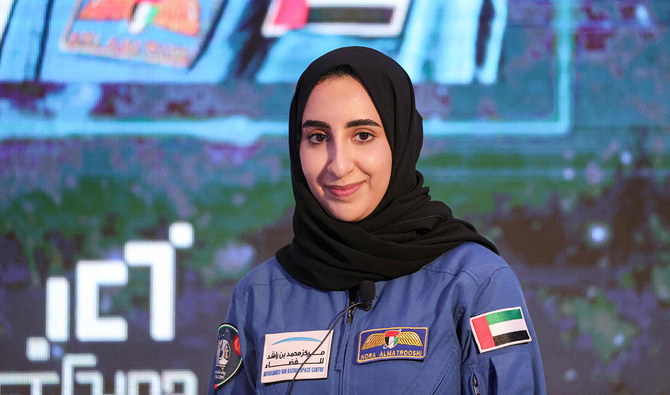
Nora Al-Matrooshi, first Arab woman astronaut in training

UAE astronaut Nora Al-Matrooshi looks on during a press conference in Dubai on July 7, 2021. (AFP)
Short Url
Updated 09 July 2021
Follow

Nora Al-Matrooshi, first Arab woman astronaut in training

  • The 28-year-old mechanical engineer from Sharjah has dreamt about space since she was a girl, learning about planets, stars at school

DUBAI: The UAE’s Nora Al-Matrooshi is the first Arab woman to start training to be an astronaut, one of two Emiratis picked from thousands of applicants as the Gulf nation looks to the stars.

The 28-year-old mechanical engineer from Sharjah has dreamt about space since she was a girl, learning about planets and stars at school.

And while there are no space missions scheduled, she hopes to have the opportunity to one day visit space, continuing the tradition of exploration begun by her sailor ancestors.

“My mum’s side of the family are sailors. I’d say they explored the ocean. The term ‘astronaut’ means ‘star sailor’ in Greek,” said the soft-spoken Matrooshi.

Matrooshi and her fellow countryman, Mohammad Al-Mulla, 33, will later this year head to the US to train at NASA’s Johnson Space Center.

They now join Sultan Al-Neyadi and Hazza Al-Mansoori in the Emirati fellowship of astronauts.

(Video courtesy of Dubai Media Office)

The two Emiratis are currently training in-house in the emirate of Dubai, from learning to speak Russian to flying lessons.

The UAE is a newcomer to the world of space exploration, but is quickly making its mark.

In September 2019, the country sent the first Emirati into space as part of a three-member crew that blasted off on a Soyuz rocket from Kazakhstan for an eight-day mission.

Then in February, its “Hope” probe successfully entered Mars’ orbit on a journey to reveal the secrets of Martian weather, making history as the Arab world’s first interplanetary mission.

More recently in September 2020, Abu Dhabi said it planned to launch an unmanned rover to the moon by 2024 which would be the first trip to Earth’s satellite by an Arab country.

“If I can do it, then you can do it. If no one has done it before you, then just go ahead and be the first,” said Matrooshi. “If you’re really passionate about what you’re doing, then you should just work hard for it and look for opportunities.”


Algeria inaugurates strategic railway to giant Sahara mine

President Tebboune attended an inauguration ceremony in Bechar. (AFP file photo)
Updated 02 February 2026
Follow

Algeria inaugurates strategic railway to giant Sahara mine

  • The mine is expected to produce 4 million tons per year during the initial phase, with production projected to triple to 12 million tons per year by 2030
  • The project is financed by the Algerian state and partly built by a Chinese consortium

ALGEIRS: Algerian President Abdelmadjid Tebboune on Sunday inaugurated a nearly 1,000-kilometer (621-mile) desert railway to transport iron ore from a giant mine, a project he called one of the biggest in the country’s history.
The line will bring iron ore from the Gara Djebilet deposit in the south to the city of Bechar located 950 kilometers north, to be taken to a steel production plant near Oran further north.
The project is financed by the Algerian state and partly built by a Chinese consortium.
During the inauguration, Tebboune described it as “one of the largest strategic projects in the history of independent Algeria.”
This project aims to increase Algeria’s iron ore extraction capacity, as the country aspires to become one of Africa’s leading steel producers.
The iron ore deposit is also seen as a key driver of Algeria’s economic diversification as it seeks to reduce its reliance on hydrocarbons, according to experts.
President Tebboune attended an inauguration ceremony in Bechar, welcoming the first passenger train from Tindouf in southern Algeria and sending toward the north a first charge of iron ore, according to footage broadcast on national television.
The mine is expected to produce 4 million tons per year during the initial phase, with production projected to triple to 12 million tons per year by 2030, according to estimates by the state-owned Feraal Group, which manages the site.
It is then expected to reach 50 million tons per year in the long term, it said.
The start of operations at the mine will allow Algeria to drastically reduce its iron ore imports and save $1.2 billion per year, according to Algerian media.