

100-year-old Pakistani who witnessed two pandemics passes away in Karachi

A 100-year-old man, Israil Ahmed Menai, speaks to Arab News at his residence in Karachi, Pakistan, on March 23, 2021. (AN Photo)
Short Url
Updated 07 July 2021
Follow

100-year-old Pakistani who witnessed two pandemics passes away in Karachi

  • Israil Ahmed Menai, who lived during 1936 plague, was vaccinated against COVID-19 earlier this year
  • In interview with Arab News in March, Menai urged people to get vaccinated against the coronavirus

KARACHI: A 100-year-old Pakistani, who survived the global pandemic of 1936 and witnessed the emergence and spread of the novel coronavirus, passed away in Karachi after a brief ailment, his family said on Wednesday.
Israil Ahmed Menai was believed to be the oldest Pakistani who got vaccinated against COVID-19 on March 12 and April 5 this year. He had also urged the public to take necessary precautionary measures against the disease by getting vaccinated. 
“He remained in hospital due to breathing difficulties for a week and but peacefully passed away at home on Tuesday only a few hours after being discharged,” Mustafa Menai, his youngest son, said. “My father was very happy when he reached home. He wanted to serve his community through his legal practice and poetry, and we will strive to continue his legacy.”
Born in Rampur in present-day India on September 30, 1920, Menai celebrated his 100th birthday last year. His grandfather was the famous 19th century Urdu poet, Ameer Menai, and he received his early education in his hometown before going to Osmania University, Madras, for higher education.
After his family moved to Pakistan in 1950, Menai went to the Fletcher School of Law and Diplomacy and Harvard University on a Fulbright Scholarship. He started practicing law upon his return to his family’s newly adopted homeland and stayed in the profession for 70 years before suffering a cardiac arrest about six years ago.

He continued to visit courts and spent his free time in bar rooms.
When the government started vaccinating elderly citizens earlier this year, Menai decided to benefit from the immunization campaign.



100-year-old Israil Ahmed Menai, receives first dose of coronavirus vaccine in Karachi, Pakistan on March 12, 2021. (AN Photo)

“Such pandemics come and go,” he told Arab News in an interview at his residence in Karachi in March. “People should exercise caution like they did in the past under similar circumstances. There is no need to be scared.”
He recalled that his first experience with a pandemic was in 1936 when a plague started spreading in his hometown.
“Since there were limited communications means and news did not travel as fast as it does now, it looked like a local phenomenon,” he said. “The world has now transformed into a global village. Things that happen here get immediately reported in places as distant as New York or Seattle.”
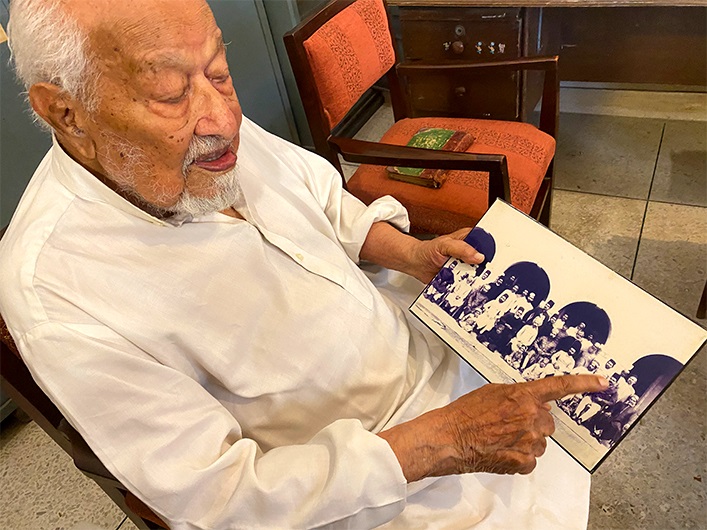


100-year-old Israil Ahmed Menai, shows an old photo from his family album on March 23, 2021, in Karachi, Pakistan. (AN Photo) 

Menai said his experience of the two pandemics was different for many reasons, but one commonality was the will of people to live and use all available resources to protect themselves.
“We may witness yet another pandemic in the future,” he added. “But man has always strived for his existence and health. These efforts [to produce and administer vaccines] are a continuation of the same thing and will endure in the future as well.”


Peace can only prevail if Afghanistan renounces support for ‘terrorism’— Pakistan defense chief

Updated 04 March 2026
Follow

Peace can only prevail if Afghanistan renounces support for ‘terrorism’— Pakistan defense chief

  • Pakistan’s chief of defense forces visits South Waziristan district bordering Afghanistan
  • Pakistan says has killed 481 Afghan Taliban operatives since clashes began last Thursday

ISLAMABAD: Pakistan’s Chief of Defense Forces Field Marshal Syed Asim Munir said on Wednesday that peace with Afghanistan can only prevail if Kabul renounces support for “terrorism” and “terrorist” organizations, the military’s media wing said as the two countries remain locked in conflict. 

Fighting between the two neighbors, the worst in decades, broke out last Thursday night after Afghan forces attacked Pakistan’s military installations along their shared border. Afghanistan said its attacks were in response to earlier airstrikes by Pakistan against alleged militant hideouts in its country. 

Pakistan accuses Afghanistan of sheltering militant outfits such as the Tehreek-e-Taliban Pakistan (TTP) on its soil who have launched attacks against Pakistani civilians and security forces in recent years. Kabul denies the allegations. 

Munir visited Wana town in Pakistan’s South Waziristan district to review the security situation and troops’ operational preparedness at the Afghan border, the Pakistani military’s media wing said in a statement. 

“The Field Marshal reiterated that peace could only prevail between both sides if the Afghan Taliban renounced their support for terrorism and terrorist organizations,” the Inter-Services Public Relations (ISPR) said. 

The military chief said the use of Afghan soil by militant outfits to launch attacks against Pakistan was unacceptable, vowing that “all necessary measures” would be taken to neutralize cross-border threats. 

During the visit, Munir was briefed by military commanders about ongoing intelligence-based operations and measures being taken by the military to manage the border with Afghanistan.

He was also briefed about “Operation Ghazab Lil Haq” or “Wrath for the Truth,” the name Pakistan has given to its military operation against Afghan forces, the ISPR said. 

The Pakistani military chief spoke to troops deployed in the area, praising their vigilance, professional conduct and high morale, the ISPR said. 

Pakistan’s Information Minister Attaullah Tarar said on Wednesday that the military has killed 481 Taliban operatives, injured more than 690 and destroyed 226 Afghan checkposts since clashes began. 

Arab News has been unable to verify claims by both sides about the damages they claim to have inflicted on each other.

Afghanistan has signaled it is open for dialogue but Pakistan rejected the offer, saying it would continue its military operations till its objectives were achieved. 

Since the conflict began, diplomatic efforts have intensified with several countries, including global bodies such as the European Union and United Nations, urging restraint and calling for talks.

Turkish President Recep Tayyip Erdogan told Pakistani Prime Minister Shehbaz Sharif that ⁠Ankara would help ⁠reinstate a ceasefire, the Turkish Presidency said on Tuesday, as other countries that had offered to mediate have since been hit by the conflict in the Gulf.