

Saudi Ministry of Hajj says 'fully prepared' for this year’s Hajj season

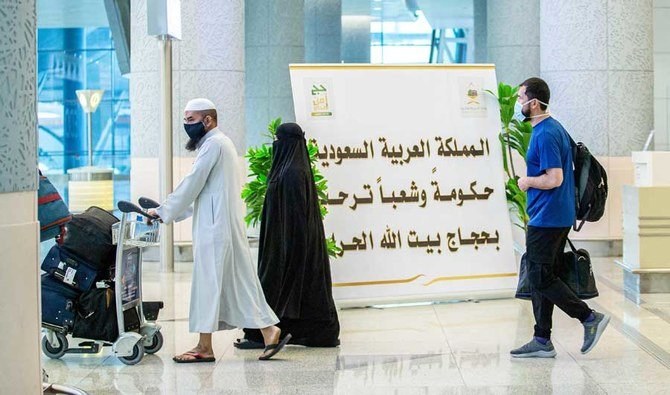
A handout picture provided by the Saudi Ministry of Media on July 25, 2020, shows travelers walking with luggage past a welcome sign at the Red Sea coastal city of Jeddah's King Abdulaziz International Airport. (AFP)
Short Url
Updated 06 July 2021
Follow

Saudi Ministry of Hajj says 'fully prepared' for this year’s Hajj season

  • The applications were sorted according to a specific mechanism such as the readiness of the pilgrim physically, taking into account if they had already performed Hajj

MAKKAH: The Ministry of Hajj and Umrah has confirmed it is fully prepared for this year’s Hajj season.

Dr. Abdulfattah Mashat, deputy minister of Hajj and Umrah, stressed that the pace of work to ready the Kingdom’s holy sites will increase in the coming days, and all relevant sectors will complete the requirements for receiving pilgrims on time.

“The Ministry of Hajj and Umrah has long developed strategic and operational plans related to Hajj activities in cooperation with more than 30 entities, from various private, government and security sectors,” he added.

In an interview broadcast on Riyadh Radio, Mashat said that pilgrim residences at the holy sites are ready, as are gathering points around Makkah, stressing that there is an integrated plan to make this year’s season safe and secure.

Pilgrims’ tents at Arafat, as well as facilities in Mina and other areas where pilgrims will stay in Muzdalifah have all been inspected.

“The environment … this year will be different from the previous Hajj seasons. It will be a healthy environment, ensuring social distancing between the pilgrims during the entire journey, thanks to large camps allowing continuous air movement, thus eliminating any risks,” said Mashat.

He pointed out that the Saudi government has created an integrated transportation network connecting all relevant sites across the region.

“There will be buses transporting pilgrims from their residence … to the arrival station,” he said. “The authorities are currently developing the final plan for transport with the security authorities, which will be revealed very soon, accompanied by an awareness program targeting pilgrims via their smart phones or through social media platforms.”

Mashat said pilgrims performing Hajj this season have never been on the pilgrimage before. “In June, the Ministry of Hajj and Umrah began to receive applications. We received, in ten days, over 500,000 applications, while the target number was 60,000.

“The applications were sorted according to a specific mechanism such as the readiness of the pilgrim physically, taking into account if they had already performed Hajj. The data was also sorted out by age groups, with priority initially given to those over 50 years of age from all nationalities residing in the Kingdom.”

The pilgrims were distributed across 190 companies offering three packages. Mashat said the chosen pilgrims will start arriving on July 17 and 18, and that buses that used to accommodate 50 pilgrims in the past will accommodate just 20 this year.

He added that pilgrims’ smart cards would be essential during their stay, providing them with information of significant help to them and service providers.

Ahmed Saleh Halabi, a journalist and writer specializing in Hajj and Umrah services, said: “This year’s Hajj season comes while the coronavirus disease pandemic is still ravaging the world. Some believed that the performance of the Hajj (would have to) stop, after some countries closed their borders, but the Saudi leadership was keen to hold the Hajj season, in a way that guarantees the safety of pilgrims, in limited numbers, and in accordance with precautionary and preventive measures.”

He added: “Last year’s Hajj season was an exceptional season as a result of the outbreak of the pandemic, and the government of the Kingdom has enabled pilgrims to perform their rituals with security and tranquility, gaining good experience in organizing and managing crises and overcoming the pressures imposed by the virus.”

Saudi Arabia’s decision to limit Hajj to citizens and residents within the Kingdom confirms the government’s keenness to maintain the safety, health and security of pilgrims, in line with Islam, that calls on preserving human life, he said.


Artificial intelligence is transitioning into a ‘digital employee’

Updated 4 sec ago
Follow

Artificial intelligence is transitioning into a ‘digital employee’

  • AI can be an effective tool, business leaders tell Arab News
  • Not about jobs, but ‘convergence of human capital and AI’

RIYADH:  Artificial intelligence is fundamentally reshaping the world of work, transitioning from a supporting tool to an active partner that is radically changing the nature of professions and productivity standards.

Amidst the current global transformations, an active regional digital environment is emerging.

This is being led by Saudi Arabia through Vision 2030 and massive investments in smart infrastructure, providing a living model for studying the implications of this partnership between humans and machines on the future of work in the region.

Arab News spoke to various business leaders about the emerging shape of the sector.

Salem Bagami, co-founder of Metatalent, said the ideal relationship between humans and machines at work should be complementary and collaborative.

Humans would bring creativity, emotional intelligence, and complex decision-making, while machines excel at processing big data and performing repetitive, precise tasks.

He believes that this type of balanced partnership would lead to unprecedented productivity and innovation.

While machines excel at processing big data and performing repetitive, precise tasks, humans would bring creativity, emotional intelligence, and complex decision-making. (Supplied)

Mohammad Al-Jallad, chief technologist and director at HPE, said AI has gone beyond being merely an executive tool to becoming a “digital employee” entrusted with automating routine tasks and providing insights based on data analysis.

He believes that the real opportunity lies not in the debate over job replacement, but in “the convergence of human capital and artificial intelligence.”

AI should augment human teams by taking on menial and routine tasks, enabling employees to focus on critical thinking, creativity, and ethical reasoning, significantly improving operational results.

Bagami also emphasized the complementary nature of this partnership. “The ideal relationship between humans and machines at work is one of collaboration, where each complements the others.”

He explained that humans bring creativity, emotional intelligence, and nuanced decision-making, while machines excel at processing big data and performing repetitive tasks efficiently, leading to increased productivity and innovation.

Opinion

This section contains relevant reference points, placed in (Opinion field)

Salem Alanazi, chairman of Jathwa Technology Co., notes a significant trend among Saudi Arabia companies toward using AI applications to provide faster services to customers at lower costs.

The emergence of the “virtual employee” available around the clock has eliminated the need for some traditional jobs in specific sectors.

Alanazi warns that some companies’ reluctance to adopt AI may expose them to real risks. “All those who hesitated to benefit from AI applications have a lack of understanding of these technologies.”

He said those who adopt these technologies will be able to offer lower-cost, higher-quality services, which will affect the market position of companies that lag behind.

Ali Aljumhour, CEO of VALUE Consultancy, said that the transition of AI into a partner has reshaped the list of most in-demand skills in the job market.

Skills such as “prompt engineering,” “human-machine integration,” and “digital ethics” are becoming increasingly important.

He added that AI has become an instantly available “technical knowledge base,” shifting the criteria for professional distinction toward those capable of smart interaction with these technologies.

In terms of ethics, transparency, and trust, Alanazi points to the complexities of global AI governance, where legislation overlaps and evolves rapidly to keep pace with potential risks, particularly in the areas of cybersecurity and privacy.

Ali Aljumhour, CEO of VALUE Consultancy. (Supplied)

Al-Jallad emphasizes this crucial dimension, noting that providing responsible and reliable AI solutions that meet the highest standards of transparency is a key priority, especially in regulated sectors.

Bagami believes there should be basic standards for the ethical use of Al, emphasizing the need for transparency, accountability, and fairness, along with using diverse data sets to prevent bias and protect privacy.

He believes that building trust between humans and machines requires clear explanations of how systems work, giving users the opportunity to provide feedback and conducting periodic performance reviews.

On performance evaluation, Aljumhour said: “I expect radical changes in standards, shifting from measuring individual effort to evaluating the quality of the partnership between humans and machines.”

There should be a focus on the quality of inputs provided to intelligent systems, the accuracy of review and modification, and complex decision-making based on outputs.

He warns, however, of new risks that may arise, such as over-reliance on AI or difficulty in determining responsibility for mistakes.

In the employment sector, Aljumhour expects fundamental changes in standards.

There will be questions and tests focusing on measuring skills in dealing with AI, such as asking candidates about their experiences of collaborating with these systems, or testing their ability to formulate effective requests for complex tasks.

Aljumhour identifies significant human challenges in this transition, with “fear, loss of power, and exclusivity of knowledge” being the biggest concerns for experienced employees.