

Saudi Ministry of Hajj says 'fully prepared' for this year’s Hajj season

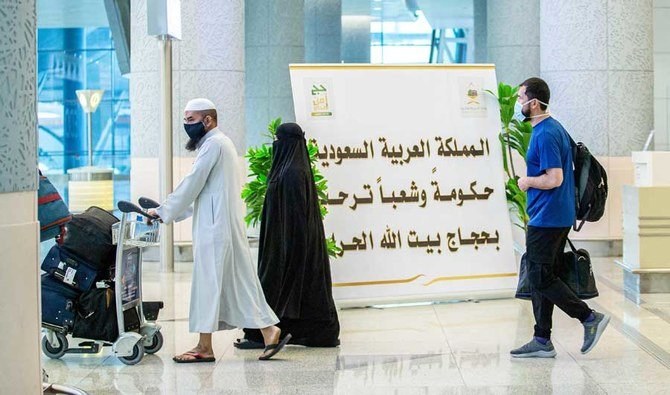
A handout picture provided by the Saudi Ministry of Media on July 25, 2020, shows travelers walking with luggage past a welcome sign at the Red Sea coastal city of Jeddah's King Abdulaziz International Airport. (AFP)
Short Url
Updated 06 July 2021
Follow

Saudi Ministry of Hajj says 'fully prepared' for this year’s Hajj season

  • The applications were sorted according to a specific mechanism such as the readiness of the pilgrim physically, taking into account if they had already performed Hajj

MAKKAH: The Ministry of Hajj and Umrah has confirmed it is fully prepared for this year’s Hajj season.

Dr. Abdulfattah Mashat, deputy minister of Hajj and Umrah, stressed that the pace of work to ready the Kingdom’s holy sites will increase in the coming days, and all relevant sectors will complete the requirements for receiving pilgrims on time.

“The Ministry of Hajj and Umrah has long developed strategic and operational plans related to Hajj activities in cooperation with more than 30 entities, from various private, government and security sectors,” he added.

In an interview broadcast on Riyadh Radio, Mashat said that pilgrim residences at the holy sites are ready, as are gathering points around Makkah, stressing that there is an integrated plan to make this year’s season safe and secure.

Pilgrims’ tents at Arafat, as well as facilities in Mina and other areas where pilgrims will stay in Muzdalifah have all been inspected.

“The environment … this year will be different from the previous Hajj seasons. It will be a healthy environment, ensuring social distancing between the pilgrims during the entire journey, thanks to large camps allowing continuous air movement, thus eliminating any risks,” said Mashat.

He pointed out that the Saudi government has created an integrated transportation network connecting all relevant sites across the region.

“There will be buses transporting pilgrims from their residence … to the arrival station,” he said. “The authorities are currently developing the final plan for transport with the security authorities, which will be revealed very soon, accompanied by an awareness program targeting pilgrims via their smart phones or through social media platforms.”

Mashat said pilgrims performing Hajj this season have never been on the pilgrimage before. “In June, the Ministry of Hajj and Umrah began to receive applications. We received, in ten days, over 500,000 applications, while the target number was 60,000.

“The applications were sorted according to a specific mechanism such as the readiness of the pilgrim physically, taking into account if they had already performed Hajj. The data was also sorted out by age groups, with priority initially given to those over 50 years of age from all nationalities residing in the Kingdom.”

The pilgrims were distributed across 190 companies offering three packages. Mashat said the chosen pilgrims will start arriving on July 17 and 18, and that buses that used to accommodate 50 pilgrims in the past will accommodate just 20 this year.

He added that pilgrims’ smart cards would be essential during their stay, providing them with information of significant help to them and service providers.

Ahmed Saleh Halabi, a journalist and writer specializing in Hajj and Umrah services, said: “This year’s Hajj season comes while the coronavirus disease pandemic is still ravaging the world. Some believed that the performance of the Hajj (would have to) stop, after some countries closed their borders, but the Saudi leadership was keen to hold the Hajj season, in a way that guarantees the safety of pilgrims, in limited numbers, and in accordance with precautionary and preventive measures.”

He added: “Last year’s Hajj season was an exceptional season as a result of the outbreak of the pandemic, and the government of the Kingdom has enabled pilgrims to perform their rituals with security and tranquility, gaining good experience in organizing and managing crises and overcoming the pressures imposed by the virus.”

Saudi Arabia’s decision to limit Hajj to citizens and residents within the Kingdom confirms the government’s keenness to maintain the safety, health and security of pilgrims, in line with Islam, that calls on preserving human life, he said.


Threat to Kingdom’s security is ‘red line’ that will be ‘addressed and neutralized,’ Saudi envoy says

Updated 14 January 2026
Follow

Threat to Kingdom’s security is ‘red line’ that will be ‘addressed and neutralized,’ Saudi envoy says

  • Abdulaziz Alwasil tells UN Security Council the situation in southern Yemen is ‘a just cause with social and historic dimensions’ that can only be resolved through dialogue
  • Recent military activity in the south was unilateral, resulting in an escalation that harms the interests of Yemeni people and undermines efforts to address issues in the south, he said

NEW YORK CITY: Any attempt to threaten Saudi Arabia’s national security is a “red line” and will be met with decisive action, the Kingdom’s ambassador to the UN told the Security Council on Wednesday.

Speaking during a meeting of the council to discuss Yemen, Abdulaziz Alwasil said the situation in the south of the country is “a just cause with social and historic dimensions” that can only be resolved through dialogue.

“We stress that any attempt to threaten our national security is a red line, and we will not hesitate to take the necessary actions and steps to address it and neutralize it,” he added.

Alwasil reaffirmed Saudi Arabia’s support for Yemeni President Rashad Al-Alimi, the Presidential Leadership Council, and the Yemeni government in their efforts to achieve security, stability, development and peace while preserving national unity.

He said military activity by Southern Transitional Council forces in Hadramout and Al-Mahra on Dec. 2, 2025, was unilateral, did not have the approval of the Presidential Leadership Council, and was not carried out in coordination with the Coalition to Restore Legitimacy in Yemen.

It had resulted in an unjustified escalation that harmed the interests of the Yemeni people, undermined efforts to address the issues in the south, and ran counter to the coalition’s objectives, Alwasil added.

The Kingdom, working with its coalition partners, the Presidential Leadership Council and the Yemeni government, had moved to contain the situation by dispatching a military force to coordinate arrangements with the Southern Transitional Council in Aden, he said.

The aim was to ensure the return of the southern council’s forces to their previous positions outside of Hadramout and Al-Mahra, and the handover of camps to legitimate government forces and local authorities in line with agreed procedures, Alwasil added.

He expressed regret over the military operations that took place in Hadramout and Al-Mahra, close to Saudi Arabia’s southern border, which he said posed a direct threat to the Kingdom’s national security, as well as the security of Yemen and regional stability. Such steps were extremely dangerous, he added, and contradicted the principles on which the Coalition to Restore Legitimacy in Yemen had been founded.

Alwasil welcomed a prisoner and detainee exchange agreement signed in Muscat on Dec. 23, which he described as an important humanitarian measure to alleviate suffering and build confidence.

He praised Oman for hosting and sponsoring the consultations and supporting negotiations, and commended the efforts of UN’s special envoy for Yemen, Hans Grundberg, the International Committee of the Red Cross and all others that has played a part.

Regarding the political efforts to resolve the crisis, Alwasil said Saudi Arabia welcomed President Al-Alimi’s call for an inclusive conference in Riyadh to bring together all stakeholders to discuss just solutions to the situation in southern Yemen.

Preparations for the conference have begun, he added, in cooperation with the Yemeni government and southern representatives, reflecting the close ties between the two countries and their shared interests in stabilizing Yemen.

He urged all southern stakeholders to participate actively and constructively in the talks, to help find comprehensive and just solutions that meet the legitimate aspirations of the people of southern Yemen.

Alwasil called on all Yemeni forces and stakeholders to cooperate and intensify their efforts to reach a lasting political settlement that would ensure security and stability.

He described the southern issue as “a just cause with social and historic dimensions,” adding that “the only way to address it is through dialogue that leads to a comprehensive political solution” based on nationally and internationally agreed terms of reference.