

OPEC+ leaves oil market wondering after postponing meeting indefinitely

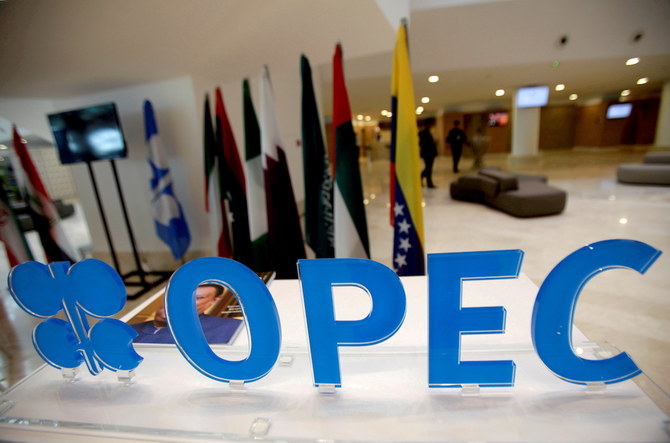
The OPEC+ alliance was unable to reach an agreement last week on extending the current oil output deal. (Reuters/File)
Short Url
Updated 06 July 2021
Follow

OPEC+ leaves oil market wondering after postponing meeting indefinitely

  • The OPEC+ alliance was unable to reach an agreement last week on extending the current oil output deal

DUBAI: A crucial meeting of the energy ministers of OPEC+ was called off on Monday as the UAE insisted on conditions unacceptable to the other 22 members
of the oil producers’ alliance led by Saudi Arabia and Russia.

The cancellation of the meeting — reconvened from last week — left global oil markets uncertain about how producers will meet rising demand as the pandemic recovery gathers pace.

Brent crude, the global benchmark, maintained its three-year high of about $77 a barrel after the cancelation.

Mohammed Barkindo, secretary-general of the Organization of Oil Exporting Countries, told ministers: “Upon consultations with Prince Abdul Aziz bin Salman, Minister of Energy of Saudi Arabia, and Alexander Novak, Deputy Prime Minister of the Russian Federation — chairman and co-chairman of OPEC+ — the reconvened 18th meeting has been called off.

“The date of the next meeting will be decided in due course and we will inform you accordingly. On behalf of the chairman and co-chairman, we regret any inconvenience caused.”

One energy official told Arab News: “It was notable that the meeting never even got started, and was called off rather than postponed.”

Proposals for a gradual increase of 400,000 barrels per day between August and the end of the year were rejected by the UAE because the country’s energy minister objected to a parallel proposal to extend the OPEC+ regime of output controls beyond the original cut-off date of next April.

That proposal was agreed on by the OPEC+ participants, including the two biggest producers Saudi Arabia and Russia, as a way of ensuring stability and flexibility in global oil markets into 2022, when rising demand, potential supply fluctuations, and possible pandemic resurgence could increase volatility.

Prince Abdul Aziz made clear that the planned output increases and the OPEC+ extension were essential to ensure that stability. “The extension is there in the agreement, it is not a branch of it,” he said on Saudi TV on Sunday.

The UAE objected to the extension on the ground that its output had been set “unfairly” from a low base in the 2020 deal that brought some calm back to markets roiled by the pandemic recession and fall in demand.

Despite the UAE’s hardening position, some experts believe that there is still room for a compromise.

Robin Mills, chief executive of energy consultancy Qamar Energy, told Arab News: “We will have to see if a compromise can be reached in the next few days — perhaps a delay in extending the agreement while baselines are assessed, or a compromise increase in the UAE baseline.”


Middle East aviation sector ‘champion of net profit’ — IATA 

Updated 8 sec ago
Follow

Middle East aviation sector ‘champion of net profit’ — IATA 

GENEVA: Net passenger profit in the Middle East’s aviation sector is the highest globally, providing “a great model for other areas of the world,” according to the International Air Transport Association’s director general.

Speaking at IATA’s global media day in Geneva, Switzerland, Willie Walsh praised the region’s focus on long-haul travel as well as its increasing efficiency in the industry.

In its latest financial outlook for the global airline industry, IATA announced that 2026 is set to be a record-breaking year in terms of net profit, with a forecast total of $41 billion.

Airlines are expected to achieve a record-breaking combined total net profit of $41 billion in 2026, up from $39.5 billion in 2025.

The Middle East is set to be the strongest region in terms of net profit margin and profit per passenger in 2026, as it was over the previous 12-month period.

In 2025, net profit was $28.90 per passenger, totaling $6.6 billion and leading to a net profit margin of 9.3 percent. For 2026, the IATA forecast the Middle East’s net profit margin will remain the same, but net profit per passenger will be $28.60, equating to $6.8 billion.

In contrast, Europe’s aviation sector saw net profit of $13.2 billion in 2025 but the margin was considerably smaller — 4.8 percent, working out at $10.60 per passenger. North America posted a net profit of $10.8 billion, working out to $9.50 per passenger with a net profit margin of 3.3 percent.

When asked to clarify which factors contributed to the region’s ranking as the highest for net profit, Walsh told Arab News: “The Middle East has clearly a much stronger focus on long-haul travel, strong premium demand, very good infrastructure availability, clear coordination between airports, suppliers, and regulators —  all working together to ensure the effective operation of the industry,”

He added: “I think it is a great model for other areas of the world to look at.” 

International Air Transport Association’s Director General Wille Walsh. IATA

Reflecting on the role played by the Gulf in contributing to these figures, Walsh said he was “pleased to see the GCC look at a common safety regulator.”

He added: “Working together can enhance the overall benefit and security of operation. So, I think it’s a great example of where everybody is working in the same direction.”

The director general continued: “You’ve got alignment between all of the key players, and that helps to ensure that the operation of the industry there is as efficient as possible.”

He also said he was “very encouraged” by the investments that are being made by airlines, airports, and air navigation service providers in the Middle East.

According to the report, passenger demand continues to be robust, driven by long haul traffic and the expansion of hub carriers.

The global net profit margin is set to remain at 3.9 percent in 2026, the same level as the previous 12-month period.

Saudi Arabia will develop its aviation sector in 2026, with its newest airline Riyadh Air continuing to roll out. The company is expected to contribute over $20 billion to the non-oil gross domestic product and create more than 200,000 direct and indirect jobs. 

The IATA report highlights how governments in the Middle East are doubling down on aviation infrastructure investments.

Saudi Arabia is seeking to boost its aviation capacity with the construction of King Salman International Airport, set to accommodate up to 120 million passengers by 2030 and 185 million passengers by 2050, and Red Sea International Airport.

Other developments in the region include expansion of Al Maktoum International Airport in the UAE.