Rebound in global gas demand threatens international climate targets, warns IEA

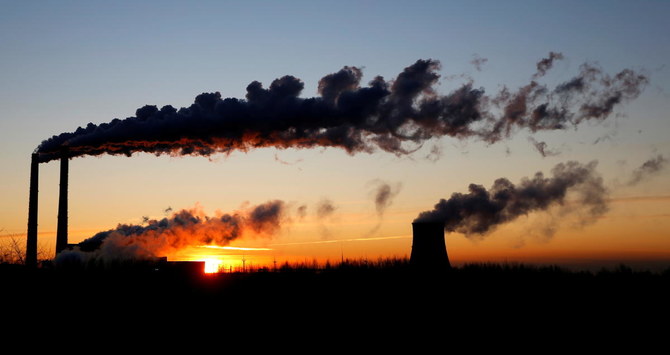
The sun rises behind a gas-fired power station in Minsk, Belarus. (Reuters)
Short Url
Updated 05 July 2021
Follow

Rebound in global gas demand threatens international climate targets, warns IEA

  • Global gas prices have soared to multi-year highs over the past month
  • IEA in May published a pathway for the energy sector to meet net zero emissions target

LONDON: A rebound in global gas demand to 2024 following a record fall last year is poised to knock the world off track for a climate goal of achieving net zero emissions by 2050, the International Energy Agency (IEA) said on Monday.
More than 190 countries have signed the Paris agreement designed to limit global warming to 1.5 degrees Celsius, which will require a huge reduction in the use of fossil fuels such as coal and gas.
“Natural gas demand is set to rebound strongly in 2021 and will keep rising further if governments do not implement strong policies to move the world onto a path toward net-zero emissions by mid-century,” the IEA said in its latest gas outlook.
Gas demand in 2021 is expected to rise by 3.6 percent as global economies recover following a record fall in 2020 due to restrictions to limit the spread of the novel coronavirus.
From 2022-2024 demand growth is expected to average 1.7 percent per year, meaning gas demand would be too high to keep to the IEA’s roadmap toward meeting global net zero emissions by 2050.
The IEA in May published a pathway for the energy sector to meet the net zero emissions target and said investors should not fund new oil, gas and coal supply projects.
But new demand could be met by projects already approved or under development before the pandemic, the latest report said.
Global gas prices have soared to multi-year highs over the past month, with high temperatures driving demand for power generation in the northern hemisphere for air conditioning and as some regions such as Asia seek to boost stocks before winter.
The report said Europe’s benchmark Dutch gas prices are expected to average $9.5 per million British Thermal Units (MBtu) in 2021, their highest since 2013, while Asian spot LNG prices are expected to average $11/MBtu, the highest since 2014.
In Monday’s report the IEA said the gas industry should ramp up efforts to reduce emissions such as addressing methane leaks.


Saudi minister at Davos urges collaboration on minerals

Global collaboration on minerals essential to ease geopolitical tensions and secure supply, WEF hears. (Supplied)
Updated 20 January 2026
Follow

Saudi minister at Davos urges collaboration on minerals

  • The reason of the tension of geopolitics is actually the criticality of the minerals

LONDON: Countries need to collaborate on mining and resources to help avoid geopolitical tensions, Saudi Arabia’s minister of industry and mineral resources told the World Economic Forum on Tuesday.

“The reason of the tension of geopolitics is actually the criticality of the minerals, the concentration in different areas of the world,” Bandar Alkhorayef told a panel discussion on the geopolitics of materials.

“The rational thing to do is to collaborate, and that’s what we are doing,” he added. “We are creating a platform of collaboration in Saudi Arabia.”

Bandar Alkhorayef, Saudi Minister of Industry and Mineral Resources 

The Kingdom last week hosted the Future Minerals Forum in Riyadh. Alkhorayef said the platform was launched by the government in 2022 as a contribution to the global community. “It’s very important to have a global movement, and that’s why we launched the Future Minerals Forum,” he said. “It is the most important platform of global mining leaders.”

The Kingdom has made mining one of the key pillars of its economy, rapidly expanding the sector under the Vision 2030 reform program with an eye on diversification. Saudi Arabia has an estimated $2.5 trillion in mineral wealth and the ramping up of extraction comes at a time of intense global competition for resources to drive technological development in areas like AI and renewables.

“We realized that unlocking the value that we have in our natural resources, of the different minerals that we have, will definitely help our economy to grow to diversify,” Alkhorayef said. The Kingdom has worked to reduce the timelines required to set up mines while also protecting local communities, he added. Obtaining mining permits in Saudi Arabia has been reduced to just 30 to 90 days compared to the many years required in other countries, Alkhorayef said.

“We learned very, very early that permitting is a bottleneck in the system,” he added. “We all know, and we have to be very, very frank about this, that mining doesn’t have a good reputation globally.

“We are trying to change this and cutting down the licensing process doesn’t only solve it. You need also to show the communities the impact of the mining on their lives.”

Saudi Arabia’s new mining investment laws have placed great emphasis on the development of society and local communities, along with protecting the environment and incorporating new technologies, Alkhorayef said. “We want to build the future mines; we don’t want to build old mines.”