

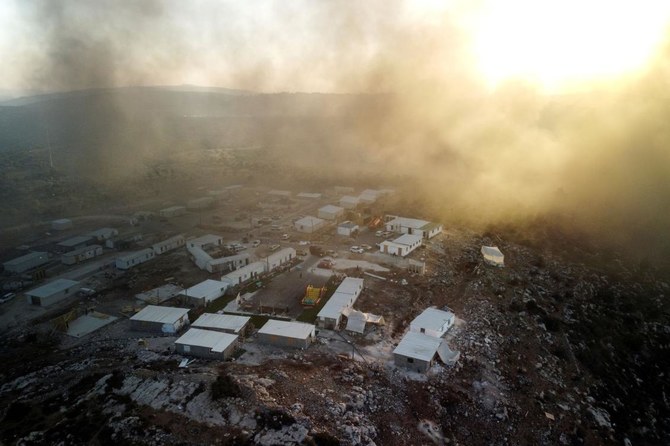

JERUSALEM: Jewish settlers have agreed to quit a remote outpost that has become a flashpoint for clashes with Palestinians who also claim the land, officials said, under a deal aimed at addressing an awkward political test for the new Israeli government.
Under the agreement with Prime Minister Naftali Bennett, the settlers will leave Givat Eviatar outpost in the Israeli-occupied West Bank.
But it seemed likely that at least some of the outpost’s new buildings would remain, locked and under military guard, an outcome that is certain to anger Palestinian protesters who demand it be removed.
The hilltop settlement outpost near the Palestinian city of Nablus was established without Israeli government permits in May and is now home to more than 50 settler families.
The Israeli military ordered it to be cleared, presenting an early challenge for the new prime minister. Bennett was once a leader of the settler movement and heads a pro-settler party, putting him at odds with some of his own voter base if the settlers were forcibly evicted.
But his ruling coalition only survives with the support of left-wing and Islamist Arab parties, making sensitive policy decisions on the Israeli-Palestinian conflict difficult.
An official with Israel’s Defense Ministry, which administers the settlements, said the Givat Eviatar families had agreed to leave voluntarily by the weekend.
Troops would stay on and a land survey conducted to determine if a government-backed settlement can be established there, the official told Reuters.
Settler leader Yossi Dagan said the families would leave on Friday under the deal. The structures serving as their homes would be locked, he said, suggesting they would not be dismantled. The Defense Ministry official did not confirm that.
On Wednesday Moussa Hamayel, deputy mayor of the nearby Palestinian village Beita, said: “We will continue our popular activities (protests) until the settlement is removed and our land is returned to us.” Beita’s residents claim ownership of the area on which Givat Eviatar sits.
Most world powers deem all of the settlements, built on land Israel captured and occupied in a 1967 Middle East war, to be illegal. Israel disputes this, citing historical ties to the land on which they sit, and its own security needs.
Israeli soldiers have shot dead five Palestinians during stone-throwing protests since the outpost was set up, Palestinian officials said. The military did not comment on fatalities, but said troops used live fire only as a last resort.


