

Punjab authorities kick off 'NORM' campaign to increase mask-wearing

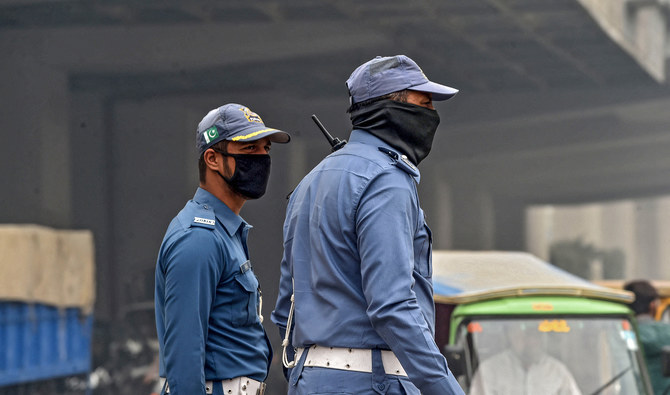
Police officers control traffic on a street amid heavy smog conditions in Lahore on November 14, 2019. (AFP/File)
Short Url
Updated 30 June 2021
Follow

Punjab authorities kick off 'NORM' campaign to increase mask-wearing

  • Commissioner of Lahore city says the NORM initiative was originally conceived by students Yale and Stanford universities
  • NORM model is an evidence-based approach to normalizing mask-wearing, being implemented in Bangladesh, Pakistan, India, Nepal, Latin America

LAHORE: The provincial administration of Punjab on Wednesday launched an initiative entitled NORM to deliver free face masks to people at their doorstep to ensure their safety and prevent the possibility of a fourth wave of the coronavirus pandemic in the country’s most densely populated region.

The Pakistan Medical Association recently warned against another surge in COVID-19 cases and highlighted the importance of following health guidelines to prevent further spread of the virus.

The NORM model is an evidence-based approach to increasing mask-wearing and is being implemented in Bangladesh, Pakistan, India, Nepal, and Latin America.

“This unique model to deliver face masks at people’s doorsteps has been originally conceived by the students Yale and Stanford universities,” Commissioner Lahore Captain Muhammad Usman Younis told Arab News, adding the Lahore University of Management Sciences (LUMS) was helping implement the project.

“The district government approached philanthropists and the business community [to implement the project] and they gave us a positive response,” he said, saying provincial authorities would distribute “10.5 million masks in Lahore alone.”

Speaking to Arab News, Maha Rehman, a LUMS faculty member supervising the project, said the initiative was based on a similar project launched in rural areas in Bangladesh.

“The mask distribution campaign will also be extended to mosques and markets,” she said, noting that celebrities had also been engaged to reinforce the awareness campaign.

Apart from university students and the business community, the project has also been supported by the country’s postal service free of cost.

“We are partners of the Punjab government in the project initiated by the Lahore commissioner, and we plan to deliver 4.5 million masks in the first phase of the campaign to the people of Lahore,” Shahid Iqbal, superintendent of the Pakistan Post in Lahore, told Arab News, adding that the project would soon be expanded to other districts of the province as well.

President of Lahore Chamber of Commerce and Industry Tariq Misbah said the business community in the city had also distributed masks and sanitizers among police officers working in the metropolis.

“We are fully participating in the cause and will meet the demand of the district and provincial governments in connection with this,” he noted.


Chinese group plans up to $1.3 billion investment in Pakistan’s industrial complex, says official

Updated 6 sec ago
Follow

Chinese group plans up to $1.3 billion investment in Pakistan’s industrial complex, says official

  • Shandong Xinxu eyes $800 million for shipbuilding and $540 million for broader maritime complex
  • The project aims to turn Pakistan’s Port Qasim into regional hub for heavy industry and logistics

KARACHI: China’s Shandong Xinxu Group is planning to invest as much as $1.34 billion to build an integrated maritime industrial complex (IMIC) at Pakistan’s second-largest port in southern commercial capital Karachi, a senior official familiar with the project told Arab News on Tuesday.

IMIC is the government’s flagship initiative to modernize industrial operations through upgrading port infrastructure, establishing shipbuilding and recycling facilities as well as an integrated steel mill at Port Qasim, which houses the Qasim International Container Terminal of DP World.

“They have shown interest in investing an estimated $1.34 billion overall in the IMIC project,” said a maritime affairs ministry official on condition of anonymity since the project’s modalities are still being discussed.

The planned investment, if materialized soon would augur well for Pakistan’s economy which has stabilized with the help of a $7 billion International Monetary Fund’s loan but desperately awaits dollar inflows especially on account of foreign direct investment (FDI) and exports, which according to official data, dropped 43 percent to $808 million in July-Dec.FY26 and 7 percent to $18.2 billion in July-Jan. FY26 period, respectively.

Shandong Xinxu Group Corporation Ltd. is a global manufacturer specializing in green battery manufacturing, nuclear power equipment, environmental protection products and other industrial solutions.

“The Chinese plan to invest about $800 million in shipbuilding and $540 million in the rest of the IMIC or sea-to-steel project,” said the official, referring to the government’s initiative to integrate ship recycling with domestic steel production, adding that the amount of investment was contingent upon the establishment of a 300,000-ton furnace oil plant at Port Qasim.

In Nov. 2025, Prime Minister Shehbaz Sharif’s government announced new initiatives including Pakistan’s first green ship repair and recycling yard to be established under the sea-to-steel IMIC project. IMIC will also support the revival of Pakistan Steel Mills (PSM).

Pakistan’s government has long been in talks with Russia for the revival of PSM that has been dormant since June 2015 due to financial losses and technical issues.

Muhammad Arshad, public relations officer at the maritime affairs ministry, said the Chinese were keen to invest in Pakistan’s port infrastructure, though he said the exact amount was not clear at the moment.

Shandong Xinxu Group, in a previous meeting with Pakistan’s maritime authorities, had estimated the project cost between €1 billion ($1.18 billion) and €2 billion ($2.37 billion), according to a ministry statement on Dec. 18.

“The Chinese group has been asked to submit a detailed proposal as soon as possible,” Arshad told Arab News when contacted.

The Chinese, once all the modalities are finalized, will build a shipbuilding and ship maintenance facility at Port Qasim and use the leftover steel from shipbuilding and recycling at PSM.

“They are expected to submit a comprehensive unsolicited feasibility study that would include financial impact assessments, structural and hydrographic analyzes and quantitative risk evaluations,” he said.

Pakistan plans to build a $100 billion blue economy by 2047, develop three new deep-sea ports and AI-enabled maritime industrial complexes, expand shipping fleet, manufacture vessels and achieve 100 percent green digital ports with multimodal connectivity under its Maritime Century (2047-2147) initiative.

Explaining the project, Arshad said one of IMIC’s core components was the revival and upgradation of Port Qasim’s iron ore and coal berth jetty, which has been abandoned for many years.

“The jetty once revived would be used for the recycling and repair of vessels, with the resulting scrap used to revive the Steel Mills,” the official said.

The IMIC project is envisaged to connect ship recycling with domestic steel production to cut the cash-strapped nation’s reliance on imported raw materials and leverage recyclable scrap.

Once approved, IMIC would rank among Pakistan’s largest recent maritime and industrial investments, turning Port Qasim into a regional hub for heavy industry and logistics.