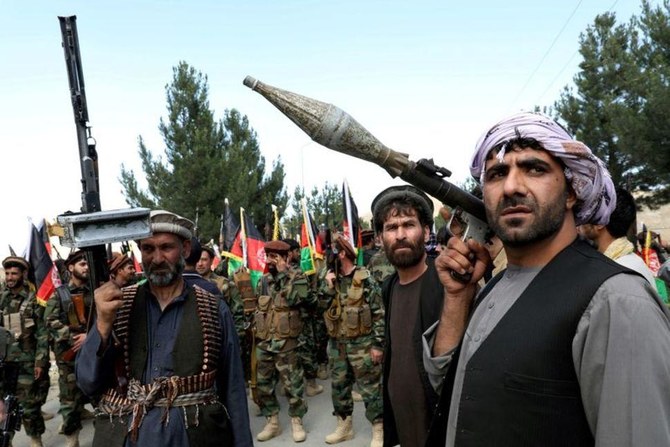
Afghan civilians take up arms as US-led forces leave

Armed men attend a gathering to announce their support for Afghan security forces and that they are ready to fight against the Taliban, on the outskirts of Kabul, Afghanistan, June 23, 2021. (Reuters)
Short Url
Updated 30 June 2021
Follow

Afghan civilians take up arms as US-led forces leave

  • Dost Mohammad Salangi: ‘If they impose war on us, oppress us and encroach on women and people’s property, even our seven-year-old children will be armed and will stand against them’
  • Faced with rising violence, President Ashraf Ghani visited Washington this month to meet Joe Biden, who pledged US support to Afghanistan but said Afghans must decide their own future

PARWAN, Afghanistan: Gun in hand, 55-year-old Dost Mohammad Salangi recites poetry as he leads a small group of men to a look-out post high in the rugged hills of Parwan province, north of the Afghan capital Kabul.
Heavily bearded and wearing a traditional circular pakol hat to keep off the sun, he has a warning for the militant Taliban movement, which has increased attacks on Afghan forces and claimed more territory as foreign troops withdraw.
“If they impose war on us, oppress us and encroach on women and people’s property, even our seven-year-old children will be armed and will stand against them,” he told Reuters.
Salangi is one of hundreds of former “mujahideen” fighters and civilians who have felt compelled to take up arms to help the army repel a growing Taliban insurgency.
The group’s ascendancy on the ground comes as the last US-led international forces prepare to leave after two decades of fighting that ended with no clear victory for either side.
“We have to protect our country ... now there is no choice as the foreign forces abandon us,” said Farid Mohammed, a young student who joined a local anti-Taliban leader from Parwan.
He was speaking as the German military concluded the withdrawal of the second largest contingent of foreign troops after the United States with around 150,000 soldiers deployed over the past two decades, many of them serving more than one tour in the country.
US President Joe Biden and NATO said in mid-April they would pull out the roughly 10,000 foreign troops still in Afghanistan by Sept. 11, the 20th anniversary of the attacks on the World Trade Center in New York that prompted the mission.
The United Nations envoy for Afghanistan said this week the Taliban had taken more than 50 of 370 districts and was positioned to control provincial capitals as the country looked increasingly unstable as foreign military support ended.
Armed mainly with old assault rifles, pistols and grenade launchers, men like Salangi and Mohammed have joined local shopkeepers and traders as part of a loosely-formed Public Uprising Force trying to reclaim some of those areas.
Ajmal Omar Shinwari, a spokesman for the Afghan defense and security forces, said Afghans keen to take up arms against the Taliban were being absorbed intro the structure of territorial army forces.
But some political analysts warn of the growing risk of a return to civil war as more groups took up arms.
Faced with rising violence, President Ashraf Ghani visited Washington in June to meet Biden, who pledged US support to Afghanistan but said Afghans must decide their own future.
Talks to try and find a political settlement in Afghanistan have stalled, although the head of the Afghan peace council has said they should not be abandoned despite the surge in Taliban attacks.


Russia puts death toll from Ukrainian strike on occupied village at 27. Kyiv rejects accusation

Updated 58 min 22 sec ago
Follow

Russia puts death toll from Ukrainian strike on occupied village at 27. Kyiv rejects accusation

  • Russia’s accusations against Ukraine come amid a US-led diplomatic push to end the nearly four-year war in Ukraine

Russian authorities said Friday that the death toll from a Ukrainian drone strike they said struck a café in a Russian-occupied village in Ukraine’s Kherson region rose to 27 people. Kyiv denied attacking civilian targets.
Svetlana Petrenko, spokeswoman of Russia’s main criminal investigation agency, the Investigative Committee, said in a statement that a Ukrainian drone strike on a café and hotel in the village of Khorly, where at least 100 civilians were celebrating New Year’s Eve overnight into Thursday, killed 27 people, including two minors. A total of 31, including five minors, were hospitalized with injuries.
A criminal probe on the charges of carrying out an act of terrorism has been opened, Petrenko said.
Kyiv denied attacking civilians. Spokesman of Ukraine’s General Staff, Dmytro Lykhovii, told Ukraine’s public broadcaster Suspilne on Thursday that Ukrainian forces “adhere to the norms of international humanitarian law” and “carry out strikes exclusively against Russian military targets, facilities of the Russian fuel and energy sector, and other lawful targets.”
Lykhovii said that General Staff has published an explicit list of targets that the Ukrainian army struck on the night of New Year’s Eve. The list did not include strikes on occupied parts of the Kherson region.
Lykhovii noted that Russia has repeatedly used disinformation and false statements to disrupt the ongoing peace negotiations.
The Associated Press could not independently verify claims made about the attack.
Russia’s accusations against Ukraine come amid a US-led diplomatic push to end the nearly four-year war in Ukraine. Earlier this week, Moscow alleged that Kyiv launched a long-range drone attack against a residence of Russian President Vladimir Putin in northwestern Russia overnight from Sunday to Monday.
Kyiv has called the allegations of an attack on Putin’s residence a ruse to derail ongoing peace negotiations, which have ramped up in recent weeks on both sides of the Atlantic.
In his New Year’s address, Ukrainian President Volodymyr Zelensky said that a peace deal was “90 percent ready” but warned that the remaining 10 percent, believed to include key sticking points such as territory, would “determine the fate of peace, the fate of Ukraine and Europe, how people will live.”
Trump’s special envoy Steve Witkoff said Wednesday that he, Secretary of State Marco Rubio and Trump’s son-in-law and adviser Jared Kushner had a “productive call” with the national security advisers of Britain, France, Germany and Ukraine “to discuss advancing the next steps in the European peace process.”
Elsewhere in Ukraine, Russia conducted what local authorities called “one of the most massive” drone attacks at Zaporizhzhia overnight.
At least nine Russian drones struck the city, damaging dozens of residential buildings and other civilian infrastructure, head of the regional administration, Ivan Fedorov, wrote on Telegram on Friday. There were no casualties, the official said.
Overall, Russia fired 116 long-range drones at Ukraine last night, according to Ukraine’s Air Force, which said that 86 drones were intercepted, while 27 more have reached their targets.
The Russian Defense Ministry reported Friday that its air defenses intercepted 64 Ukrainian drones overnight over multiple Russian regions.
Vyacheslav Gladkov, governor of Russia’s Belgorod region on the border with Ukraine, on Friday also accused Ukrainian forces of carrying out a missile strike on the city of Belgorod. Two women were hospitalized with injuries, Gladkov said. The strike shattered windows in multiple residential buildings and damaged an unspecified “commercial” facility and a number of cars, according to the official.