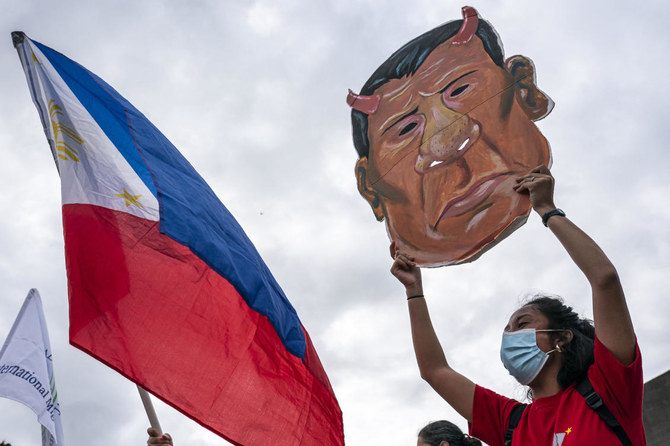
Protesters mark Philippine president’s last year in power

Riot police prevented more than 150 flag-waving protesters from approaching the presidential palace in Manila. (File/AFP)
Short Url
Updated 30 June 2021
Follow

Protesters mark Philippine president’s last year in power

  • The protesters held placards that read “Stop the killing, prosecute Duterte”
  • Duterte has denied condoning the murder of large numbers of drug suspects

MANILA: Left-wing activists and relatives of people killed in Philippine President Rodrigo Duterte’s anti-drug campaign marked the start of his last year in office Wednesday with a noisy protest and a “countdown toward achieving justice.”

Riot police prevented more than 150 flag-waving protesters from approaching the presidential palace in Manila. The demonstrators dispersed peacefully after less than an hour and police made no arrests despite a ban on such gatherings under COVID-19 restrictions.

“We count 365 days left in his reign of terror,” protest leader Renato Reyes said. “We want to mark this as a countdown toward achieving justice and accountability.”

The protesters held placards that read “Stop the killing, prosecute Duterte.” Others carried a mock coffin, while several family members displayed portraits of mostly young people they said were victims of extrajudicial killings in the drug crackdown.

Duterte’s anti-drug campaign, in which thousands of mostly petty drug suspects have died since he took office in June 2016, has alarmed human rights groups and prompted several people to file complaints with the International Criminal Court.

“My appeal to the ICC is please don’t abandon us,” said Emily Soriano, whose 15-year-old son died in the crackdown. “ICC is the only one which can hold Duterte accountable for all that he did here in the Philippines in his war on drugs.”

The International Criminal Court’s outgoing chief prosecutor said this month that a preliminary examination found reason to believe crimes against humanity had been committed during the crackdown. The prosecutor sought authorization to open a formal investigation and the court’s judges have 120 days to decide.

Duterte, a 76-year-old former mayor who made a name in politics with his extra-tough approach to crime, has denied condoning the murder of large numbers of drug suspects but has openly threatened drug dealers with death. He said suspects were killed after they violently resisted arrest, although human rights groups have reported cases of police killing unarmed suspects and then altering the crime scene to make it appear the suspects opened fire at them.

Duterte has said he would never cooperate in a possible ICC investigation.


Nigerian Muslims look to Ramadan for peace after US strikes

Updated 2 sec ago
Follow

Nigerian Muslims look to Ramadan for peace after US strikes

NIGERIA: The northern Nigerian state where the United States staged Christmas Day air strikes targeting militants is preparing for the Muslim holy month of Ramadan and trying to banish thoughts of the violence that has plagued the region.
Sokoto state is home to Sultan Muhammadu Sa’ad Abubakar, the spiritual head of Muslims in Nigeria, who typically announces the start of Ramadan in the west African country, during which Muslims fast for 29 to 30 days.
Largely spared insurgency and banditry, unlike other states, Muslim-majority Sokoto was the site of surprise US air strikes on December 25, which Nigerian authorities said targeted “two major Daesh terrorist enclaves” in the state’s Tangaza district.
The Abu Hurairah central mosque in the state capital was packed on Friday when AFP visited. Hundreds of people, including children, defied the sweltering heat to attend prayers.
With Ramadan so close, the imam emphasized brotherhood, charity and togetherness.
Several worshippers told AFP they were shocked by the US strikes, just 75 kilometers (about 47 miles) away. But they are clutching to cautious optimism that the holy month would mark the beginning of enduring peace.
“It is a new thing in this part of the country, having air strikes or bomb explosions. It only happened once, when (fellow Islamist militant group) Boko Haram was at its peak,” Ahmad Mustapha, a 37-year-old doctor, told AFP after Friday prayers.
“People are praying vehemently that the insurgency comes to an end.”
For Umaru Riskuwa, 59, the custodian of the mosque, Ramadan offers “those who take insurgency as their business” an opportunity to make “people feel peace in their heart.”

- Busy streets, bustling markets -

The city’s main market bustled on Friday afternoon as shoppers jostled through heavy traffic.
The streets remained busy at 8:00 pm, with many shops and businesses still open.
Elsewhere in the city, religious leaders gathered at a government-hosted one-day “capacity-building” workshop ahead of the fasting.
Some researchers have linked some members of the armed group known as Lakurawa — the main militant group located in Sokoto state — to Islamic State Sahel Province (ISSP), but other analysts have disputed the links.
“Hopefully, people are going to do Ramadan in a peaceful way,” said Aminu Muhammad, a 43-year-old trader at the Sokoto Central Market. “Things are going normal. We don’t expect any evil thing to happen.”
State governor Ahmad Aliyu Sokoto said last week the government had distributed bags of maize and cash support to 1,000 people ahead of Ramadan. He vowed “continuous food and cash support” for “families affected by banditry” — the word commonly used for the violence racking the region.
With more than nine in 10 people in the region living below the poverty line in 2022, according to the National Bureau of Statistics, the effort may be only a drop in the bucket.