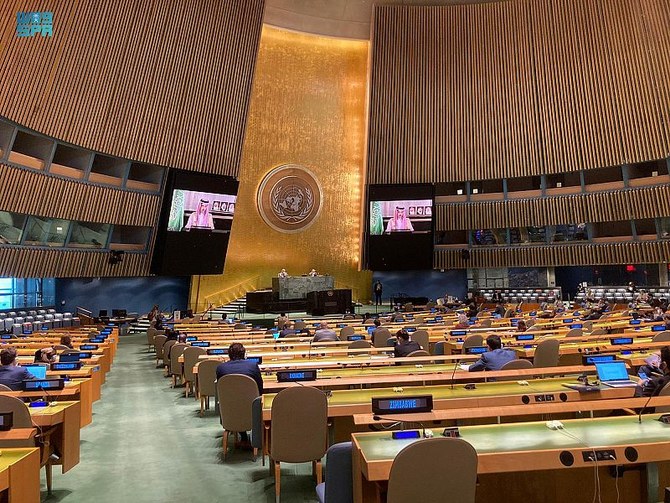
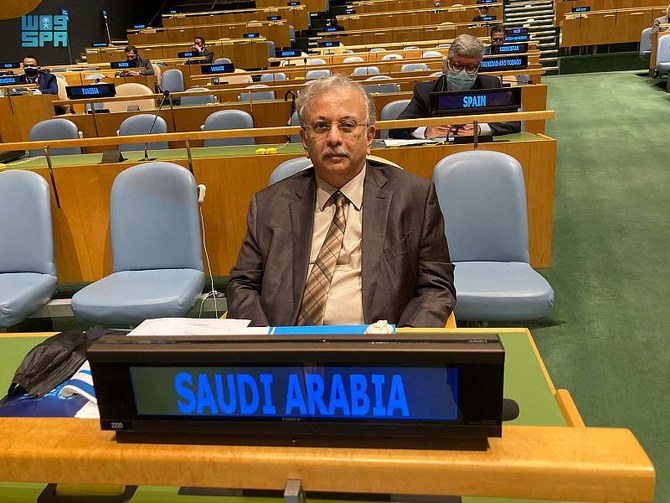
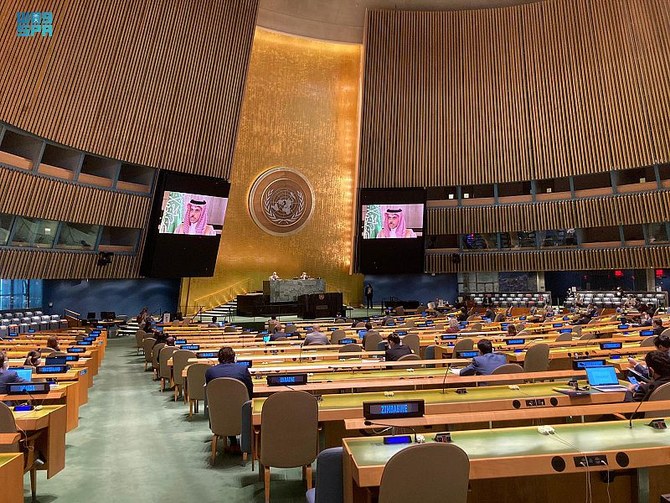


NEW YORK: Saudi Arabia condemns terrorism in all its forms, Saudi Foreign Minister Prince Faisal bin Farhan told the UN on Monday.
At the second UN High Level Conference of Heads of Counter Terrorism Agencies of Member States, Bin Farhan called on all member states and international and regional organizations to come together and implement the UN Global Counter-Terrorism strategy in the face of this “persistent challenge to international peace and security.”
The UN Counter-Terrorism Centre (UNCCT), of which Saudi Arabia is a founding nation, is celebrating its tenth anniversary and Bin Farhan told participants that the center remains a vital and supportive partner of the UN system in combating terrorism.
Saudi Arabia pays particular attention to the financing of terrorism, Bin Farhan said. For that, the Kingdom has ratified a number of bilateral, regional and international agreements and stepped up international legal cooperation in criminal matters related to terrorism and its financing.
This year’s conference theme, “Countering and Preventing Terrorism in the Age of Transformative Technologies,” highlights the fact that the threat of terrorism has evolved with technology, but also, as US Ambassador to the UN Linda Thomas-Greenfield put it, provides the opportunity to harness technology to counter terrorism and prevent violent extremism from taking root in communities.
“Terrorists (have) adapted,” said Thomas-Greenfield. “They use communication technology to enhance their networks, recruit and inspire supporters, disseminate propaganda, and challenge our ability to prevent acts of terrorism. (Increasingly) they’re using advanced technology to actually perpetrate criminal acts.”
The American envoy called for a new strategy that keeps up with the evolving landscape of terrorism.
Bin Farhan said that his country’s counter-terrorism approach goes beyond conventional measures to include countering terrorist cybercrime through “legal and technological” means.
“The National Cybersecurity Authority and the Intellectual Warfare Center are examples of national institutions established to address the root causes of extremism and terrorism, as well as the Global Center for Combating Extremist Ideology, which counters extremist ideologies using new and innovative methods including by analyzing extremist narratives,” he said.
The Saudi foreign minister also highlighted the memorandum of understanding (MoU) signed in April 2021 between the Global Center for Combating Extremist Ideology and the UNCCT which “shows the Kingdom’s commitment to supporting the international community’s effort in fighting the scourge of terrorism.
“Under the MoU the two centers will launch joint projects focused on capacity building, countering the use of internet for terrorist purposes, raising awareness among youth, promoting tolerance and supporting the victims of terrorism,” he said.
Bin Farhan also underscored his country’s attachment to the promotion of a culture of peace and dialogue. A case in point is the recent signing of an MoU between King Abdullah Bin Abdul Aziz International Center for Interreligious and Intercultural dialogue and the UN Alliance for Civilization.
Bin Farhan told the participants, which included the UN Secretary-General Antonio Guterres and the president of the General Assembly, Volkan Bozkir, that although the Kingdom has suffered from terrorist attacks, it has managed to “drastically degrade and defeat these terrorists.
“We have taken numerous counter measures at the national, regional and international levels and upheld international law and relevant resolutions on prohibiting actions such as committing, financing, inciting and participating in terrorist acts.
“We have also complied with all resolutions and decisions of international counter terrorism agencies.”
He called on member states to couple their access to counter-terrorism instruments with a “genuine desire to combat and eliminate this phenomenon,” and to devote more effort to the first pillar of the strategy: “Most importantly to education, development, justice and the rule of law, given their contributions to eliminating the root causes of the problem.”
He also stressed that a distinction must be made between terrorism on one hand and the right of people to self-determination, sovereignty and resisting foreign occupation on the other.
“Condemning terrorism must go as far as condemning terrorism committed by states,” he said.
Thomas-Greenfield warned that as the world’s counter-terrorism approach evolves, “we cannot waver on human rights and free expression. Because ultimately, our steadfast commitment to those rights and freedoms are our most powerful counter-terrorism tool of all.”
Guterres said that some progress has been made in the fight against terrorism but such progress has been “slow and not comprehensive.
“Years of increasing polarization, governance failures, and a normalization of hate speech have benefitted terrorist groups,” Guterres said.
“The threat stemming from white supremacist, neo-Nazi and other ethnically or racially-motivated movements is increasingly transnational.
“It is also clear that terrorist groups will exploit hardships and inequalities related to the coronavirus disease pandemic.”
Guterres urged the international community to establish and strengthen “strong, just, and accountable institutions” as a pre-requisite to deny terrorists the space to operate, bring them to justice, and provide safety for the population.
To break the cycle of violence, Guterres called for the rehabilitation and reintegration of terrorists after serving their sentences. The secretary-general also called for a “human-rights reset” for counter-terrorism to avoid the latter being used to “infringe upon the rights and freedoms of people, the result (of which) is more alienation within communities and stronger terrorist
narratives.
He finally told member states that they bear “the ultimate responsibility to prevent technologies from falling into terrorist hands,” where social media is already being used to foster hate speech and violent ideologies, blockchain and ransomware to fund terrorists, commercial drones and 3-D printing to access weapons, and deep-fakes to stoke conspiracy theories peddled by terrorists.