

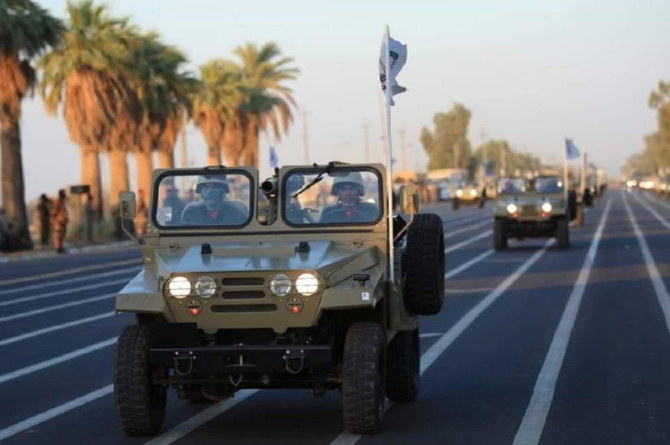

BAGHDAD: Thousands of Iran-backed militants in Iraq staged a show of strength on Saturday with a parade of fighters and military equipment including tanks and rocket launchers.
The event at a former US military base in Diyala province east of Baghdad, near the Iran border, marked seven years since the Hashd Al-Sha’abi were formed to fight Daesh.
Prime Minister Mustafa Al-Kadhimi, flanked by militia commanders, watched as hundreds of armored vehicles drove past a banner honoring Abu Mahdi Al-Muhandis, a paramilitary chief who was killed in a US drone strike last year.
“I esteem your sacrifices, and the sacrifices of the Iraqi armed forces,” Kadhimi said, but he warned against “sedition” within the ranks of the paramilitaries.
Hours before the parade, three explosives-laden drones targeted the northern city of Irbil in Iraqi Kurdistan. Two drones damaged a house, while the explosives on the third failed to detonate. The US condemned the attack, which it said was “a clear violation of Iraqi sovereignty.”
US targets in Iraq have come under repeated attack by the Hashd Al-Sha’abi in recent months, but the use of drones is relatively new. Since the start of the year there have been 43 attacks against US interests in Iraq, where 2,500 American troops are deployed as part of an international coalition to fight Daesh.
HIGHLIGHTS
Hours before the parade, three explosives-laden drones hit the northern city of Irbil.
Two drones damaged a house, while the explosives on the third failed to detonate.
The US condemned the attack, which it said was ‘a clear violation of Iraqi sovereignty.’
Most have been bombs against logistics convoys, while 14 were rocket attacks claimed by pro-Iran militias that aim to pressure the US into withdrawing all its troops.
In April, a drone packed with explosives hit the coalition’s Iraq headquarters in the military part of the airport in Irbil, the Iraqi Kurdish regional capital. The new tactic poses a headache for the coalition, as drones can evade air defenses.
In May a drone packed with explosives hit the Ain Al-Asad air base housing US troops. On June 9 three explosives-laden drones targeted Baghdad airport, where US soldiers are also deployed. One was intercepted by the Iraqi Army.
Earlier that day five rockets were fired at Balad air base, where US contractors are based, causing no casualties or damage.
Iraq's People's Mobilization Forces (PMF) is a state-sanctioned umbrella organization of mostly Shiite militias backed by Iran, but also include Sunni Muslim, Christian, and Yazidi groups.
The PMF was created when the influential Shiite cleric Ali Al-Sistani urged all able-bodied Iraqis to take up arms against Daesh, which had taken over a third of Iraq.
Since Daesh’s defeat in 2017 the Hashd Al-Sha’abi, the biggest of the PMF groups, have expanded their military, political and economic power and attacked bases housing the 2,500 remaining US forces in Iraq.
They have allies in parliament and government and a grip over some state bodies, including security institutions.
Those factions are also accused of killing protesters who took to the streets in late 2019 demanding the removal of Iraq’s ruling elite. The groups deny involvement in activist killings.
Kadhimi, a US-friendly interim premier, has tried to crack down on the most powerful Iran-backed factions but without success because of their military strength and political influence.
The membership of Iran-aligned groups in the PMF has made it difficult for Kadhimi and state security forces to check the power of the militias, since they are effectively part of the state itself.
(With Reuters)


