

Pakistan calls for international attention to illegal uranium sales in India

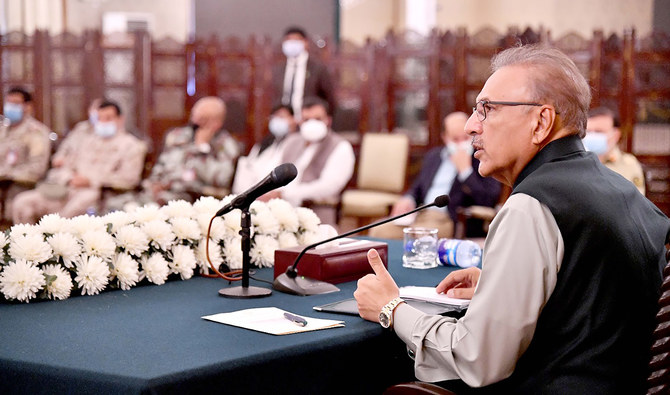
Pakistan's president Arif Alvi speaks during a session with military officers from 12 countries who were attending a security workshop by the National Defense University in Islamabad on June 25, 2021. (Photo courtesy: @PresOfPakistan/Twitter)
Short Url
Updated 26 June 2021
Follow

Pakistan calls for international attention to illegal uranium sales in India

  • Since May, at least 13 kilograms of uranium worth millions of dollars were seized by Indian law enforcers
  • In early June, Pakistan called for a probe into illegal possession and sales of nuclear materials in India

ISLAMABAD: Pakistan President Arif Alvi on Friday called for international attention to illegal uranium sales in India after a number of recent incidents in which kilograms of the nuclear material were seized by Indian authorities.

Since early May, at least 13 kilograms of uranium worth millions of dollars were seized by law enforcers in the western Indian state of Maharashtra and in the eastern state of Jharkhand.

Pakistan has since expressed its "deep concern" over the incidents and called for a thorough investigation.

"International community should take serious note of illegal sale of uranium on black market in India," President Alvi said during a session with military officers from 12 countries who were attending a security workshop by the National Defense University in Islamabad.

"Radioactive substances in the wrong hands can endanger human lives and the security of nations," Alvi said, as quoted by his office.


On June 4, after the uranium incident in Jharkhand, Pakistan's foreign office said such incidents "point to lax controls, poor regulatory and enforcement mechanisms, as well as possible existence of a black market for nuclear materials inside India."

It also called for a probe over the security of nuclear materials in India to "prevent their diversion."

"It is equally important to ascertain the intent and ultimate user of the attempted uranium sale given its relevance to international peace and security as well as the sanctity of global non-proliferation regime."

"The United Nations Security Council Resolution 1540 and the IAEA Convention on the Physical Protection of Nuclear Material (CPPNM) make it binding on states to ensure stringent measures to prevent nuclear material from falling into wrong hands."
 
The UN resolution regarding the non-proliferation of weapons of mass destruction was adopted unanimously in 2004.

The IAEA convention, ratified by both Pakistan and India, establishes legal obligations for parties regarding the physical protection of nuclear material. It criminalizes offences related to illicit trafficking and sabotage of nuclear material.


Pakistan, China discuss $2.2 billion maritime industrial complex at Port Qasim

Updated 12 sec ago
Follow

Pakistan, China discuss $2.2 billion maritime industrial complex at Port Qasim

  • The proposal aligns with Pakistan’s push to modernize port infrastructure and link Central Asian trade routes to sea lanes
  • The project may include shipbuilding, shipbreaking and a port-linked steel mill, as authorities streamline port operations

KARACHI: Pakistan and China discussed plans for a large maritime industrial complex at Port Qasim involving up to €2 billion ($2.2 billion) in investment on Thursday, as Islamabad seeks to modernize its ports and position itself as a regional trade and logistics hub, a government statement said.

The proposal comes as Pakistan looks to upgrade port infrastructure to handle higher trade volumes and improve connectivity between sea lanes and landlocked Central Asian states, leveraging its geographic position at the crossroads of South and Central Asia. The effort aligns with the multibillion-dollar China-Pakistan Economic Corridor (CPEC), which has underpinned Chinese investment in Pakistan’s energy, transport and infrastructure sectors with the aim of boosting regional connectivity.

The project was discussed during a meeting between a delegation from China’s Shandong Zinxu Group and Pakistan’s Minister for Maritime Affairs Junaid Anwar Chaudhry, according to the statement.

“Proposal for a comprehensive maritime industrial complex at Port Qasim was reviewed during the meeting,” Chaudhry said in a statement circulated after the talks.

“The proposed project could involve investment of €1–2 billion,” he added.

Chaudhry said the project under discussion could include the establishment of shipbuilding and shipbreaking facilities, as well as a modern, port-linked steel mill aimed at reducing Pakistan’s reliance on imported steel.

He added that the revival of the steel jetty at Port Qasim would be critical for the project’s viability.

The minister said employment generation, value addition and environmental considerations would be prioritized as part of the proposed investment, which, if approved, could rank among Pakistan’s largest industrial projects.

Pakistan has in recent months stepped up efforts to streamline port operations, including the introduction of artificial intelligence-based technologies to improve efficiency, reduce congestion and speed up cargo handling.

Only a day earlier, the maritime affairs minister met a delegation from Pakistan’s Ministry of Railways to discuss plans to establish a railway station and modern storage facilities at Port Qasim, aimed at improving logistics and cargo movement to and from the port.