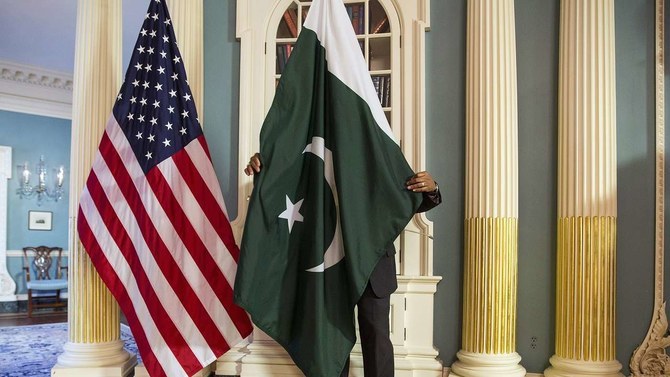
ISLAMABAD: Pakistan reiterated its commitment to a broad-based and long-term bilateral relationship with the United States on Friday, pointing out that “structured engagement” between the two countries was essential to achieve their shared objectives of peace and development in the region.
According to an official statement circulated by the foreign office in Islamabad, Pakistan’s Foreign Secretary Sohail Mahmood made the observations after receiving a phone call from US Under Secretary of State for Political Affairs Ambassador Victoria Nuland.
The statement added that the foreign secretary maintained there was no military solution to the conflict in Afghanistan and reaffirmed his country’s support to the Afghan peace process.
“He stressed that there was a fundamental convergence between Pakistan and the United States on the need for a peaceful settlement in Afghanistan,” said the official statement. “The Foreign Secretary underscored the urgency of accelerating intra-Afghan peace negotiations and the importance of a responsible withdrawal of foreign forces from Afghanistan.”
The senior Pakistani official also noted it was essential for key regional and international stakeholders to press all Afghan parties “to engage constructively toward achieving an inclusive, broad-based and comprehensive political settlement.”
Pakistan’s Prime Minister Imran Khan told a leading US publication in a recent interview that his country played a pivotal role in convincing the Taliban to talk to the United States and the administration in Kabul.
However, US President Joe Biden has not made contact with him since he took over the top political office in his country in January.
Biden has already held a meeting with Afghan President Ashraf Ghani in Washington.
The Pakistani prime minister recently refused to lend military bases to the United States to monitor the situation in Afghanistan and launch limited aerial incursions in that country after the withdrawal of its forces.
The country’s national security adviser Moeed Yusuf wished Washington “good luck” during an interview with a local news channel if it thought it did not need to engage with Islamabad at a critical juncture when it was pulling out its troops from Afghanistan.
However, officials in Islamabad have expressed interest in a continued economic engagement with the US.
The foreign secretary also emphasized the idea of further strengthening trade relations between the two countries.
“Underlining Pakistan’s focus on geo-economics, the Foreign Secretary reiterated the importance of enhancing economic, trade and investment ties between Pakistan and the United States,” the statement added. “He highlighted the progress made by the Government in improving the ease of doing business and promoting a more conducive environment for foreign investment in Pakistan.”
The two officials agreed to “maintain close coordination on all matters of common interest.”


Pakistan advocates ‘structured engagement’ with United States for peace and development
https://arab.news/c2z3b
Pakistan advocates ‘structured engagement’ with United States for peace and development

- The country’s foreign secretary emphasizes a responsible withdrawal of foreign forces from Afghanistan while talking to a top US official
- US President Joe Biden has not made contact with Prime Minister Imran Khan since taking over the top political office in his country

Pakistan launches second indigenous EO-2 satellite from China, SUPARCO says
- Earth observation satellite launched from Yangjiang Seashore Launch Center in China
- EO-2 to enhance disaster response, governance, resource management capabilities
KARACHI: Pakistan has successfully launched its second indigenous Earth Observation satellite, EO-2, from China’s Yangjiang Seashore Launch Center, the national space agency SUPARCO said on Thursday.
The launch marks a significant step in Pakistan’s efforts to strengthen its domestic space and remote sensing capabilities, with the satellite expected to improve imaging continuity, disaster monitoring, agricultural planning and strategic resource management.
In a statement, Pakistan’s SUPARCO said the EO-2 satellite would enhance the country’s earth observation and imaging capabilities and support governance and planning functions across multiple sectors.
“Pakistan’s second indigenous EO-2 satellite has been successfully launched,” SUPARCO said, adding that the mission represents a “milestone” in the expansion of the country’s satellite fleet.
According to the agency, EO-2 will provide critical data for planning and resource management while improving the continuity and accuracy of national earth observation systems.
The satellite is expected to support disaster management, urban planning, environmental monitoring and infrastructure development by supplying updated geospatial imagery and data.
SUPARCO said the launch demonstrates growing indigenous capability in satellite development and reflects Pakistan’s broader objective of strengthening its national space program through locally developed platforms.
Pakistan has gradually expanded its space cooperation with China in recent years, including satellite launches and joint missions, as Islamabad seeks to build technical capacity and reduce reliance on external data sources.
The EO-2 satellite is expected to play a key role in improving data availability for federal and provincial authorities, particularly in areas vulnerable to floods, climate stress and rapid urbanization.


