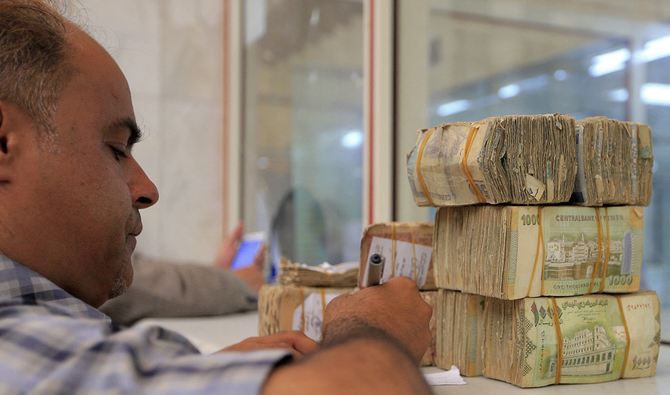

ALEXANDRIA: Yemen’s currency on Thursday reached a new low after the Iran-backed Houthi militia renewed its ban on banknotes printed by the Yemeni government and banned people from moving cash from government-controlled areas to their territories, Yemeni officials and economists said.
Local currency dealers said the Yemeni riyal traded at 940 against the US dollar in the black market on Thursday compared to 930 last week, shortly after the Houthi-controlled Central Bank in Sanaa circulated an order that warned people against using new money that looks like the old banknotes available in their territories.
To evade the Houthi ban and address the shortage of cash in the market, the Aden-based Central Bank of Yemen has recently pumped into the market billions of large 1,000-riyal banknotes similar to the banknotes used by the Houthis.
Local media reported that the Houthis stepped up security at their checkpoints, searching for the new banknotes.
On Thursday, Hamed Rezq, a journalist loyal to the Houthis, accused the US of launching an economic war on the Yemeni economy by allowing printing and circulating new banknotes.
“This is part of the US economic war on Yemen after Washington ran out of military options and (its) deception and political pressures have failed,” he tweeted.
In December 2019, the Houthis banned the use of banknotes printed by the legitimate and internationally recognized government, giving residents a month to hand over their cash or face punishment.
The Houthi decision sparked outrage across Yemen, pushed up transfer charges from government-controlled areas to Houthi-ruled areas, and led to a halt in the payment of salaries to thousands of public servants.
Travelers from government-controlled areas to Sanaa told Arab News that they were forced into buying Saudi riyals or exchanging the new banknotes with old ones at inflated prices.
Economists are now warning that the Houthis will use the latest measures to snoop into exchange firms and people’s lives.
“This step will allow the Houthi group to interfere more in the work of banks, exchange companies and even ordinary citizens. Using its security grip, the group will find a justification for confiscating money and interfering in people's privacy in search of ‘fake currency’ as it describes it,” Mustafa Nasr, director of the Economic Media Center, said.
He added that the current economic war between the legitimate government and the Houthis would have implications on the country’s troubled economy and people’s lives.
Nasr also criticized the Yemeni government for printing money without coverage and its loose grip on the exchange market in the liberated provinces.
“The injection of the new cash by the Central Bank aggravates the problem in terms of inflation and it weakens the currency,” he said, advising the government to increase revenues and curb speculative activities by local money dealers in areas under its control.
“The fall of the riyal in areas under the control of the legitimate government is caused by currency speculation and corruption, not due to a real demand for currency,” Nasr said.