

Yemeni riyal drops as Houthis renew ban on new banknotes

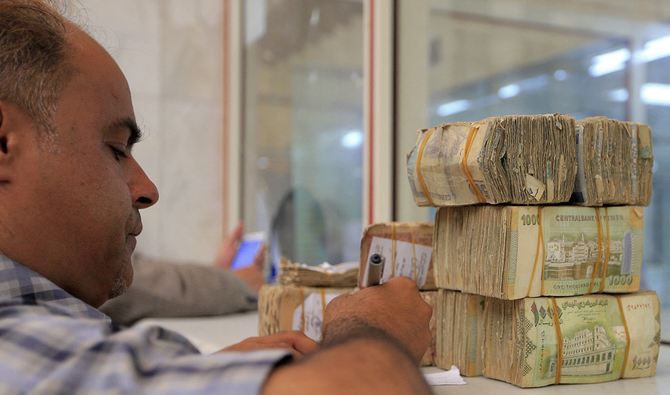
An employee of Yemen's Central Bank writes a note next to stacks of Yemeni currency at the bank headquarters in Sanaa on June 23, 2021. (AFP)
Short Url
Updated 24 June 2021
Follow

Yemeni riyal drops as Houthis renew ban on new banknotes

  • Economists are now warning that the Houthis will use the latest measures to snoop into exchange firms and people’s lives

ALEXANDRIA: Yemen’s currency on Thursday reached a new low after the Iran-backed Houthi militia renewed its ban on banknotes printed by the Yemeni government and banned people from moving cash from government-controlled areas to their territories, Yemeni officials and economists said.

Local currency dealers said the Yemeni riyal traded at 940 against the US dollar in the black market on Thursday compared to 930 last week, shortly after the Houthi-controlled Central Bank in Sanaa circulated an order that warned people against using new money that looks like the old banknotes available in their territories.

To evade the Houthi ban and address the shortage of cash in the market, the Aden-based Central Bank of Yemen has recently pumped into the market billions of large 1,000-riyal banknotes similar to the banknotes used by the Houthis.

Local media reported that the Houthis stepped up security at their checkpoints, searching for the new banknotes.

On Thursday, Hamed Rezq, a journalist loyal to the Houthis, accused the US of launching an economic war on the Yemeni economy by allowing printing and circulating new banknotes.

“This is part of the US economic war on Yemen after Washington ran out of military options and (its) deception and political pressures have failed,” he tweeted. 
In December 2019, the Houthis banned the use of banknotes printed by the legitimate and internationally recognized government, giving residents a month to hand over their cash or face punishment.

The Houthi decision sparked outrage across Yemen, pushed up transfer charges from government-controlled areas to Houthi-ruled areas, and led to a halt in the payment of salaries to thousands of public servants.

Travelers from government-controlled areas to Sanaa told Arab News that they were forced into buying Saudi riyals or exchanging the new banknotes with old ones at inflated prices.

Economists are now warning that the Houthis will use the latest measures to snoop into exchange firms and people’s lives.

“This step will allow the Houthi group to interfere more in the work of banks, exchange companies and even ordinary citizens. Using its security grip, the group will find a justification for confiscating money and interfering in people's privacy in search of ‘fake currency’ as it describes it,” Mustafa Nasr, director of the Economic Media Center, said.

He added that the current economic war between the legitimate government and the Houthis would have implications on the country’s troubled economy and people’s lives.

Nasr also criticized the Yemeni government for printing money without coverage and its loose grip on the exchange market in the liberated provinces.

“The injection of the new cash by the Central Bank aggravates the problem in terms of inflation and it weakens the currency,” he said, advising the government to increase revenues and curb speculative activities by local money dealers in areas under its control.

“The fall of the riyal in areas under the control of the legitimate government is caused by currency speculation and corruption, not due to a real demand for currency,” Nasr said.


Closing Bell: Saudi benchmark index closes lower at 10,540 

Updated 24 December 2025
Follow

Closing Bell: Saudi benchmark index closes lower at 10,540 

RIYADH: Saudi equities ended Wednesday’s session lower, with the Tadawul All Share Index falling 55.13 points, or 0.52 percent, to close at 10,540.72. 

The sell-off was mirrored across other indices, with the MSCI Tadawul 30 Index retreating 5.79 points, or 0.41 percent, to close at 1,393.32, while the parallel market Nomu slipped 74.56 points, or 0.32 percent, to 23,193.21.  

Market breadth remained firmly negative, as decliners outpaced advancers, with 207 stocks ending the session lower against just 51 gainers on the main market. 

Trading activity moderated compared to recent sessions, with volumes reaching 123.5 million shares, while total traded value stood at SR2.72 billion ($725.2 million). 

On the sectoral and stock level, Al Moammar Information Systems Co. led the gainers after surging 9.96 percent to close at SR172.30, extending its rally following a series of contract announcements tied to data center and IT infrastructure projects.  

Al Masar Al Shamil Education Co. climbed 4.89 percent to SR27.48, while Naqi Water Co. advanced 3.36 percent to SR58.50. Al Yamamah Steel Industries Co. and Al-Jouf Agricultural Development Co. also posted solid gains, rising 3 percent and 2.86 percent, respectively. 

Losses, however, were concentrated in industrial names. Saudi Kayan Petrochemical Co. fell 3.67 percent to SR4.73, while Makkah Construction and Development Co. slid 3.44 percent to SR80.  

Saudi Tadawul Group Holding Co. retreated 3.28 percent to SR147.50, weighed down by broader market weakness, and Saudi Cable Co. declined 3.18 percent to SR143.  

Alkhaleej Training and Education Co. rounded out the top losers, shedding just over 3 percent. 

On the announcement front, BinDawood Holding announced the signing of a share purchase agreement to acquire 51 percent of Wonder Bakery LLC in the UAE for 96.9 million dirhams, marking a strategic expansion of its food manufacturing footprint beyond Saudi Arabia.   

The acquisition, which remains subject to regulatory approvals, is expected to support the group’s regional growth ambitions and strengthen supply chain integration.  

BinDawood shares closed at SR4.68, up 0.43 percent, reflecting a positive market reaction to the overseas expansion move.  

Meanwhile, Al Moammar Information Systems disclosed the contract sign-off for the renewal of IT systems support licenses with the Saudi Central Bank, valued at SR114.4 million, inclusive of VAT.   

The 36-month contract is expected to have a positive financial impact starting from fourth quarter of 2025, reinforcing MIS’s position as a key technology partner for critical government institutions. The stock surged to the session’s limit making it the top gainer. 

In a separate disclosure, Maharah Human Resources confirmed the completion of the sale of its entire stake in Care Shield Holding Co. through its subsidiary, Growth Avenue Investments, for a total consideration of SR434.3 million.  

The transaction involved the transfer of 41.36 percent of Care Shield’s share capital to Dallah Healthcare, with Maharah receiving the full cash proceeds.  

Despite the strategic divestment, Maharah shares closed lower, ending the session at SR6.12, down 1.29 percent.