

Egypt retrieves 114 smuggled antiquities from France

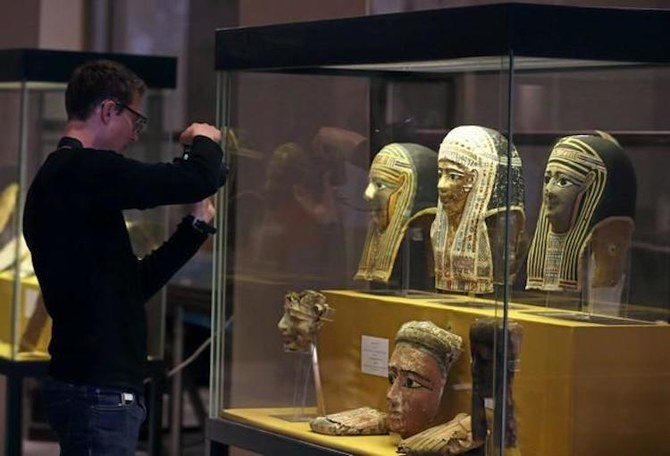
A visitor takes a photo of ancient artifacts, returned by Italy, at the Egyptian Museum in Cairo, Egypt, July 4, 2018. (Reuters)
Short Url
Updated 24 June 2021
Follow

Egypt retrieves 114 smuggled antiquities from France

  • Antiquities retrieved following joint investigations by the Egyptian Public Prosecution office and French judicial authorities
  • Alaa Yousef, Egypt’s ambassador to France, praised the collaboration, describing it as an achievement that added to the record of Egyptian-French bilateral relations

CAIRO: Egyptian officials have retrieved 114 looted antiquities smuggled to France following joint investigations by the Egyptian Public Prosecution office and French judicial authorities.

Heading a high-level delegation, Hamada Al-Sawy, Egypt’s public prosecutor, arrived in Paris on Tuesday and visited the Egyptian Embassy, along with Mostafa Waziri, secretary-general of the Supreme Council of Antiquities, to resume the retrieval process and halt any attempts to sell the artefacts.

The officials took inventory of the recovered items in preparation for the transfer to Cairo, the Egyptian prosecution said on Wednesday.

The pieces were transferred to the embassy and unpacked with the help of the French Interior Ministry.

Al-Sawy said the public prosecution office is following a plan within the framework of Egypt’s strategy to recover its smuggled antiquities and preserve their history.

He highlighted the need for Cairo and Paris to exchange information on criminal investigation techniques and new technologies in fighting crime.

Al-Sawy also detailed the effective cooperation between all stakeholders in combating organized and transnational crimes, terrorism, money laundering, antiquities smuggling, human trafficking and violence against women.

Alaa Yousef, Egypt’s ambassador to France, praised the collaboration, describing it as an achievement that added to the record of Egyptian-French bilateral relations.

Both countries’ relations have strengthened in several areas over recent years, he added.


Hezbollah accepts resignation of senior security official Wafiq Safa amid restructuring

Updated 4 sec ago
Follow

Hezbollah accepts resignation of senior security official Wafiq Safa amid restructuring

  • Safa survived an Israeli assassination attempt in October 2024
  • A source said “the resignation and its acceptance were part of an internal restructuring move“

BEIRUT: Lebanon’s Hezbollah accepted the resignation of senior security official Wafiq Safa on Friday, the first time an official of his rank has stepped down, sources familiar with the group’s thinking told Reuters.
Safa, who heads Hezbollah’s liaison and coordination unit responsible for working with Lebanese security agencies, survived an Israeli assassination attempt in October 2024.
A source said “the resignation and its acceptance were part of an internal restructuring move” ⁠following losses Hezbollah sustained in last year’s war with Israel, adding that southern commander Hussein Abdullah was appointed to replace Safa.
Israel and Lebanon agreed to a US-brokered ceasefire in 2024 to end more than a year of cross-border fire between Israel and Hezbollah, ⁠which had culminated in Israeli strikes that severely weakened the Iran-backed militant group. Since then, the sides have traded accusations of ceasefire violations.
Lebanon has faced growing pressure from the US and Israel to disarm Hezbollah, and its leaders fear that Israel could dramatically escalate strikes across the battered country to push Lebanon’s leaders to confiscate Hezbollah’s arsenal more quickly.
Hezbollah has fought numerous conflicts with Israel since ⁠it was founded by Iran’s Revolutionary Guards in 1982. It kept its arms after the end of Lebanon’s 1975-1990 civil war, using them against Israeli troops who occupied the south until 2000.
Safa, whom Middle East media reports said was born in 1960, oversaw negotiations that led to a 2008 deal in which Hezbollah exchanged the bodies of Israeli soldiers captured in 2006 for Lebanese prisoners in Israel. The 2006 incident triggered a 34-day war with Israel.