Shahid Afridi hopes for Multan victory but says Peshawar ‘strongest’ PSL team

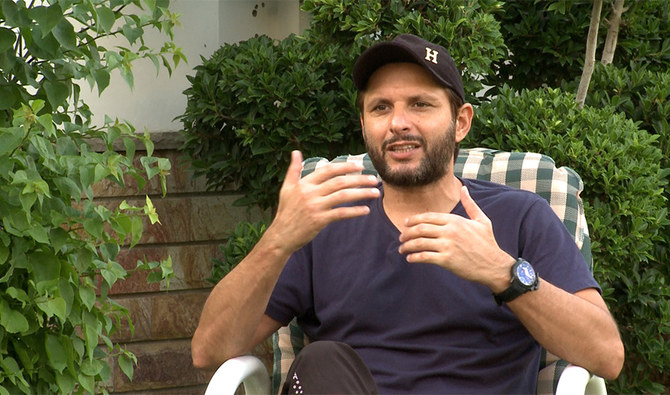
Shahid Afridi gestures during an exclusive interview with Arab News in Karachi on Sept 24 2020. (AN Photo)
Short Url
Updated 24 June 2021
Follow

Shahid Afridi hopes for Multan victory but says Peshawar ‘strongest’ PSL team

  • Zalmi won the PSL champions title in 2017 and was the runner-up in the 2018 and 2019 editions
  • Afridi says Multan had a rocky start but improved performance, team pacer Shahnawaz Dahani excellent addition to squad

KARACHI: Pakistan’s former cricket captain Shahid Khan Afridi has said his T20 squad, the Multan Sultans, was capable of lifting this year’s Pakistan Super League trophy but Peshawar Zalmi was the “strongest” side in the ongoing tournament in Abu Dhabi.
Peshawar Zalmi will play its fourth Pakistan Super League final today, Thursday, after a thumping eight-wicket victory over Islamabad United in the playoffs on Tuesday. Zalmi won the PSL champions title in 2017 and was the runner-up in the 2018 and 2019 editions. United has won the tournament twice.
Afridi could not join his team during the PSL playoffs in Abu Dhabi this month due to a back injury.
“I believe if Multan Sultans continues with its [current] form, it can win,” Afridi told Arab News in an interview on Tuesday. “But the combination of Peshawar is excellent when we see their bowling and batting. So in my view, the strongest team [in this tournament] is Peshawar.”
“It’s a matter of happiness that my team [Multan] has qualified for the finals, and I extend congratulations to the entire squad, especially [captain Muhammad] Rizwan,” he said.
Afridi said Multan did not have a good start in this year’s series but significantly improved its performance, which helped it qualify for the final. He said the team’s pacer Shahnawaz Dahani, who hails from a remote town in Pakistan’s Sindh province, was an excellent addition to the squad, saying his performance reflected there was immense hidden talent in the rural areas of the province.
“I am happy that a player has come from Larkana,” the all-rounder said. “We see few players [from rural Sindh]. Most of the players come from big cities. So, the presence of such talent means there is ample flair for cricket out there, but we need to provide requisite facilities to the [rural] areas [to explore the latent talent].”
Afridi also congratulated the Pakistan Cricket Board, PSL franchise owners and players for the successful completion of the T20 tournament, which had to be posted in March due to COVID-19 cases among players and officials, but was resumed this month in the UAE.
“It’s very difficult to reschedule any tournament after it has been postponed once,” he said. “The PSL is a big tournament, and I would like to give credit to the PCB, owners of all franchises and players since they came out of a difficult situation and the tournament is being concluded in such an excellent way. So, the credit goes to all.”


Pakistan approves first national gemstones policy, targets $1 billion exports

Updated 7 sec ago
Follow

Pakistan approves first national gemstones policy, targets $1 billion exports

  • Government seeks to overhaul certification, mining, processing to curb smuggling and boost value-added exports
  • Move follows broader push to tap Pakistan’s vast mineral wealth and attract much-needed foreign investment

ISLAMABAD: Pakistan has granted in-principle approval to its first national policy framework for gemstones and precious stones, aiming to reform the sector, align it with international standards and lift annual exports to $1 billion within five years, the prime minister’s office said on Friday.

The decision was taken during a meeting chaired by Prime Minister Shehbaz Sharif, which reviewed reforms for the largely underdeveloped gemstones sector despite Pakistan holding significant reserves of emeralds, rubies, sapphires, peridot and topaz.

The move comes as Pakistan intensifies efforts to monetize its untapped mineral resources amid fiscal pressures and an IMF-backed reform program. Over the past two years, Islamabad has hosted international minerals conferences and signed cooperation agreements with countries including the United States, Saudi Arabia and China to improve governance, attract foreign investment and move up the value chain in mining and minerals processing.

Despite officials estimating Pakistan’s gemstone reserves at around $450 billion, formal exports remain negligible, at about $5.8 million annually, due to weak certification systems, limited domestic processing capacity, widespread smuggling and fragmented regulation across federal and provincial authorities.

“Sharif has granted in-principle approval to a national policy framework to reform Pakistan’s gemstones and precious stones sector and align it with international standards,” the PM’s office said in a statement. 

“The Ministry of Industries and Commerce, after identifying challenges during the preparation of the national policy framework, has developed a comprehensive set of priority policy measures which aim to achieve $1 billion in gemstone-related exports within five years through sectoral reforms.”

According to the statement, the policy framework includes geological mapping to accurately assess reserves, the establishment of internationally accredited laboratories and certification regimes and the creation of a dedicated authority to regulate and promote the sector. The government also plans to set up a National Warranty Office and at least two centers of excellence this year to support training, research and value-added processing.

The policy prioritizes private sector participation, particularly encouraging young entrepreneurs, and seeks to shift Pakistan away from exporting raw stones toward domestic cutting, polishing and branding. The statement said this approach could significantly increase export earnings while generating skilled jobs.

The prime minister also directed the ministry of finance to ensure timely allocation of financial resources required to implement the reforms and stressed the need to involve provincial governments, industry stakeholders and international experts to address structural bottlenecks.

“Pakistani precious stones are renowned globally for their quality, and curbing smuggling while ensuring exports through legal channels will secure billions of dollars in foreign exchange,” the prime minister said, according to the statement.