BARCELONA: Spain’s government granted pardons on Tuesday to the nine imprisoned instigators of an illegal 2017 secession bid for Catalonia in a bold move to defuse the festering political crisis in the nation’s affluent northeastern corner.
The decision by the left-wing government, however, has angered many in Spain, even some of Catalonia’s most fervent separatists who say the pardons don’t go far enough.
Separatist sentiment skyrocketed in Catalonia over the past two decades, fueled by the global recession and an increasingly polarized political climate. Many Catalans, despite being comparatively wealthy and enjoying a large degree of self-rule, felt they paid too much in taxes and were ignored by central authorities.
In October 2017 the government of Catalonia pushed through with a referendum on independence despite repeated warnings from the country’s highest courts that a vote on national sovereignty by a region violated the Constitution.
Most unionist voters boycotted the vote, while 2 million of 5.3 million potential voters cast ballots for secession despite a violent police crackdown that injured hundreds.
The Catalan Parliament declared independence on Oct. 27, but it failed to garner any international support.
While the regional president at the time, Carles Puigdemont, and some associates fled the country, a dozen leaders of the secession bid were arrested. In 2019, Spain’s Supreme Court found the 12 guilty of a varying mix of crimes, including sedition, misuse of public funds and disobedience.
Nine were given lengthy prison sentences, while three were fined and did not do jail time.
Former regional vice president Oriol Junqueras received the heaviest sentence of 13 years for sedition and misuse of public funds.
Eight more, including former members of the Catalan Cabinet, Carme Forcadell, ex-speaker of the Catalan parliament, and Jordi Sànchez and Jordi Cuixart, two leaders of separatist grassroots groups, received sentences ranging from nine to 12 years.
They are now expected to go free after having spent three-and-a-half years behind bars, although they will likely remain banned from holding public office for years.
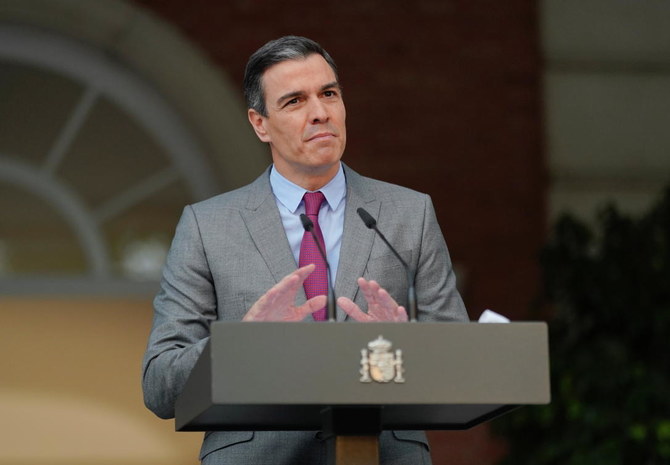
Socialist Prime Minister Pedro Sánchez has weathered harsh criticism in recent weeks while his government prepared the pardons, both from Spain’s conservatives and far-right parties, as well as a large sector of the public.
But the decision is widely backed in Catalonia, where even many unionists hope it can help mend bridges. Important business leaders and Catholic bishops have also voiced their support.
In two regional elections since the failed secession bid the separatists have maintained their hold on power as the political battle lines have become entrenched. Roughly half support parties in favor of secession; the other half vote for parties that want to remain in Spain.
Spain’s government hopes that the freeing of the separatists can convince those Catalans who only recently joined the separatist camp to consider coming back into the fold.
Sánchez will also likely need the votes of some Catalan separatists in the national Parliament in Madrid to keep his minority government afloat over the next two years.
While celebrating the liberty of their cohorts, the separatist movement is far from satisfied. Its politicians are pushing for not just being spared the punishment but a full amnesty for all of those in trouble for helping organize the 2017 breakaway attempt. That would clear up their criminal records and allow them to participate in politics.
They also don’t renounce their dream of founding a new state.
But the protest held on Tuesday when Sánchez visited Barcelona to announce that he would sign the pardons was very subdued. Compared to the tens — or even hundreds — of thousands of protesters who have taken to the streets in recent years, a few hundred turned out to jeer Sánchez.
The pardons come after Junqueras recently acknowledged for the first time that the 2017 referendum was not considered legitimate by a part of Catalonia’s society. That is in stark contrast to the position maintained by Puigdemont, who says that the referendum and independence declaration remain valid.
WHAT ABOUT PUIGDEMONT?
The act of grace by Spain does not include Puigdemont and the handful of other high-profile separatists who fled to Belgium, Scotland and Switzerland, where they have avoided Spain’s extradition requests.
The government has insisted that they must return home to face justice.
Puigdemont and two former Catalan Cabinet members won seats to the European Parliament in 2019. Their immunity as parliament members was stripped by the chamber, which would allow Spain to again pursue their extradition. But a European court temporarily restored their extraordinary legal coverage recently while it considers their appeal.
So Puigdemont’s future, as ever, is uncertain.


![]()

Why has Spain pardoned 9 Catalan separatists?
Short Url
https://arab.news/md7eu
Why has Spain pardoned 9 Catalan separatists?
- In October 2017 the government of Catalonia pushed through with a referendum on independence despite repeated warnings from the country’s highest courts


Latest updates





© 2026 SAUDI RESEARCH & PUBLISHING COMPANY, All Rights Reserved And subject to Terms of Use Agreement.