

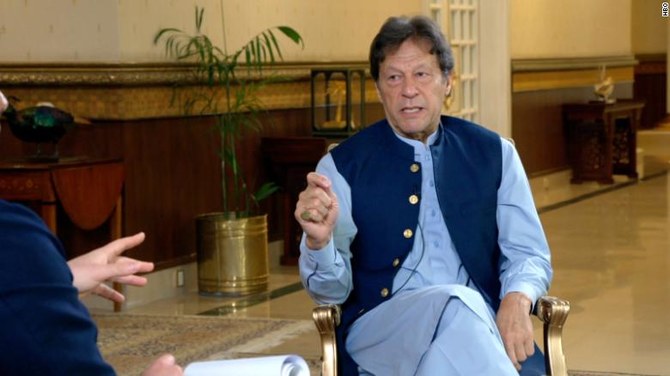

RAWALPINDI: Pakistan Prime Minister Imran Khan has faced a torrent of criticism this week by rights groups, journalists, and social media users for his comments in a TV interview widely seen to be blaming a rise in sexual violence in Pakistan on women's clothes.
The remarks were made in an interview to Jonathan Swan on Axios on HBO aired on Sunday.
“If a woman is wearing very few clothes, it will have an impact on the men unless they’re robots. I mean, it’s common sense," Khan said, adding removing "temptation" was necessary to curb a spike in rape and sexual assault cases across Pakistan.
"We don’t have discos here, we don’t have nightclubs, so it is a completely different society, way of life here, so if you raise temptation in society...all these young guys have nowhere to go, it has consequences in the society," the prime minister said.
Khan's had made similar remarks in a live TV program in April this year when he linked “obscenity” to a surge in rape cases across Pakistan. At the time, his office had said that the PM's remarks were "taken out of context."
Several Pakistanis took to Twitter to criticise the PM's comments, with political analyst Mosharref Zaidi saying the remarks absolved “rapists of the responsibility of their actions.”
it isn’t complicated and you don’t need to be a feminist or a gender studies PhD to understand it.
what does the argument that rape is a product of the rapists’ environment show?
it shows an intent to absolve rapists of the responsibility for their actions.
it’s that simple.
— Mosharraf Zaidi (@mosharrafzaidi) June 21, 2021
Sharing the now-viral clip of the HBO interview, journalist Diaa Hadid said Khan's comments were not being "misunderstood" this time either.
"The last time the Pakistani prime minister blamed women for being raped by not being modest enough, his team quickly insisted he was misunderstood. So in English: "Men aren't robots," he says, when asked if what women wear has an impact on their sexual violence".
The last time the Pakistani prime minister blamed women for being raped by not being modest enough, his team quickly insisted he was misunderstood.
SO in English: "Men aren't robots" he says, when asked if what women wear has an impact on their sexual violence https://t.co/5SbRb2athQ
— Diaa Hadid ضياء حديد (@diaahadid) June 21, 2021
In a second tweet, Hadid said:
"An interesting aspect of @ImranKhanPTI blaming women in short clothes for the sexual violence they face is how it gaslights the experiences of Pakistani women, who do not, 99% of the time, ever wear anything short or revealing. But that's where the conversation is now."
An interesting aspect pf @ImranKhanPTI blaming women in short clothes for the sexual violence they face is how it gaslights the experiences of Pakistani women, who do not, 99% of the time, ever wear anything short or revealing.
But that's where the conversation is now https://t.co/BA5slDuS8N
— Diaa Hadid ضياء حديد (@diaahadid) June 22, 2021
Journalist Gharidah Farooqi agreed, saying: “This is victim blaming and giving a pass to men. Don’t insult victims. Don’t justify rape as temptation.”
Disgusted. Appalled. Outraged. Strongly condemnable. No, Mr PM Khan, women clothing is NOT responsible for temptation leading to rape/assault/violence. ABSOLUTELY NOT!
This is victim blaming and giving a pass to men. Don’t insult victims. Don’t justify rape as temptation.— Gharidah Farooqi (@GFarooqi) June 21, 2021
Content creator @Meemelif highlighted that victim-blaming was what made rape so prevalent.
Rapists don’t rape because women don’t wear enough layers. They rape because they know the victim will be blamed for THEIR crime. Really makes it the easiest crime to get away with.
— m (@meemelif) June 21, 2021
Journalist Abbas Nasir said he was “appalled” by Khan’s comments, urging the prime minister to "ask your police to give you stats on how many women who were violated wore 'too few' clothes.”
Just saw your interview, PM. Appalled by your views on crimes against women. Women are NOT responsible for their own rape, sexual harassment. Out of control men are. It is that simple. Ask your police to give you stats on how many women who were violated wore 'too few' clothes.
— Abbas Nasir (@abbasnasir59) June 21, 2021
Meanwhile, Mariam Tareen, founder of The Writing Room, asked Khan: “There have been over 22,000 *reported* rape cases in the last six years in Pakistan. How many victims were wearing “very few clothes”?
Rape is about violence and misogyny and power. It’s not about uncontrollable sexual urges that women must avoid ‘activating’. Please. Stop.
There have been over 22,000 *reported* rape cases in the last six years in Pakistan. How many victims were wearing “very few clothes”?
— Mariam T (@mariamtee) June 21, 2021
In a Twitter post retweeted hundreds of times, political and human rights activist Tooba Syed called on Pakistani women to "share photos of the clothing they wore when they were harassed or assault."
Pakistani women must start sharing the photos of the clothes we were wearing when we got harassed and assaulted! Just so we can be told if they meets the standards of “very less clothes” or not. Also men who don’t rape women please change your names to robots so we know !
— Tooba (@Tooba_Sd) June 21, 2021
Others drew attention to the "dangerous threat" to the women in the country.
“It is a public, dangerous threat to the women of our country where they are informed that rape and assault is their own fault. And that their own PM stands with rapists," Kanwal Ahmed, journalist and host of the YouTube show Conversations with Kanwal, said in her Twitter post.
Imran Khan’s words are not a slip of a tongue or an ‘opinion by an uncle in a drawing room’. It is a public, dangerous threat to the women of our country where they are informed that rape and assault is their own fault. And that their own PM stands with rapists.
— Kanwal Ahmed (@kanwalful) June 21, 2021
Salman Sufi of the Salman Sufi Foundation echoed Ahmed’s sentiments saying: “Leadership of #Pakistan must understand that their words have consequences for the lives of millions of women who fear even raising their voice against oppression due to already rampant victim-blaming.”
Leadership of #Pakistan must understand that their words have consequences for the lives of millions of women who fear even raising their voice against oppression due to already rampant victim blaming.
— Salman Sufi (Wear a Mask to Keep All Safe) (@SalmanSufi7) June 22, 2021
Many also voiced concern that Khan's statement that men lacked self-control would encourage Islamophobia, especially among those who view Muslim men as violent and uncontrollable.
Feminist activist and professor Nida Kirmani said: “The PM repeating his victim-blaming narrative, which paints Pakistani men as uncontrollable beasts for an international audience & yet people like myself are accused of hating men & giving the country a bad name.”
The PM repeating his victim-blaming narrative, which paints Pakistani men as uncontrollable beasts for an international audience & yet people like myself are accused of hating men & giving the country a bad name. pic.twitter.com/rqcN4P9NtH
— Nida Kirmani (@NidaKirmani) June 21, 2021
Political Anthropologist Arsalan Khan shared a thread responding to Khan’s opinion of Pakistani men.
“[He] is saying that Pakistani men by virtue of ‘culture,’ cannot control their sexual impulses when faced with the ‘temptation’ of women’s bodies,” adding, “This is an Islamophobic trope that is constantly repeated in Western countries that Muslims are sexual predators who have not and cannot adjust to Western society.”
My thoughts on IK’s rape apologia and misogyny, how it reinforces Islamophobia and how it is steeped in his class privilege. pic.twitter.com/Dw3PKwOY5n
— Arsalan Khan (@akkhan81) June 21, 2021
Human Rights Activist Ammar Ali Jan said he hoped Pakistani men also felt outraged by Khan's comments.
"We can't accept that men are inherently so barbaric that they would resort to rape at the slightest temptation.”
Hope men also feel outraged by Imran Khan's comments. We cant accept that men are inherently so barbaric that they would resort to rape at the slightest temptation. Surely we have the ability to respect others and know our boundaries. Otherwise we would be worse than robots.
— Ammar Ali Jan (@ammaralijan) June 21, 2021
Journalist Zarar Khuhro posted a tweet demanding that Khan and his supporters educate themselves on the crime of committing rape and "un-learn the old".
“Most of us, grew up believing wholeheartedly that rape is a 'lust' crime, a 'crime of passion' involving loss of control over the man's impulses. Certainly this is what i was socialized into believing too,” he said, adding: "To learn new things, to grow, means to first un-learn the old.
Look here's the thing: we all, or most of us, grew up believing wholeheartedly that rape is a 'lust' crime, a 'crime of passion' involving loss of control over the man's impulses. Certainly this is what i was socialised into believing too. But as you grow (as you should) you
— Zarrar Khuhro (@ZarrarKhuhro) June 21, 2021
Several, including journalist Nuzhat S. Siddiqui, asked authorities to stop looking for "scapegoats".
“We cannot end rape if we keep finding scapegoats in time-of-the-night or size-of-clothing, especially not from the Prime Minister's seat. You have the power to fix systems & change mindsets, PM @ImranKhanPTI - please don't waste your time & words in further enabling what's wrong.”
We cannot end rape if we keep finding scapegoats in time-of-the-night or size-of-clothing, especially not from the Prime Minister's seat. You have the power to fix systems & change mindsets, PM @ImranKhanPTI - please don't waste your time & words in further enabling what's wrong.
— Nuzhat S. Siddiqi (@guldaar) June 21, 2021
Others, such as digital rights activist and lawyer Usama Khilji, extended support to victims: “To every survivor of rape & sexual assault: please know that it was not your fault at all.”
To every survivor of rape & sexual assault: please know that it was not your fault at all.
— Usama Khilji (@UsamaKhilji) June 21, 2021


