



DUBAI: Global data analytics and consulting company Kantar has released its ranking of the top 100 most valuable brands of the year.
The total value of the top 100 brands has grown by 42 percent, to reach a new record of over $7 trillion, demonstrating a significant rebound from the pandemic. The increase — more than four times the study’s annual average percentage increase over the past 15 years — has been driven by confidence derived from vaccine availability, economic stimulus packages and improving GDP outlooks, according to the report.
“2020-1 has been a record year for brand growth, and despite many facing a difficult year, our research has again proven that strong brands deliver superior shareholder returns, are more resilient and recover more quickly,” said Nathalie Burdet, chief marketing officer of Kantar.
American brands account for more than half of the top 100 brands, with Amazon and Apple leading the way.
Amazon maintained its position as the world’s most valuable brand, growing by 64 percent to $684 billion. It became the first half-a-trillion-dollar brand, alongside Apple, at No. 2, which is valued at $612 billion.
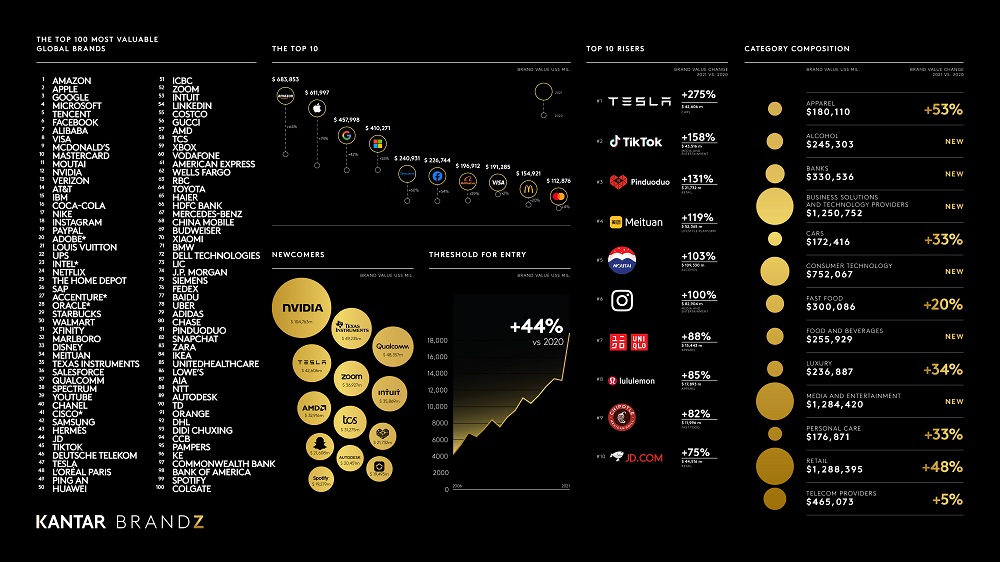
The high rankings of Amazon and Apple are reflective of the growth of big tech companies with seven out of the top 10 brands coming from the technology sector. These include Google at No. 3, Microsoft at No. 4, Tencent at No. 5, Facebook at No. 6 and Alibaba at No. 7
Technology has also enabled non-tech brands to grow during the last year with several of them having to expand their digital presence and pivot to online sales. That explains why this year Zoom and Spotify made it on the top 100 list for the first time. Zoom came in at No. 52 with a valuation of $36.9 billion, while Spotify came in at No. 54 following a 454 percent growth in subscribers between 2015 and 2020.
“With global e-commerce growing from 12 to 15 percent of all sales in 2020, it has been a positive year for brands involved in that value chain — from the retailers through to the couriers like FedEx and UPS,” added Burdet.
This year, five brands doubled their value. At No. 47 is Tesla, the fastest-growing brand, which grew its value by 275 percent to $43 billion. The other four are all Chinese brands: Moutai, Meituan, TikTok and Pinduoduo.
The predominance of Chinese brands on the list marks China’s lead over Europe with Chinese brands having grown from 11 percent of the top 100 value in 2011 to 14 percent today. On the other hand, European brands represent 8 percent of the ranking’s value versus 20 percent in 2011.
The pandemic played a crucial role in driving brands’ value this year. As consumers spent more time at home, the top 10 media and entertainment brands experienced a growth of over 50 percent with gaming chip providers NVIDIA and AMD entering the ranking for the first time.
The time spent working from home also blurred the lines between loungewear and formal wear resulting in a rise in athleisure clothing, which was driven by Adidas, Nike, Puma and Lululemon all securing over 50 percent value growth.
Even the luxury category saw a 34 percent brand growth. Kantar attributes this growth to brands investing in reputation, especially for sustainable and ethical purposes, which has increasingly become a driver for brand growth. For example, LVMH invested in its corporate reputation through pandemic-related initiatives, sustainable transformation and support for social movements such as Black Lives Matter, while L’Oréal Paris secured brand growth across its beauty brands by driving female empowerment.
“This year’s results show that brand building remains critical to securing growth,” said Burdet.
Kantar tracks the stock market performance of the strongest brands and has seen that these brands recover twice as fast as other key indices, she added. The firm’s analytics show that 70 percent of the success of a brand depends on four fundamentals: providing superior experience across consistently branded touchpoints; a range of well-designed and functional products and services; convenience; and exposure through great advertising.
“However, [the pandemic] has emphasized consumer values such as trust and reliability. Those brands that are evolving their values, projecting leadership on these issues, are demonstrating differentiation and standing out,” said Burdet.


