Abu Dhabi opens up free COVID-19 vaccines to tourists

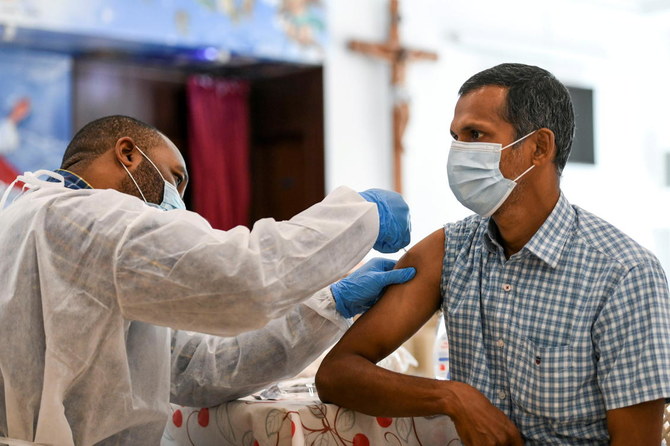
A man receives a dose of a vaccine against the coronavirus disease (COVID-19) at St. Paul's Church in Abu Dhabi. (Reuters)
Short Url
Updated 22 June 2021
Follow

Abu Dhabi opens up free COVID-19 vaccines to tourists

  • Infections have risen in the UAE in the past month, and Abu Dhabi still has restrictions on entry, including home quarantine and PCR testing at intervals after arrival

DUBAI: Abu Dhabi, the capital of the United Arab Emirates, is offering tourists free COVID-19 vaccinations that were previously restricted to UAE citizens and residency visa holders.
There is no indication that the change applies to Dubai, the most populous emirate, or the other five emirates that make up the UAE.
Visitors with visas issued by Abu Dhabi and passport holders eligible for tourist visas when they arrive in the UAE through Abu Dhabi can book free vaccines, according to information provided by the Abu Dhabi Health Services Company (SEHA), which operates the emirate’s public health infrastructure.
Holders of expired residency or entry visas are also eligible for free vaccinations, Abu Dhabi Media Office said on June 11.
Job losses and travel restrictions during the pandemic mean some people’s residency visas have expired or have been canceled when they were made redundant.
UAE Health authorities said this month nearly 85 percent of the eligible population had received at least one vaccine dose, but did not say how many had had two doses.
Infections have risen in the UAE in the past month, and Abu Dhabi still has restrictions on entry, including home quarantine and PCR testing at intervals after arrival. People driving from other emirates are tested to show they are not infected.
Travelers from 27 countries including China, Germany and the United States can enter without quarantine on arrival.
SEHA offers COVID-19 vaccines by China’s state-owned drugmaker Sinopharm and by Pfizer/BioNTech in Abu Dhabi.
Dubai Media Office did not immediately respond to a request for comment on whether eligibility criteria was to change. Dubai Health Authority information says vaccines are given only to citizens and holders of valid Dubai residency visas.


Oil prices rise sharply after attacks in Middle East disrupt global energy supply

Updated 53 min 42 sec ago
Follow

Oil prices rise sharply after attacks in Middle East disrupt global energy supply

  • Traders were betting the supply of oil from Iran and elsewhere in the Middle East would slow or grind to a halt.
  • Attacks throughout the region have restricted countries’ ability to export oil to the rest of the world

NEW YORK: Oil prices rose sharply Monday as US and Israeli attacks on Iran and retaliatory strikes against Israel and US military installations around the Gulf sent disruptions through the global energy supply chain.
Traders were betting the supply of oil from Iran and elsewhere in the Middle East would slow or grind to a halt. Attacks throughout the region, including on two vessels traveling through the Strait of Hormuz, the narrow mouth of the Arabian Gulf, have restricted countries’ ability to export oil to the rest of the world. Prolonged attacks would likely result in higher prices for crude oil and gasoline, according to energy experts.
West Texas Intermediate, the light, sweet crude oil produced in the United States, was selling for about $72 a barrel early Monday, up around 7.3 percent from its trading price of about $67 on Friday, according to data from CME group.
A barrel of Brent crude, the international standard, was trading at $78.55 per barrel early Monday, according to FactSet, up 7.8 percent from its trading price of $72.87 on Friday, which had been a seven-month high at the time.
Higher global energy prices could lead to consumers paying more for gasoline at the pump and shelling out more for groceries and other goods, at a time when many are already feeling the impacts of elevated inflation.
Roughly 15 million barrels of crude oil per day — about 20 percent of the world’s oil — are shipped through the Strait of Hormuz, making it the world’s most critical oil chokepoint, according to Rystad Energy. Tankers traveling through the strait, which is bordered in the north by Iran, carry oil and gas from Saudi Arabia, Kuwait, Iraq, Qatar, Bahrain, the UAE and Iran.
Iran had temporarily shut down parts of the strait in mid-February for what it said was a military drill, which led oil prices to jump about 6 percent higher in the days that followed.
Against that backdrop, eight countries that are part of the OPEC+ oil cartel announced they would boost production of crude Sunday. The Organization of Petroleum Exporting Countries, in a meeting planned before the war began, said it would increase production by 206,000 barrels per day in April, which was more than analysts had been expecting. The countries boosting output include Saudi Arabia, Russia, Iraq, the United Arab Emirates, Kuwait, Kazakhstan, Algeria and Oman.
“Roughly one-fifth of global oil supply passes through the Strait of Hormuz, a vital artery for world trade, meaning markets are more concerned with whether barrels can move than with spare capacity on paper,” said Jorge León, Rystad’s senior vice president and head of geopolitical analysis, in an email. “If flows through the Gulf are constrained, additional production will provide limited immediate relief, making access to export routes far more important than headline output targets.”
Iran exports roughly 1.6 million barrels of oil a day, mostly to China, which may need to look elsewhere for supply if Iran’s exports are disrupted, another factor that could increase energy prices.