

Tax-shy Gulf states will rely on hydrocarbons for at least a decade: Moody’s

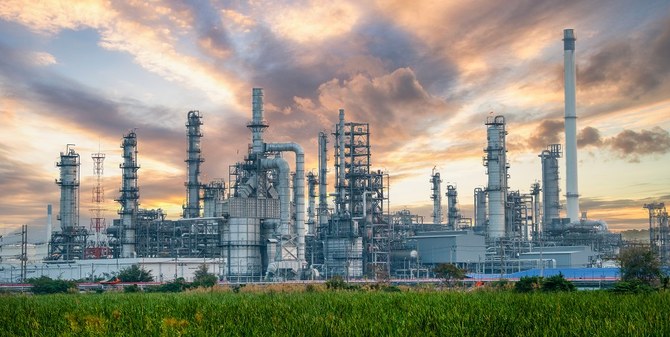
For most Gulf countries, oil and gas still account for at least a fifth of GDP. (Shutterstock)
Short Url
Updated 21 June 2021
Follow

Tax-shy Gulf states will rely on hydrocarbons for at least a decade: Moody’s

  • Gulf states’ reliance on hydrocarbons will remain the key credit constraint despite ongoing diversification efforts

DUBAI: The reluctance of Gulf states to hike taxes is among the reasons that the region will remain dependent on hydrocarbons for at least a decade, Moody’s said.
Gulf states’ reliance on hydrocarbons will remain the key credit constraint despite ongoing diversification efforts, it said
“Economic diversification away from hydrocarbons remains the most frequently stated policy objective in the region but will likely take many years to achieve,” said Alexander Perjessy, a senior analyst at Moody’s and the author of the report. “The announced plans to boost hydrocarbon production capacity and government commitments to zero or very low taxes make it unlikely that heavy reliance on hydrocarbons will diminish significantly in the coming years.”
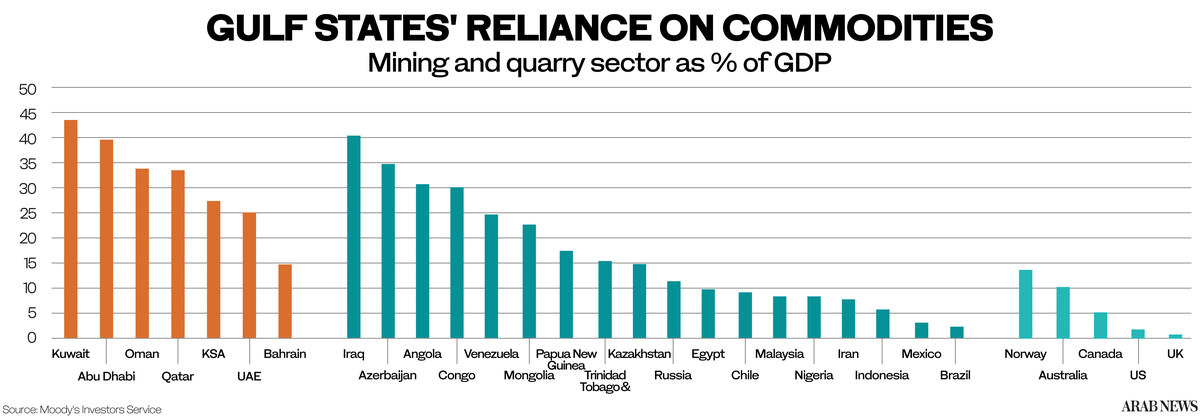

For most Gulf countries, oil and gas still account for at least a fifth of GDP, more than 65 percent of total exports and at least 50 percent of government revenue.
Despite ambitious governments’ plans, diversification efforts since 2014 have yielded only limited results and will be held back by lower oil prices, Moody’s warned.
While diversification momentum may accelerate, it is likely to be held back by the reduced availability of resources to fund projects as well as intra-GCC competition in a narrow range of sectors.
Hydrocarbon revenue, collected in the form of profit taxes, royalties and dividends (paid by the national oil companies), still account for the lion’s share of government income across the region.
Moody’s sees this partly as a consequence of GCC governments’ long-standing commitment to a zero or very low tax environment, “which is part of the implicit social contract between the rulers and the citizens but also reflects the desire to incentivize non-oil sector growth and development.” it said.
It estimates that GCC sovereign states collected non-hydrocarbon tax revenues equivalent, on average, to less than 4 percent of non-shuhydrocarbon GDP in 2019. That compares to an equivalent rate of more than 22 percent for major high-income economies.
Moody’s said that if oil prices average $55 per barrel (around the middle of its medium range forecast) hydrocarbons would likely remain the single largest contributor to GCC sovereigns’ GDP and the main source of government revenue over at least the next decade.


Saudi POS spending jumps 28% in final week of Jan: SAMA

Updated 06 February 2026
Follow

Saudi POS spending jumps 28% in final week of Jan: SAMA

RIYADH: Saudi Arabia’s point-of-sale spending climbed sharply in the final week of January, rising nearly 28 percent from the previous week as consumer outlays increased across almost all sectors. 

POS transactions reached SR16 billion ($4.27 billion) in the week ending Jan. 31, up 27.8 percent week on week, according to the Saudi Central Bank. Transaction volumes rose 16.5 percent to 248.8 million, reflecting stronger retail and service activity. 

Spending on jewelry saw the biggest uptick at 55.5 percent to SR613.69 million, followed by laundry services which saw a 44.4 percent increase to SR62.83 million. 

Expenditure on personal care rose 29.1 percent, while outlays on books and stationery increased 5.1 percent. Hotel spending climbed 7.4 percent to SR377.1 million. 

Further gains were recorded across other categories. Spending in pharmacies and medical supplies rose 33.4 percent to SR259.19 million, while medical services increased 13.7 percent to SR515.44 million. 

Food and beverage spending surged 38.6 percent to SR2.6 billion, accounting for the largest share of total POS value. Restaurants and cafes followed with a 20.4 percent increase to SR1.81 billion. Apparel and clothing spending rose 35.4 percent to SR1.33 billion, representing the third-largest share during the week. 

The Kingdom’s key urban centers mirrored the national surge. Riyadh, which accounted for the largest share of total POS spending, saw a 22 percent rise to SR5.44 billion from SR4.46 billion the previous week. The number of transactions in the capital reached 78.6 million, up 13.8 percent week on week. 

In Jeddah, transaction values increased 23.7 percent to SR2.16 billion, while Dammam reported a 22.2 percent rise to SR783.06 million. 

POS data, tracked weekly by SAMA, provides an indicator of consumer spending trends and the ongoing growth of digital payments in Saudi Arabia.  

The data also highlights the expanding reach of POS infrastructure, extending beyond major retail hubs to smaller cities and service sectors, supporting broader digital inclusion initiatives.  

The growth of digital payment technologies aligns with Saudi Arabia’s Vision 2030 objectives, promoting electronic transactions and contributing to the Kingdom’s broader digital economy.