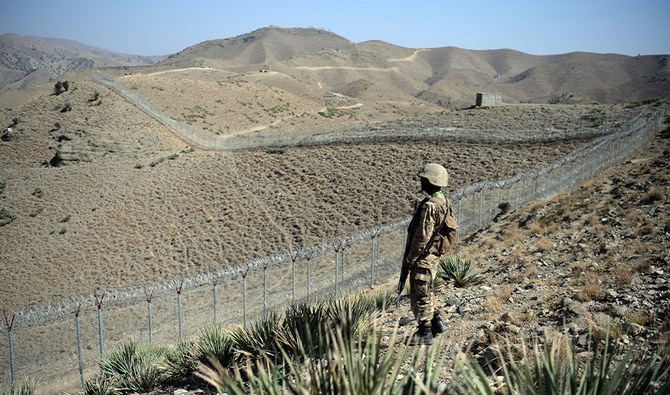
ISLAMABAD: Pakistan’s interior minister Sheikh Rashid Ahmed has said that fencing work along the country’s porous border with Afghanistan will finish by June 30.
During an address to the National Assembly on Saturday, he added that “88 percent of the fencing work has already been completed,” according to media reports.
Pakistan began fencing its 2,600 km border with Afghanistan in 2017 to prevent militant crossings and smuggling and has frequently attributed high-profile attacks to groups based in Afghanistan.
Afghanistan, in turn, accuses Islamabad of sheltering the Afghan Taliban militants who are battling the Western-backed government in Kabul. Both countries deny the charges.
On Saturday, Pakistan’s military conducted an intelligence-based operation in the Spinwam area of North Waziristan district near Afghanistan, killing two “terrorists” which it says “were active members of the TTP [Tehreek-e-Taliban Pakistan].”
“[They were] involved in terrorist activities against Security Forces,” the Inter-Service Public Relations (ISPR), the Pakistani military’s media wing, said in a statement.

Fencing of Pakistani border with Afghanistan to be completed this month — interior minister
https://arab.news/5w5rd
Fencing of Pakistani border with Afghanistan to be completed this month — interior minister
- Sheikh Rashid says 88 percent of the work is “already complete”
- Army conducted operation in North Waziristan on Saturday, two militants and soldier killed
Pakistani Muslims shop for Ramadan supplies amid price hike concerns
- Pakistan endured one of Asia’s highest inflation spikes in 2023, nearly 40 percent, exacerbated by a macroeconomic crisis
- PM Shehbaz Sharif this week announced $136 million Ramadan Relief Package for deserving people across Pakistan
KARACHI: Pakistanis thronged markets on Friday and Saturday to shop for supplies ahead of the holy month of Ramadan, while keeping a watchful eye on rising food prices.
In cities such as Karachi, many people were seen buying commodities at the main wholesale market of the city. Some, like Islamabad resident Danish Ali, have noted high inflation as the cause of price hike.
“There are about six or seven days left for Ramadan, so the prices have started to increase,” Ali said. “Now, l have bought banana for 200 rupees a dozen, and it is small size.
“A few days ago it was being sold for 100 rupees a dozen. As Ramadan is starting, inflation is increasing. So is with the prices of vegetable.”
Pakistan endured one of Asia’s highest inflation spikes in 2023, nearing 40 percent, driven by a weakening rupee, rising fuel costs and price hikes linked to IMF-backed reforms.
“Look how much sales tax the government has imposed,” Najeebullah, a shopkeeper selling dates, said.
“I used to pay 100,000 ($357) or 130,000 rupees ($465) for one container. So guess what, the tax has reached 800,000 rupees ($2863) for one container,” he added.
Although inflation has since slowed to 5.8 percent, analysts warn the changes to power prices could add inflationary pressure.
Prime Minister Shehbaz Sharif on Saturday announced Rs38 billion [$136 million] Ramadan Relief Package which will be disbursed among deserving people across the country, his office said.


