

Israel says Iran’s Raisi extreme, committed to nuclear program

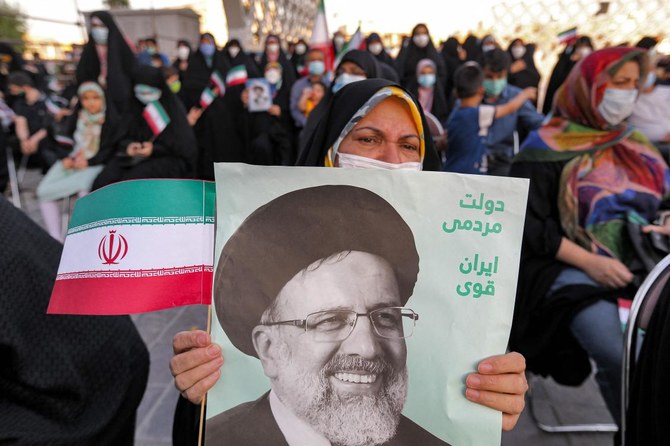
A woman holds a poster of Iran's newly-elected president Ebrahim Raisi in Imam Hussein square in the capital Tehran. (AFP)
Short Url
Updated 20 June 2021
Follow

Israel says Iran’s Raisi extreme, committed to nuclear program

  • Foreign minister Yair Lapid calls Iran's new president the ‘butcher of Tehran’
  • Says Ebrahim Raisi is committed to the regime’s nuclear ambitions and to its campaign of global terror

JERUSALEM: Israel on Saturday condemned Iran’s newly-elected president Ebrahim Raisi, saying he was its most extreme president yet and committed to quickly advancing Tehran’s nuclear program.
“Iran’s new president, known as the Butcher of Tehran, is an extremist responsible for the deaths of thousands of Iranians. He is committed to the regime’s nuclear ambitions and to its campaign of global terror,” Foreign Minister Yair Lapid said on Twitter.
A separate statement from the Israeli Foreign Ministry said Raisi’s election should “prompt grave concern among the international community.”
Israel’s new government, sworn in on Sunday, has said it would object to the revival of a 2015 nuclear deal between world powers and its arch-foe, Iran.
Israel sees a nuclear-armed Iran as an existential threat. Tehran denies seeking nuclear weapons.
Toeing the policy line set by the administration of Israel’s former prime minister, Benjamin Netanyahu, the foreign ministry said: “More than ever, Iran’s nuclear program must be halted immediately, rolled back entirely and stopped indefinitely.”
“Iran’s ballistic missile program must be dismantled and its global terror campaign vigorously countered by a broad international coalition.”
Raisi, a hard-line judge who is under US sanctions for human rights abuses, secured victory as expected on Saturday in Iran’s presidential election after a contest marked by voter apathy over economic hardships and political restrictions.

Battle for the Nile
How will Egypt be impacted by Ethiopia filling its GERD reservoir ?

Enter


keywords

Italy wants military to stay in Lebanon after peacekeepers leave

Updated 2 sec ago
Follow

Italy wants military to stay in Lebanon after peacekeepers leave

  • Defense Minister Guido Crosetto says Italy will continue to 'do its part' even after UNIFIL mission ends next year
ROME: Italy said Monday it intends to keep a military presence in Lebanon even after the UN peacekeeping force it belongs to leaves as planned from December 31, 2026.
“Even after (the peacekeeping force) UNIFIL, Italy will continue to do its part, supporting with conviction the international presence and supporting the capacity development of the Lebanese armed forces,” Defense Minister Guido Crosetto said during a visit to Lebanon, according to a statement.
Asked by AFP if this meant Italy wanted to maintain a military presence in the country, a ministry spokesman confirmed that this was the case.
The United Nations Interim Force in Lebanon (UNIFIL) has acted as a buffer between Israel and Lebanon since 1978, remaining after Israel ended an occupation of southern Lebanon in 2000.
Lebanon had wanted UNIFIL to stay.
But the UN Security Council voted in August to allow only one final extension for UNIFIL after pressure from Israel and its US ally to end the mandate.
UNIFIL is currently led by Italian Major General Diodato Abagnara and numbers 9,923 troops from 49 countries, according to the force’s website.
Italy is the second biggest contributing country with 1,099 soldiers deployed after Indonesia which has 1,232 soldiers.
Israel has hailed the termination of UNIFIL and urged the Beirut government to exert its authority after an Israeli military campaign which devastated Iranian-backed militia Hezbollah.
Under a truce between Israel and Hezbollah, the long-fledgling Lebanese national army has been deploying in southern Lebanon and dismantling Hezbollah’s infrastructure.
“Support is needed to strengthen the Lebanese armed forces, so that they are in the best possible position to defend the country, ensuring security and respect for its borders,” Crosetto said in Monday’s statement.
“We will guarantee our presence in multilateral and bilateral contexts,” he said.