Pakistan’s national air carrier launches scenic air safari for tourism promotion

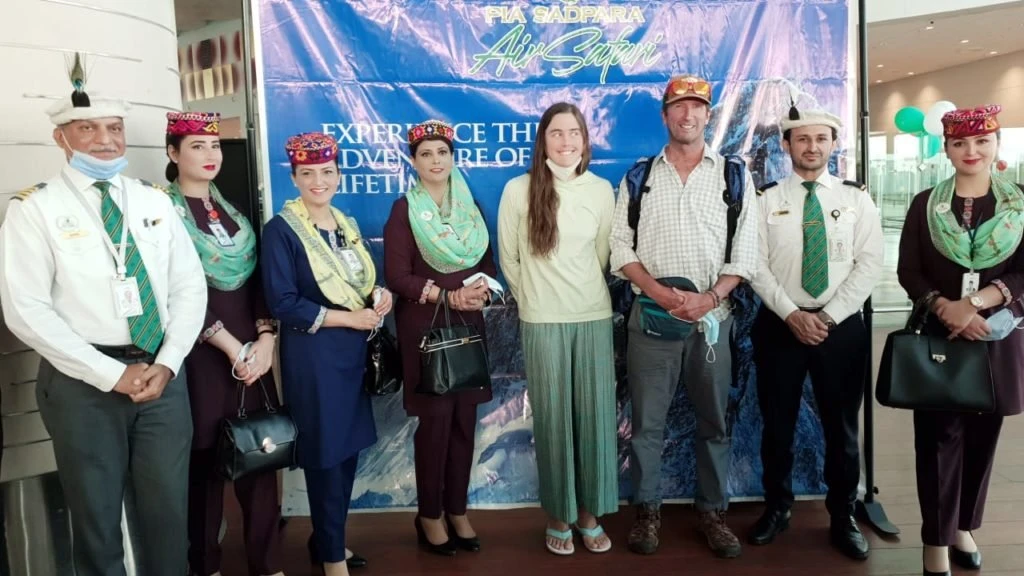
The Pakistan International Airlines crew is seen with passengers on the launch of Sadpara Air Safari on June 19, 2021. (Photo Courtesy: Social Media)
Short Url
Updated 19 June 2021
Follow

Pakistan’s national air carrier launches scenic air safari for tourism promotion

  • Named after the country’s iconic high-altitude mountaineer, Sadpara Air Safari will take tourist from Islamabad to Skardu and fly over K2 and Nanga Parbat
  • Tour operators believe the initiative will help the residents of Gilgit-Baltistan who mostly rely on tourism for livelihood

KHAPLU, Gilgit-Baltistan: The Pakistan International Airlines launched Sadpara Air Safari on Saturday to benefit the tourism industry in the country’s northern areas by offering passengers a spectacular view of some of the world’s tallest snowy mountains, glaciers and lakes.
Named after Pakistan’s iconic high-altitude mountaineer Muhammad Ali Sadpara, who tragically lost his life earlier this year while attempting a winter ascent of K2, the air safari will take tourists from Islamabad to Skardu and charge them a one-way fare of Rs24,000.
“Our flight will depart from the Islamabad International Airport and fly over K2, Nanga Parbat, Gasherbrum peaks, Deosai Plain and the famous Saif-ul-Malook Lake where every passenger will wonder at the beauty of the air safari from their personal window seat,” said the airline’s official statement.
While most flights to Gilgit-Baltistan offer a clear view of the world’s ninth tallest Nanga Parbat mountain, not many people get a glimpse of K2, also known as “Savage Mountain,” which hides in a remote corner of the region.
Hundreds of domestic and international tourists have already started visiting Pakistan’s Gilgit-Baltistan region in the north after the government eased the COVID-19 restrictions and opened the tourism sector on May 24.
“People living abroad usually fear security deficit while planning a trip to Pakistan,” PIA spokesperson Abdullah Hafiz Sheikh recently told Arab News over the phone. “Many of them are not aware of the beautiful and scenic locations of the country. Once they experience the air safari and fly over these places, they will surely come back to explore them again.”
Sheikh informed that the airline would only sell window seats.
“The return flight will depart from Skardu after two hours of arrival,” he continued. “It will be entirely up to our passengers if they want to take the same flight back to Islamabad or prolong their trip to the region to experience more magical moments.”
Asghar Ali Porik, who leads the Pakistan Association of Tour Operators, applauded the initiative, saying it would positively impact Pakistan’s image.
“Allowing travelers to decide when to get back after experiencing the air safari will also help the residents of Gilgit-Baltistan since they mostly rely on tourism to make a living,” he said.
“Like the air safari, the authorities should also start a helicopter service for backpackers in Skardu because that is what most foreigners demand in the area. If the helicopter service is launched, it will also make things easier for international climbers who will be able to reach Concordia, K2’s basecamp, in a short span,” he added.



Pakistan police book man for wounding buffalo with ax in Bahawalpur district

Updated 9 sec ago
Follow

Pakistan police book man for wounding buffalo with ax in Bahawalpur district

  • Complainant accuses a landowner in Ahmadpur East of attacking buffalo for straying into his fodder field 
  • Pakistan police register case against suspect under Pakistan Penal Code for injuring cattle 

ISLAMABAD: Police in Pakistan’s eastern Bahawalpur district registered a case on Sunday against a landowner for wounding a buffalo with ax for straying into his fodder field, in another case of animal brutality in the country. 

As per a copy of the police complaint seen by Arab News, the complainant Bashir Ahmad, a laborer and resident of the Ismail Pur area of the Ahmadpur East city, said the incident took place on Jan. 24. 

Ahmad said he arrived at his home after work on Saturday to find that his buffalo had escaped. Ahmad searched for the animal along with two others he cited as eyewitnesses in his report. They discovered that the buffalo had strayed into a fodder field nearby owned by a man named Manzoor Hussain.

“During this time, Manzoor Hussain came with an ax and as we watched, attacked both of the front legs of the buffalo,” the police report quoted Ahmad as saying. 

The complainant said the buffalo collapsed as a result of the assault. It did not mention whether the buffalo had died or not. 

Ahmad said the suspect abused him and the other eyewitnesses and left the area after they arrived. 

“Manzoor Hussain has committed a grave injustice by injuring my buffalo,” the report quoted Ahmad as saying. “I want action to be taken against him.”

Police registered a case against Hussain under Sections 427 [mischief causing damage to the amount of fifty rupees] and 429 [mischief by killing or maiming cattle of any value or any animal of the value of fifty rupees] of the Pakistan Penal Code. 

Local media reported the suspect had been arrested following the police complaint. 

Animal abuse cases in Pakistan have frequently made headlines over the years. In June 2024, a local landlord in the southern Sanghar district was accused of chopping off a camel’s leg after it strayed into his fields for grazing. 

The story, which triggered an uproar on mainstream and social media, led to the camel being transported to an animal shelter in Karachi for treatment. Six suspects were arrested by the police. 

In another incident in the southern Umerkot district during June 2024, a camel was found dead with its legs amputated. 

In July 2024, a man was arrested in Pakistan’s eastern Shahpur city for chopping off a buffalo’s tongue.

Pakistan’s existing animal cruelty laws, rooted in the Prevention of Cruelty to Animals Act of 1890, prohibit various forms of animal cruelty, including beating, overdriving, and mutilation. 

The legislation also prescribes penalties for breaches of these anti-cruelty provisions, which can include fines and imprisonment, though these are not always effectively enforced.