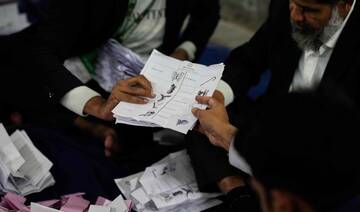
GENEVA: The UN refugee agency says war, violence, persecution and human rights violations caused nearly 3 million people to flee their homes last year, even though the COVID-19 crisis restricted movement worldwide as countries shut borders and ordered lockdowns.
In its latest Global Trends report released on Friday, UNHCR says the cumulative total of displaced people has risen to 82.4 million – roughly the population of Germany. It marks the ninth straight annual increase in the number of people forcibly displaced.
Filippo Grandi, the United Nations high commissioner for refugees, said conflict and the impact of climate change in places such as Mozambique, Ethiopia’s Tigray region and Africa’s broad Sahel area were among the leading sources of new movements of refugees and internally displaced people in 2020.
They added hundreds of thousands more people to the overall count, which has for years been dominated by the millions who have fled countries such as Syria and Afghanistan due to protracted wars or fighting.
“This is telling, in a year in which we were all locked down, confined, blocked in our homes, in our communities, in our cities,” said Grandi in an interview before the report’s release. “Almost 3 million people have had to actually leave all that behind because they had no other choice.”
UNHCR, which has its headquarters in Geneva, said that 99 of the more than 160 countries that closed their borders because of COVID-19 didn’t make exceptions for people seeking protection as refugees or asylum-seekers.
Grandi acknowledged the possibility that many internally displaced people who couldn’t leave their own countries will eventually want to flee abroad once borders start reopening, if the pandemic eases.
“A good example is the United States where already we have seen a surge in people arriving in recent months,” Grandi said, and referred to the US provision called Title 42 that let US authorities temporarily block people seeking asylum from entry for health reasons. “Title 42 will be lifted eventually – and I think this is the right thing to do – but this will have to be managed.”
Asked about US Vice President Kamala Harris’ recent trip to Central America, where she told would-be migrants to the US “do not come,” Grandi expressed hope that the remark was not reflective of overall US policy.
“I think that messaging indeed, as it was reported, is stark, and maybe shows only one part of the picture now,” Grandi said, adding that he had heard a “more complex response” from other officials in Washington when he was there recently.
Among recent hotspots, Grandi said hundreds of thousands of people were newly displaced in Mozambique and the Sahel last year, and up to 1 million in the Tigray conflict that started in October.
“I’m worried that if the international community is not able to stop these conflicts, we will continue to see the rise in the numbers,” he said.
The report said that at the end of last year there were 5.7 million Palestinians, 3.9 million Venezuelans and an additional 20.7 million refugees from various other countries displaced abroad. Another 48 million people were internally displaced in their own countries. Some 4.1 million more sought asylum.
Turkey, a neighbor of Syria, has taken in the most refugees in absolute numbers – 3.7 million – a figure more than twice that of the No. 2 host country, Colombia, which borders Venezuela. Afghanistan’s neighbor Pakistan was third.
UNHCR said now 1 percent of all humanity is displaced, and there are twice as many forcibly displaced people than a decade ago. Some 42 percent of them were aged under 18, and nearly 1 million babies were born as refugees between 2018 and 2020.
“Many of them may remain refugees for years to come,” it said.


UN: Millions driven from homes in 2020 despite COVID-19 crisis

https://arab.news/pxzd7
UN: Millions driven from homes in 2020 despite COVID-19 crisis

- Cumulative total of displaced people has risen to 82.4 million – roughly the population of Germany
- UNHCR said now 1 percent of all humanity is displaced, and there are twice as many forcibly displaced people than a decade ago


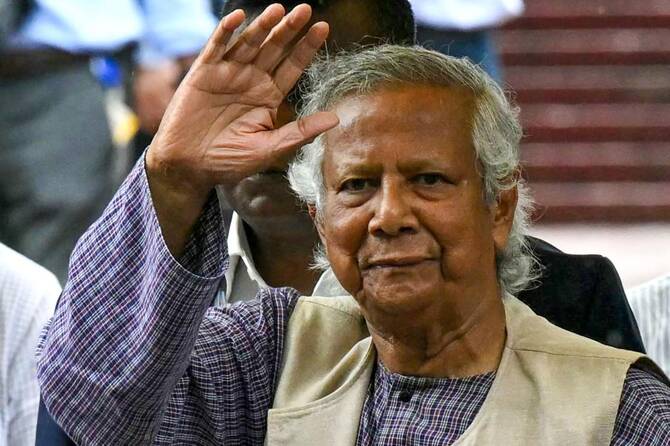
Bangladesh’s Yunus announces resignation, end of interim govt
- Yunus handed over power after congratulating the Bangladesh Nationalist Party and its leader Tarique Rahman
DHAKA: Bangladesh’s interim leader Muhammad Yunus stepped down on Monday in a farewell broadcast to the nation before handing over to an elected government.
“Today, the interim government is stepping down,” the 85-year-old Nobel Peace Prize winner said.
“But let the practice of democracy, freedom of speech, and fundamental rights that has begun not be halted.”
Yunus returned from self-imposed exile in August 2024, days after the iron-fisted government of Sheikh Hasina was overthrown by a student-led uprising and she fled by helicopter to India.
“That was the day of great liberation,” he said. “What a day of joy it was! Bangladeshis across the world shed tears of happiness. The youth of our country freed it from the grip of a demon.”
He has led Bangladesh as its “chief adviser” since, and now hands over power after congratulating the Bangladesh Nationalist Party (BNP) and its leader Tarique Rahman on a “landslide victory” in elections last week.
“The people, voters, political parties, and stakeholder institutions linked to the election have set a commendable example,” Yunus said.
“This election has set a benchmark for future elections.”
Rahman, 60, chief of the BNP and scion of one of the country’s most powerful political dynasties, will lead the South Asian nation of 170 million.
‘Rebuilt institutions’
Bangladeshi voters endorsed sweeping democratic reforms in a national referendum, a key pillar of Yunus’s post-uprising transition agenda, on the same day as the elections.
The lengthy document, known as the “July Charter” after the month when the uprising that toppled Hasina began, proposes term limits for prime ministers, the creation of an upper house of parliament, stronger presidential powers and greater judicial independence.
“We did not start from zero — we started from a deficit,” he said.
“Sweeping away the ruins, we rebuilt institutions and set the course for reforms.”
The referendum noted that approval would make the charter “binding on the parties that win” the election, obliging them to endorse it.
However, several parties raised questions before the vote, and the reforms will still require ratification by the new parliament.
The BNP alliance won 212 seats, compared with 77 for the Jamaat-e-Islami-led alliance, according to the Election Commission.
Jamaat chief Shafiqur Rahman conceded on Saturday, saying his party would “serve as a vigilant, principled, and peaceful opposition.”
Newly elected lawmakers are expected to be sworn in on Tuesday, after which Tarique Rahman is set to become Bangladesh’s next prime minister.
Police records show that political clashes during the campaign period killed five people and injured more than 600.
However, despite weeks of turbulence ahead of the polls, voting day passed without major unrest and the country has responded to the results with relative calm.