

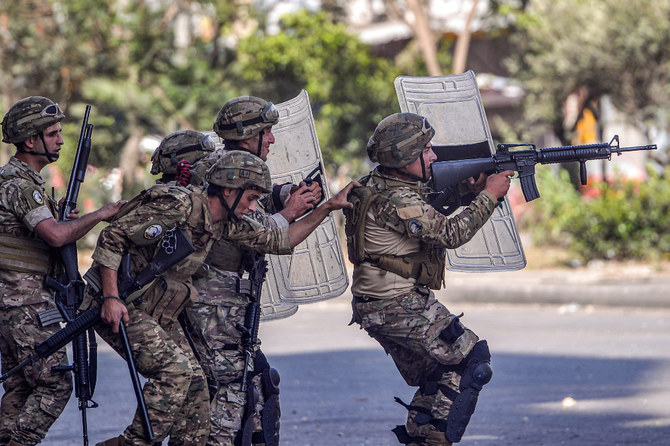

BEIRUT: Lebanese army commander Gen. Joseph Aoun on Thursday expressed confidence that the military will overcome what he described as a “crucial and delicate period” facing Lebanon.
The military chief warned of an increasingly untenable situation, but said that the institution remains strong.
“We believe that we will overcome this crucial and delicate period thanks to the strong will of our soldiers, and to the support of the Lebanese people and the friendly countries,” Gen. Aoun said.
His remarks came as 20 members of the International Support Group for Lebanon (ISG), in addition to European and Arab countries, the UN, EU and other international organizations attended a virtual conference on Thursday to support the army.
Discontent is brewing among Lebanon’s security forces over a currency crash that has wiped out most of the value of their salaries. Lebanon’s pound has lost 90 percent of its value against the dollar since late 2019.
The conference, organized by France in collaboration with Italy and the UN, aimed to mobilize support through in-kind aid for the Lebanese Army such as food, medicine and spare parts for its military equipment, in light of the collapse of the pound and the effect of the country’s struggling economy on the military.
Lebanon is facing a political deadlock and the biggest economic crisis in its history, and there are expectations that the army will step in to protect public safety in the event of a full collapse — much feared by the international community.
French Defense Minister Florence Parly said: “We are concerned that the Lebanese army remains capable of fulfilling its duties in maintaining security and stability.”
Her Italian counterpart, Lorenzo Guerrini, highlighted the importance of “quickly responding to the needs of the army by providing it with basic support requirements.”
Joana Wronecka, UN special coordinator for Lebanon, said that the army must be kept “cohesive and operative.”
Zeina Akar, Lebanon’s caretaker defense minister, said: “Taking into consideration the unstable environment — full of upheaval and uncertainty — that surrounds Lebanon, the army is a guarantee for stability and for the security of the Lebanese people.”
The minister said the army is facing the same problems as the Lebanese people.
“Its purchase power is eroding and it needs strong support to keep performing its duties. The army’s personnel need support in order to provide livelihood for their families.”
Gen. Aoun reviewed the army’s requirements at Thursday’s talks, saying that there is “an incremental need today to support it so that it remains tenacious and capable of doing its duties.”
He said that the depreciation of the Lebanese pound had stripped military salaries of 90 percent of their value.
Gen. Aoun warned that “the continuous retreat of the economic and financial situation in Lebanon will eventually lead to the collapse of institutions, including the military institution, which will render the whole country vulnerable on the security level.”
Soldiers “need support as individuals to overcome this precarious period,” he added.
“The army is the guarantee for security and stability in Lebanon and the region. Jeopardizing its role will lead to the collapse of Lebanon and to the spread of chaos.”
France, which has led international efforts, has sought to ramp up pressure on Lebanon’s squabbling politicians after failed attempts to agree a new government and launch reforms.
“The participants highlighted the dire and steadily degrading economic and social conditions in Lebanon. In this context, they stressed that the Lebanese army, though overstretched, remains a crucial pillar of the Lebanese state,” the French Armed Forces Ministry said in a statement.
“Their cohesiveness and professionalism remain key to preserving the country’s stability.”




