RIYADH: The US envoy to Yemen has blamed the Houthi militia for failed efforts to bring peace to the country.
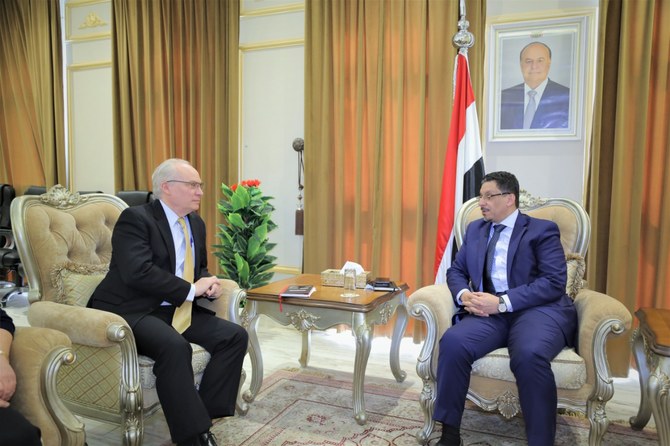
Tim Lenderking made the comments during a meeting on Thursday with Yemen’s Foreign Minister Ahmed Awad bin Mubarak in Saudi Arabia, Saba news agency reported.
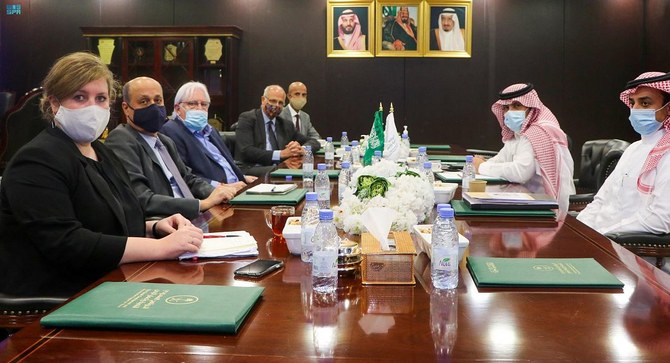
Lenderking is holding talks in the Kingdom as part of a US push to bring a nationwide cease-fire.
But the Biden administration appears increasingly frustrated by the Iran-backed Houthis and their refusal to engage with peace efforts.
During his meeting with Bin Mubarak, Lenderking repeated Washington’s position that there is no military solution to the Yemen conflict.
He strongly condemned the continued Houthi attacks on civilians and said an immediate and comprehensive cease-fire was a basic necessity to alleviate human suffering.
He said the US continued to support the legitimate government and the unity, stability and security of Yemen.
Bin Mubarak said: “The Houthi militia’s refusal to agree a comprehensive cease-fire, reopen Sanaa airport, and guarantee the supply of oil derivatives revenues to pay employees’ salaries proves the false pretexts these militias claim and confirms their bargaining on the humanitarian side, in order to continue implementing Iran’s subversive agenda.”
He said the militia’s targeting of civilians and populated areas in Marib with ballistic missiles has not stopped, but rather increased in severity, which exacerbates the seriousness of the humanitarian situation, increases the number of civilian casualties and undermines international efforts to establish peace.”


US blames Houthis for failed Yemen peace efforts
https://arab.news/47k8u
US blames Houthis for failed Yemen peace efforts

- Envoy Tim Lenderking condemns Houthis for civilian attacks, tells Yemen’s foreign minister that his government has Washington’s support
- Saudi ambassador to Yemen held talks with UN envoy to Yemen Martin Griffiths


Israeli military says it will pursue every successor of Iran’s Khamenei
- The clerical body that will choose Iran’s next supreme leader has more or less reached a majority consensus
- Minor disagreement over whether their final decision must follow an in-person meeting or instead be issued
The Israeli military warned it would continue pursuing every successor of Iran’s next supreme leader.
In a post on X in Farsi, the Israeli military also warned it would pursue every person who seeks to appoint a successor for Ayatollah Ali Khamenei, referring to the clerical body charged with choosing the Islamic Republic’s supreme leader.
The clerical body that will choose Iran’s next supreme leader, succeeding the slain Ayatollah Ali Khamenei, has more or less reached a majority consensus, Assembly of Experts member Ayatollah Mohammadmehdi Mirbaqeri said on Sunday.
The Mehr news agency quoted him as saying “some obstacles” still needed to be resolved regarding the process.
On Saturday, a senior cleric in the Assembly of Experts said its members would meet “within one day” to choose the leader.
Iranian media said the group had a minor disagreement over whether their final decision must follow an in-person meeting or instead be issued without adhering to this formality.
Ayatollah Mohsen Heidari Alekasir, another member of the Assembly of Experts, said in a video released by Nournews on Sunday that an in-person meeting by the assembly for a final vote was not possible under current conditions.
He said a candidate had been picked, based on the late supreme leader’s advice that Iran’s top leader should “be hated by the enemy” instead of praised by it.
“Even the Great Satan (US) has mentioned his name,” Heidari Alekasir said of the chosen successor, days after US President Donald Trump said that Khamenei’s son, Mojtaba, was an “unacceptable” choice for him.