

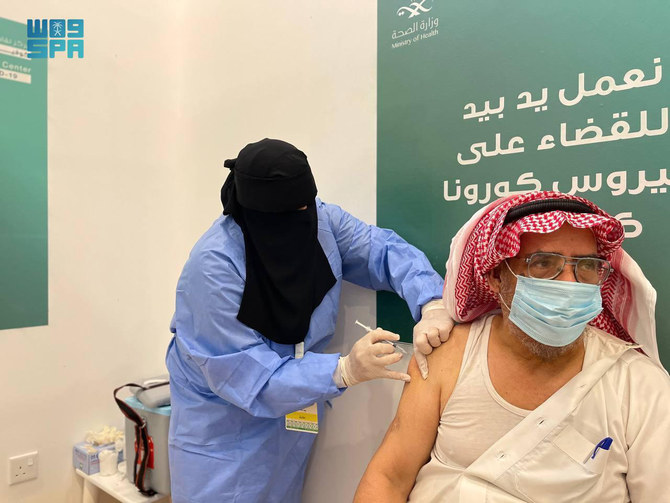
Saudi Arabia reports high rates of coronavirus immunization among elderly

1 / 2
Since Saudi Arabia began its nationwide vaccination campaign on Dec. 17, the Ministry of Health has targeted the elderly as one of its priority groups. (SPA)
2 / 2
The coronavirus pandemic has affected over 177 million people globally and the death toll has reached around 3.85 million. (File/SPA)
Short Url
Updated 18 June 2021
Follow

Saudi Arabia reports high rates of coronavirus immunization among elderly

  • The Kingdom recorded 14 COVID-19 deaths and 1,309 new cases in past 24 hours
  • 8 mosques reopened in 4 regions after temporarily evacuating and sterilizing them after 8 people tested positive for coronavirus

RIYADH: The Ministry of Health announced on Thursday that a high COVID immunization rate had been achieved among the elderly Saudi population (60 years and above).
Immunization rates reached 98 percent in Hafr Al-Batin, 93 percent in Al-Ahsa, 93 percent in Qurayyat, 86 percent in Bisha, 83 percent in Riyadh, 80 percent in the Eastern Province, and 80 percent in Taif.
The ministry said that these percentages were achieved after vaccinating this group with at least one dose.
Since Saudi Arabia began its nationwide vaccination campaign on Dec. 17, the Ministry of Health has targeted the elderly as one of its priority groups, launching a Priority service for Saudis and expats over the age of 75 without registration, appointment or waiting.
This has been available at vaccination centers in all regions of the Kingdom.
The ministry called on everyone to obtain the COVID-19 vaccine by registering on the “Sehhaty” application, stressing that the approved vaccines in the Kingdom are effective and safe.
Meanwhile, the ministry said that three polymerase chain reaction (PCR) tests can be conducted per month, according to the new protocol for COVID-19 tests in the Kingdom.
“If you have a respiratory disease, go to Tetamman clinics without booking an appointment and the doctor will assess your condition and conduct an examination for you,” the Ministry explained. “If you have recovered from the virus, you do not need an examination to prove your recovery. If you come in direct contact with a confirmed case after taking the COVID-19 vaccine, you don’t need a test.”
The Kingdom recorded 14 new COVID-19 related deaths on Thursday, raising the total number of fatalities to 7,635.
The Ministry of Health confirmed 1,309 new confirmed cases reported in the Kingdom in the previous 24 hours, meaning 470,723 people have now contracted the disease. 
Of the total number of cases, 10,879 remain active and 1,533 in critical condition.
According to the ministry, the highest number of cases were recorded in Makkah with 388, followed by the capital Riyadh with 265, the Eastern Province with 235, Asir recorded 115, and Jazan confirmed 95 cases.
The health ministry also announced that 1,022 patients had recovered from COVID-19, bringing the total number of recoveries in the Kingdom to 452,209.

The ministry renewed its call on the public to register to receive the vaccine, and adhere to the measures and abide by instructions.
Saudi Arabia had so far conducted 20,712,598 PCR tests, with 94,921 carried out in the past 24 hours.
Testing hubs and treatment centers set up throughout the country have dealt with hundreds of thousands of people since the COVID-19 pandemic outbreak.
Among them, Taakad (make sure) centers provide COVID-19 testing for those who show no or only mild symptoms or believe they have come into contact with an infected individual. Tetamman (rest assured) clinics offer treatment and advice to those with virus symptoms such as fever, loss of taste and smell, and breathing difficulties.
Appointments for both services can be made via the ministry’s Sehhaty app.
Meanwhile, 16,275,155 people in the country have received a jab against COVID-19.
The Ministry of Islamic Affairs reopened eight mosques in four regions after temporarily evacuating and sterilizing them after eight people tested positive for coronavirus, bringing the total number of mosques closed and reopened after being sterilized to 1,596 within 131 days.
The coronavirus pandemic has affected over 177 million people globally and the death toll has reached around 3.85 million.


Ramadan lanterns: A symbol of celebration

Updated 3 sec ago
Follow

Ramadan lanterns: A symbol of celebration


Fady Francis

CAIRO: Muslims around the world are observing Ramadan, a month of dawn-to-dusk fasting, intense prayer and charity.

The holy month has long been associated with a rich tapestry of customs and traditions that define its unique celebrations.

Among the most prominent symbols of these festivities is the Ramadan lantern, a cherished emblem that illuminates streets and homes, reflecting the spiritual and cultural essence of the season.

In the historic districts of Cairo — such as Al-Hussein, Al-Azhar and Sayyida Zeinab — millions of Egyptians gather to celebrate Ramadan.

These neighborhoods are transformed into vibrant scenes of light and color, adorned with elaborate illuminations and countless Ramadan lanterns that hang across streets and balconies.

Vendors line the bustling alleys, offering a wide array of goods associated with the sacred month.

Foremost among these cherished items is the Ramadan lantern, which remains the most iconic and sought-after symbol of the season, embodying both tradition and festivity.

The lantern, in its earliest form, served as a vital source of illumination in ancient times.

Initially, torches crafted from wood and fueled with oils were used to light homes and pathways.

During the Middle Ages, Egyptians advanced their methods of lighting, developing oil lamps and decorative lanterns. In the Mamluk era, streets were illuminated on a wider scale, and artisans excelled in architectural innovation, producing intricately designed lanterns adorned with refined artistic motifs.

Gamal Shaqra, professor of modern history, told Arab News: “The story of the Ramadan lantern is widely traced back to the Fatimid era, with several narratives surrounding its origin. One account links it to Jawhar Al-Siqilli, the general who founded Cairo and built Al-Azhar Mosque, and to the arrival of Caliph Al-Muizz li-Din Allah in 969 A.D.

“According to this, Egyptians welcomed the Fatimid caliph by carrying lanterns to light his path, using them as both illumination and a gesture of celebration.”

He added: “Following this historic scene, lanterns began to be used to light streets and public spaces. Over time, the lantern evolved into a defining symbol of Ramadan festivities, as children took to the streets carrying their brightly lit lanterns and chanting traditional songs celebrating the holy month.

“The tradition continued to flourish during the Ayyubid and Mamluk periods, with lantern designs becoming increasingly diverse. In the era of Mohammad Ali, the craft saw further development, as lanterns were manufactured from metal sheets and fitted with colored glass, marking a significant evolution in both design and production.”

Methods of manufacturing the Ramadan lantern have diversified over time, alongside the evolution of its artistic designs in the modern era.

With the advancement of tools and technology, merchants have increasingly introduced wooden lanterns crafted using laser-cut techniques, offering intricate patterns and contemporary styles.

Despite these innovations, handcrafted lanterns continue to retain their distinctive value and authenticity. Made by skilled artisans, these traditional pieces remain deeply cherished, preserving the spirit of heritage and craftsmanship associated with the holy month.

Artist Mohamed Abla told Arab News that the design of the Ramadan lantern was inspired by the form of the mishkat — the ornate niche found in mosques that embodies Islamic art and traditionally serves as a source of illumination.

He added that the lantern had long been a subject for visual artists, who had depicted it in their paintings as a symbol of folk heritage and the enduring traditions associated with celebrating the holy month.

During a tour of popular marketplaces, a clear variation in lantern prices was noted, reflecting the craftsmanship and effort invested in their production.

In the tourist markets along Al-Moeaz Street, brass and bronze lanterns are prominently displayed in antique shops, showcasing elaborate designs that appeal to both visitors and collectors seeking traditional Ramadan decor.