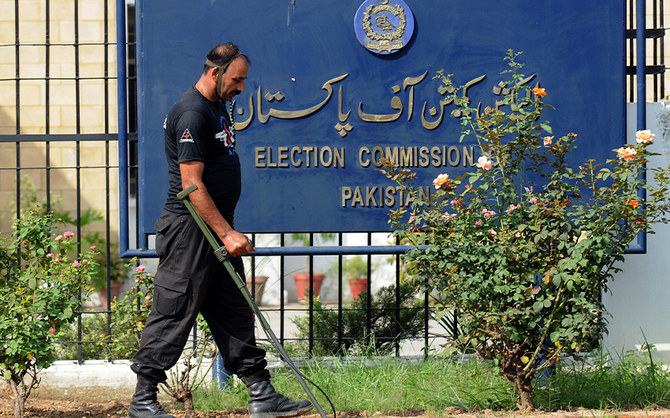
ISLAMABAD: The Election Commission of Pakistan (ECP) has expressed its reservations over a bill passed by the National Assembly to reform the country’s electoral system, reported the local media on Wednesday.
“The extent of the ECP’s concern over the new electoral reforms bill can be gauged from the fact that ... it does not support 28 of the total 62 proposed amendments,” Dawn said in a news report.
The issue was taken up in a meeting chaired by the country’s chief election commissioner Sikandar Sultan Raja.
It was pointed out during the meeting that the ECP had recorded its objections to the bill, though its observations were ignored by the relevant parliamentary committee.
“The ECP ... fears the proposed amendments will dilute its constitutional powers and shift to NADRA [National Database Registration Authority] which is part of the federal government and not an independent body like the ECP,” Dawn reported.
According to a document compiled by the country’s election regulatory authority for internal circulation, the ECP maintains it is not possible to give voting rights to overseas Pakistanis in the absence of a parliamentary legislation.
It has also objected to the use of electronic voting machines until their performance and accuracy were established and it became clear they could be employed to conduct free and fair elections.
ECP officials have also refused to support the idea of delimiting constituencies based on the number of votes instead of population density as stated in the constitution.
Other than that, the electoral body has rejected an amendment which seeks to use NADRA’s data of registered IDs as electoral roll.
“ECP says the proposed amendment seeks to give the right of correction in the electoral roll to NADRA by taking it away from ECP which is mandated by the constitution to make any correction in the rolls as and when required,” the newspaper added.
Pakistan’s election commission is an independent, autonomous and permanent constitutional body that organizes federal and provincial elections.
It is also responsible for delimitation of constituencies and preparation of electoral rolls, according to Pakistan’s constitution.

Pakistan’s election regulatory body alarmed by electoral reforms bill
https://arab.news/cguhn
Pakistan’s election regulatory body alarmed by electoral reforms bill
- The Election Commission of Pakistan does not support 28 out of 62 proposed amendments to the system
- The ECP believes the proposed amendments will dilute its constitutional powers and shift some of its authority to other federal institutions
Pakistan reports current account surplus in Jan. owing to improved trade, remittances
- Pakistan’s exports crossed the $3 billion mark in Jan. as the country received $3.5 billion in remittances
- Last month, IMF urged Pakistan to accelerate pace of structural reforms to strengthen economic growth
ISLAMABAD: Pakistan recorded a current account surplus of more than $120 million in January, the country’s finance adviser said on Tuesday, attributing it to improved trade balance and remittance inflows.
Pakistan’s exports rebounded in January 2026 after five months of weak performance, rising 3.73 percent year on year and surging 34.96 percent month on month, according to data released by the country’s statistics bureau.
Exports crossed the $3 billion mark for the first time in January to reach $3.061 billion, compared to $2.27 billion in Dec. 2025. The country received $3.5 billion in foreign remittances in Jan. 2026.
Khurram Schehzad, an adviser to the finance minister, said Pakistan reported a current account surplus of $121 million in Jan., compared to a current account deficit of $393 million in the same month last year.
“Improved trade balance in January 2026, strong remittance inflows, and sustained momentum in services exports (IT/Tech) continue to reinforce the country’s external account position,” he said on X.
Pakistan has undergone a difficult period of stabilization, marked by inflation, currency depreciation and financing gaps, and international rating agencies have acknowledged improvements after Islamabad began implementing reforms such as privatizing loss-making, state-owned enterprises (SOEs) and ending subsidies as part of a $7 billion International Monetary Fund (IMF) loan program.
Late last month, the IMF urged Pakistan to accelerate the pace of these structural reforms to strengthen economic growth.
Responding to questions from Arab News at a virtual media roundtable on emerging markets’ resilience, IMF’s director of the Middle East and Central Asia Jihad Azour said Islamabad’s implementation of the IMF requirements had been “strong” despite devastating floods that killed more than 1,000 people and devastated farmland, forcing the government to revise its 4.2 percent growth target to 3.9 percent.
“What is important going forward in order to strengthen growth and to maintain the level of macroeconomic stability is to accelerate the structural reforms,” he said at the meeting.
Azour underlined Pakistan’s plans to privatize some of the SOEs and improve financial management of important public entities, particularly power companies, as an important way for the country to boost its capacity to cater to the economy for additional exports.
“This comes in addition to the effort that the authorities have made in order to reform their tariffs, which will allow the private sector of Pakistan to become more competitive,” the IMF official said.


