Biden names Israel ambassador days after new government

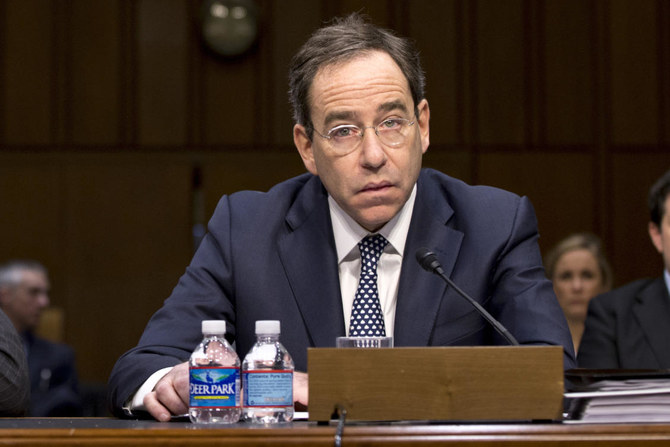
President Joe Biden has nominated veteran Democrat Thomas Nides as the US ambassador to Israel. (File/AP)
Short Url
Updated 15 June 2021
Follow

Biden names Israel ambassador days after new government

WASHINGTON: President Joe Biden on Tuesday nominated veteran Democratic Party official Thomas Nides to be US ambassador to Israel, filling the post two days after the formation of a new government eager to renew ties.
Nides, a former top banker at Morgan Stanley who has spent his adult life in Democratic politics, served in the US State Department when Barack Obama was president and defended funding for the Palestinians.
He would mark a sharp departure from the last US ambassador to Israel, David Friedman, a forceful advocate for hawkish Israeli policies who was tapped by former president Donald Trump after serving his company as a bankruptcy lawyer.
Nides grew up in a Jewish home in Duluth, Minnesota, where his father was temple president. He is not known as an ideological figure on the Middle East or other issues.
While serving as deputy secretary of state for management and resources, Nides fought attempts by Republicans in Congress to stop US funding for the UN agency for Palestinian refugees -- a step taken by Trump but reversed by Biden.
Michael Oren, the former Israeli ambassador to Washington, wrote in a 2011 book that Nides once called him to argue passionately - and profanely - against attempts in Congress to defund the UN cultural agency UNESCO after it admitted Palestine as a member state.
Nides, Oren wrote, said with colorful language that Israel would not want to defund UNESCO as it has played a role in education about the Holocaust.
Nides, whose nomination had been rumored for weeks, needs to be confirmed by the Senate, where the Democrats are narrowly in control.
His nomination was announced two days after the fall from power from Benjamin Netanyahu, Israel's longest serving prime minister who had toxic relations with Democrats after he rallied against Obama's Iran policy, rejected moves for a Palestinian state and aligned himself with Republicans.
Biden has quickly congratulated Prime Minister Naftali Bennett, who is a staunch defender of Jewish settlement in the West Bank but governs in coalition with centrists and leftists.


Sudan now has highest number of people in need ‘anywhere in the world,’ UN warns

Updated 15 sec ago
Follow

Sudan now has highest number of people in need ‘anywhere in the world,’ UN warns

  • Spokesperson Stephane Dujarric presses states to provide urgent financial support to help meet humanitarian needs that have reached ‘extraordinary levels’
  • 34m people expected to need aid this year; UN response plan calls for $2.9bn of funding to provide food, nutrition, clean water, health and protection services, and education

NEW YORK CITY: The UN on Friday pressed member states to provide urgent financial support to help stave off further suffering in war-torn Sudan, where nearly 34 million people are now expected to need assistance this year — the highest number anywhere in the world.

Spokesperson Stephane Dujarric said that despite the “extraordinary humanitarian needs,” operations remain perilously underfunded and aid workers face mounting risks.

The UN’s 2026 Humanitarian Response Plan for Sudan calls for $2.9 billion of funding to provide more than 20 million people with life-saving food, nutrition, clean water, health and protection services, and education. But funding lags behind needs, complicating efforts to scale up deliveries of aid.

The civil war between rival military factions in the country, which will enter its fourth year in April, is driving several overlapping emergencies, including acute food insecurity and outbreaks of disease.

According to the UN’s World Food Programme, more than 21 million people in Sudan face high levels of acute hunger, and famine conditions have been confirmed, or are feared to be present, in several regions.

Humanitarian workers continue to face “grave danger,” Dujarric said. In recent months, 92 of them, mostly Sudanese, have been killed, injured, kidnapped or detained, he added, and more than 65 attacks on healthcare providers and patients have been recorded.

Aid groups also warn that conflict-related obstacles, including blockades, drone strikes, and sporadic access restrictions, continue to hamper distribution efforts.

The UN has highlighted the fact that amid the growing displacement of people in North Darfur and North Kordofan, where hundreds of thousands of civilians have been uprooted, water and sanitation services are collapsing in affected areas.

The humanitarian crisis is compounded by regional spillover. Neighboring Chad has closed its border with Sudan amid security concerns, complicating the cross-border flow of aid and threatening already fragile refugee-support systems.

Dujarric warned that without increased donor support and improved access, the skills and commitment of aid workers will not be enough to keep pace with spiraling needs.

“Delivering aid at this scale requires flexible funding and guaranteed humanitarian access, so that workers can reach people in need and they can reach them safely and rapidly and without any obstruction,” he said.