

Arab League backs calls for UN Security Council intervention in dam dispute

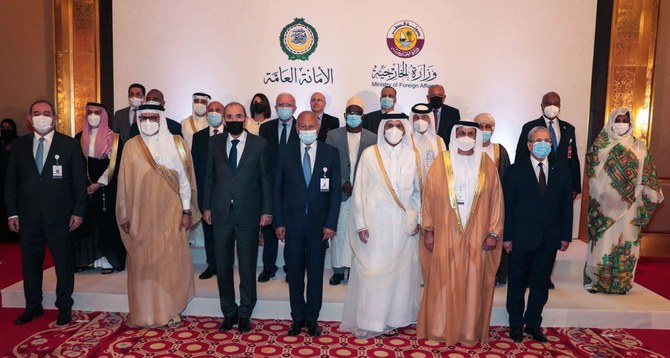
Arab Ministers of Foreign Affairs pose for a group photo ahead of a consultative meeting in Doha on Tuesday. (AFP)
Short Url
Updated 16 June 2021
Follow

Arab League backs calls for UN Security Council intervention in dam dispute

  • Arab League may also take "gradual measures" to support Egypt and Sudan

CAIRO: Arab foreign ministers on Tuesday backed calls for the UN Security Council to intervene in the contentious case of Ethiopia’s massive dam, built on one of the main tributaries of the Nile River.

The decision came during a diplomatic meeting in Qatar called by downstream Nile countries Egypt and Sudan.

Arab League Secretary-General Ahmed Aboul Gheit said in a press conference that the Arab countries will press for the Security Council to hold an urgent session on the decade-long dame dispute.

The Doha meeting came after years of failed negotiations between Ethiopia, on one side, and Egypt and Sudan on the other. Egypt and Sudan have both previously called for the US, the EU and the UN to join the talks as mediators along with the African Union, which is leading efforts to reach a deal. Ethiopia has rejected the idea.

FASTFACT

The Doha meeting came after years of failed negotiations between Ethiopia, on one side, and Egypt and Sudan on the other.

The main sticking points in past negotiations have been determining a mechanism to deal with future water disputes and how the river’s waters should be allocated during droughts.

Tuesday’s development came amid diplomatic and political pressure by Egypt and Sudan on Ethiopia ahead its planned second phase of filling the dam.

“There is a united Arab position,” Qatar’s Foreign Minister Mohammad bin Abdulrahman Al-Thani said in the same press conference following the meeting attended by 17 foreign ministers from the region. “Water security is about survival for mankind, and for the peoples of Sudan and Egypt.”

Egypt’s Foreign Ministry said Friday it had sent a letter to the Security Council to explain its position. It accused Ethiopia of failing to help reach a “fair, balanced and legally binding” agreement in previous talks overseen by the African Union.

There was no immediate comment from Ethiopian leaders. Ethiopia has maintained that the dam, which it has fully financed, will help pull millions of its nearly 110 million citizens out of poverty and make the country a major power exporter.

In April, after delegations from Egypt, Sudan and Ethiopia failed to reach an agreement on the dam, Egyptian President Abdel Fattah El-Sisi said that “all options are open if a drop of water belonging to Egypt is touched.”


El-Sisi says Egypt in ‘state of near-emergency’ as war threatens economy

Updated 7 sec ago
Follow

El-Sisi says Egypt in ‘state of near-emergency’ as war threatens economy

  • El-Sisi said “the current crisis might have some repercussions on prices“
  • He said Egypt was attempting “sincere and honest mediation efforts to stop the war”

CAIRO: Egyptian President Abdel Fattah El-Sisi said Thursday his country was in an economic “state of near-emergency” as a result of the Middle East war, warning of runaway inflation.
The Arab world’s most populous nation has not been physically impacted by the US and Israeli war with Iran, which has seen strikes on Egypt’s wealthy Gulf allies and paralyzed trade through the vital Strait of Hormuz.
But by the close of business Thursday, the Egyptian pound had fallen to an eight-month low against the US dollar, trading at 50.2 to the USD amid reports of short-term investment outflows.
Egypt’s import-dependent economy has proven highly sensitive to fluctuations in the currency, which has lost two-thirds of its value since 2022.
At a military academy event, El-Sisi said “the current crisis might have some repercussions on prices,” warning that price-gouging traders could be tried “in military courts,” according to a statement from his spokesman.
Over the weekend, El-Sisi had warned the war could spell trouble for the Suez Canal, the region’s other vital waterway besides the Strait of Hormuz and a key source of foreign currency for Egypt.
Major shipping companies have already directed traffic away from the region, rerouting around the Cape of Good Hope off the tip of southern Africa.
El-Sisi said Thursday that Egypt was attempting “sincere and honest mediation efforts to stop the war, as its continuation will have a hefty toll.”
Cairo has in the past hosted nuclear talks between Iran and the International Atomic Energy Agency, and is a guarantor of the US-brokered Gaza peace deal between Israel and Hamas.
But Iranian Foreign Minister Abbas Araghchi said Thursday his country was “not asking for a ceasefire” or negotiations with the US.