

Anti-Arab speech surges on social media during Gaza clashes, survey shows

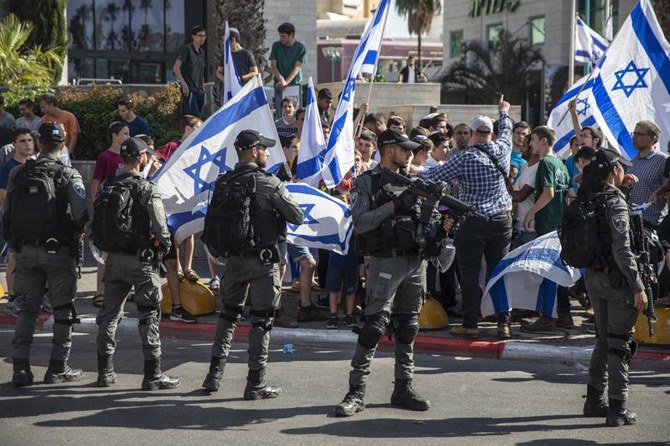
Jewish right-wing demonstrators demand the release of three Jews arrested over the death of Mousa Hasoona, outside the District Court in Lod, Israel, May 12, 2021. (AP Photo)
Short Url
Updated 15 June 2021
Follow

Anti-Arab speech surges on social media during Gaza clashes, survey shows

  • Between May 6 and May 21, when clashes with Israel were most severe, hate speech against Palestinians rose dramatically in comparison with the same period in 2020
  • The same period also witnessed widespread censorship of Palestinian posts on social media platforms, including Twitter, Facebook and Instagram

LONDON: Violent speech directed against Arabs and Palestinians on social media increased 15-fold during the recent hostilities in Gaza, a report has found. 

Between May 6 and May 21 when clashes with Israel were most severe, hate speech against Palestinians rose dramatically in comparison with the same period in 2020, according to the Arab Center for Social Media Advancement, or 7amleh.

The center recorded 1.09 million posts on social media platforms, with 16.8 percent containing racism, slurs or incitement against Arabs. 

Among tweets shared widely, one reads: “A good Arab is a dead Arab,” while another reads: “Death to all Arabs.”

Most violent speech (58 percent) took place on Twitter, compared with only 8 percent on Facebook and 1 percent on Instagram.

The same period also witnessed widespread censorship of Palestinian posts on social media platforms, including Twitter, Facebook and Instagram.

7amleh documented 500 cases of digital rights violations of Palestinians, which included content being taken down and accounts being removed.

Tech giants have been the targets of strong criticism from users for censoring Palestinian content.

Facebook was the target of a coordinated social media campaign launched by pro-Palestine activists in an attempt to push down the app’s ranking on Apple’s App Store and Android’s Google Play.

While Instagram changed the way it displays content after claims of blocking Palestine-related content, other social media giants have been reluctant to take similar steps. 

Instagram said that the “stories” feature was built according to an algorithm that favors original content as opposed to existing and reshared posts. As a result, any Palestine-related content that was reshared from other accounts was pushed lower in the Instagram feed. 

Social media has been crucial for people in the Middle East to document and spread information on destruction of homes, forced displacement and violence. 


Egyptian host Ramez Galal under heat following a lawsuit for his Ramadan prank show

Updated 24 February 2026
Follow

Egyptian host Ramez Galal under heat following a lawsuit for his Ramadan prank show

DUBAI: Egyptian actor and host Ramez Galal is under fire following a lawsuit by Egyptian actress Asmaa Galal after her appearance on his Ramadan prank show “Ramez Level the Monster.”

Ramez, known for his prank programs, returned to the screen this year for the latest edition of his show, but Asmaa took legal action against him once the episode was aired, claiming that his commentary constituted mockery and bullying.

She claims Ramez opened the episode segment by making disparaging remarks about her appearance, criticizing her choice of tight leggings, commenting on her body, and questioning whether her features were natural.

According to a statement from her lawyers’ office, the actress agreed to appear on the show on the understanding that it followed the usual prank format, without being informed of any added voice-overs or edited commentary in post-production.

However, the episode included phrases and remarks that the statement said amounted to personal insults and bodily mockery, with no relevance to the prank itself.

Her legal team emphasized that while satire and entertainment are protected forms of expression, they do not justify defamation or personal humiliation, particularly when targeting someone’s dignity or physical appearance.

The statement also noted that she initially chose to remain silent out of respect for Ramadan, but ultimately decided to respond, stressing that personal dignity remains a red line regardless of the entertainment context.

The episode has caused a significant backlash, with the National Council for Women in Egypt rejecting the treatment of women in such shows, affirming that personal dignity is a “red line.”

Ramez’s show has attracted controversy for years with accusations of torture, alleged harassment and physical contact.