Caution on Iran nuclear deal as G7 leaders vow to stop bomb

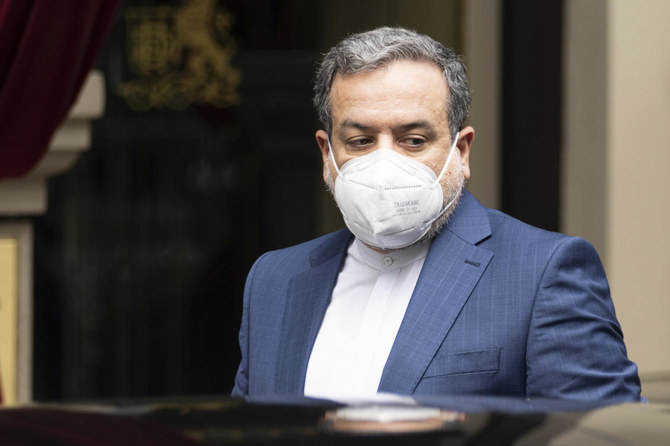
Political deputy at the Ministry of Foreign Affairs of Iran, Abbas Araghchi arrives at the closed-door nuclear talks taking place in Vienna. (AP)
Short Url
Updated 14 June 2021
Follow

Caution on Iran nuclear deal as G7 leaders vow to stop bomb

  • EU coordinators suggested that differences over the 2015 accord limiting Iran's nuclear activities had narrowed further
  • Iranian Deputy Foreign Minister said a deal was unlikely to emerge in the coming week

VIENNA: Diplomats from outside the European Union cautioned Sunday that negotiations with Iran to salvage a landmark nuclear deal still need more time.
Leaders of the Group of Seven wealthy nations also reaffirmed a commitment to stop the Islamic republic from building nuclear weapons.
Iranian envoys held another round of negotiations with international delegations in Vienna a day after EU coordinators suggested that differences over the 2015 accord limiting Iran’s nuclear activities had narrowed further. But Iranian Deputy Foreign Minister Abbas Araghchi told Iranian state media he thought a deal was unlikely to emerge in the coming week. A diplomat from Russia also said more time was needed to work out details.
The Vienna meetings are aimed at rebuilding a nuclear containment agreement between Iran and major world powers that the Trump administration withdrew the United States from in 2018.
US President Joe Biden and other G-7 leaders expressed support for the Vienna process after a three-day summit in southwest England that ended Sunday. The G-7 nations are Canada, France, Germany, Italy, Japan, the United Kingdom and the United States.
“We are committed to ensuring that Iran will never develop a nuclear weapon,” the leaders said in a joint statement.
“A restored and fully-implemented (nuclear deal) could also pave the way to further address regional and security concerns,” the statement said.
A resolution would see Iran return to commitments made in 2015, aimed at making the development of a nuclear weapon impossible, in exchange for lighter US sanctions.
US Secretary of State Antony Blinken said Sunday on CBS’ “Face the Nation” that Iran had been “galloping forward” with its nuclear ambitions and violating the terms of the accord since the United States pulled out of the deal.
“I think puts some urgency in seeing if we can put the nuclear problem back in the box,” Blinken said.
Sunday’s bilateral meetings followed joint negotiations held Saturday involving senior diplomats from China, Germany, France, Russia, and Britain. The United States was not directly involved.
An Iranian pro-opposition group held a small protest outside the famed Vienna Opera House, near the downtown hotel where the talks are taking place. Organizers said local police in Austria’s capital instructed them not to protest outside the hotel. The event ended peacefully.


‘No one to back us’: Arab bus drivers in Israel grapple with racist attacks

Updated 18 February 2026
Follow

‘No one to back us’: Arab bus drivers in Israel grapple with racist attacks

  • “People began running toward me and shouting at me, ‘Arab, Arab!’” recalled Khatib, a Palestinian from east Jerusalem

JERUSALEM: What began as an ordinary shift for Jerusalem bus driver Fakhri Khatib ended hours later in tragedy.
A chaotic spiral of events, symptomatic of a surge in racist violence targeting Arab bus drivers in Israel, led to the death of a teenager, Khatib’s arrest and calls for him to be charged with aggravated murder.
His case is an extreme one, but it sheds light on a trend bus drivers have been grappling with for years, with a union counting scores of assaults in Jerusalem alone and advocates lamenting what they describe as an anaemic police response.

Palestinian women wait for a bus at a stop near Israel's controversial separation barrier in the Dahiat al-Barit suburb of east Jerusalem on February 15, 2026. (AFP)

One evening in early January, Khatib found his bus surrounded as he drove near the route of a protest by Israel’s ultra-Orthodox Jewish community.
“People began running toward me and shouting at me, ‘Arab, Arab!’” recalled Khatib, a Palestinian from east Jerusalem.
“They were cursing at me and spitting on me, I became very afraid,” he told AFP.
Khatib said he called the police, fearing for his life after seeing soaring numbers of attacks against bus drivers in recent months.
But when no police arrived after a few minutes, Khatib decided to drive off to escape the crowd, unaware that 14-year-old Yosef Eisenthal was holding onto his front bumper.
The Jewish teenager was killed in the incident and Khatib arrested.
Police initially sought charges of aggravated murder but later downgraded them to negligent homicide.
Khatib was released from house arrest in mid-January and is awaiting the final charge.

Breaking windows

Drivers say the violence has spiralled since the start of the Gaza war in October 2023 and continued despite the ceasefire, accusing the state of not doing enough to stamp it out or hold perpetrators to account.
The issue predominantly affects Palestinians from annexed east Jerusalem and the country’s Arab minority, Palestinians who remained in what is now Israel after its creation in 1948 and who make up about a fifth of the population.
Many bus drivers in cities such as Jerusalem and Haifa are Palestinian.
There are no official figures tracking racist attacks against bus drivers in Israel.
But according to the union Koach LaOvdim, or Power to the Workers, which represents around 5,000 of Israel’s roughly 20,000 bus drivers, last year saw a 30 percent increase in attacks.
In Jerusalem alone, Koach LaOvdim recorded 100 cases of physical assault in which a driver had to be evacuated for medical care.
Verbal incidents, the union said, were too numerous to count.
Drivers told AFP that football matches were often flashpoints for attacks — the most notorious being those of the Beitar Jerusalem club, some of whose fans have a reputation for anti-Arab violence.
The situation got so bad at the end of last year that the Israeli-Palestinian grassroots group Standing Together organized a “protective presence” on buses, a tactic normally used to deter settler violence against Palestinians in the Israeli-occupied West Bank.
One evening in early February, a handful of progressive activists boarded buses outside Jerusalem’s Teddy Stadium to document instances of violence and defuse the situation if necessary.
“We can see that it escalates sometimes toward breaking windows or hurting the bus drivers,” activist Elyashiv Newman told AFP.
Outside the stadium, an AFP journalist saw young football fans kicking, hitting and shouting at a bus.
One driver, speaking on condition of anonymity, blamed far-right National Security Minister Itamar Ben Gvir for whipping up the violence.
“We have no one to back us, only God.”

‘Crossing a red line’ 

“What hurts us is not only the racism, but the police handling of this matter,” said Mohamed Hresh, a 39-year-old Arab-Israeli bus driver who is also a leader within Koach LaOvdim.
He condemned a lack of arrests despite video evidence of assaults, and the fact that authorities dropped the vast majority of cases without charging anyone.
Israeli police did not respond to AFP requests for comment on the matter.
In early February, the transport ministry launched a pilot bus security unit in several cities including Jerusalem, where rapid-response motorcycle teams will work in coordination with police.
Transport Minister Miri Regev said the move came as violence on public transport was “crossing a red line” in the country.
Micha Vaknin, 50, a Jewish bus driver and also a leader within Koach LaOvdim, welcomed the move as a first step.
For him and his colleague Hresh, solidarity among Jewish and Arab drivers in the face of rising division was crucial for change.
“We will have to stay together,” Vaknin said, “not be torn apart.”